

.png)

.png)


1. Introduction: Launching a Food Delivery Business Without Starting From Scratch
Most customers never think about what happens after they tap the "Place Order" button.
They don't see the restaurant receiving the order. They don't see a delivery partner accepting the request. They don't see the dozens of updates happening in the background before the food reaches their doorstep.
And honestly, they shouldn't have to.
The best food delivery platforms make all of that feel effortless. Customers simply open an app, find what they want, order, and wait for the doorbell to ring. That's the standard people have become used to, and it's exactly why businesses entering this space often look for a proven ubereats clone app rather than building every workflow from the ground up.
Creating that experience requires much more than a customer-facing application. Restaurants need tools to manage menus and incoming orders. Delivery partners need navigation, earnings tracking, and delivery management. Business owners need visibility across the entire operation. A successful ubereats clone app brings all of these moving parts together in a way that feels simple for everyone involved.
UrbanBite was built with that reality in mind.
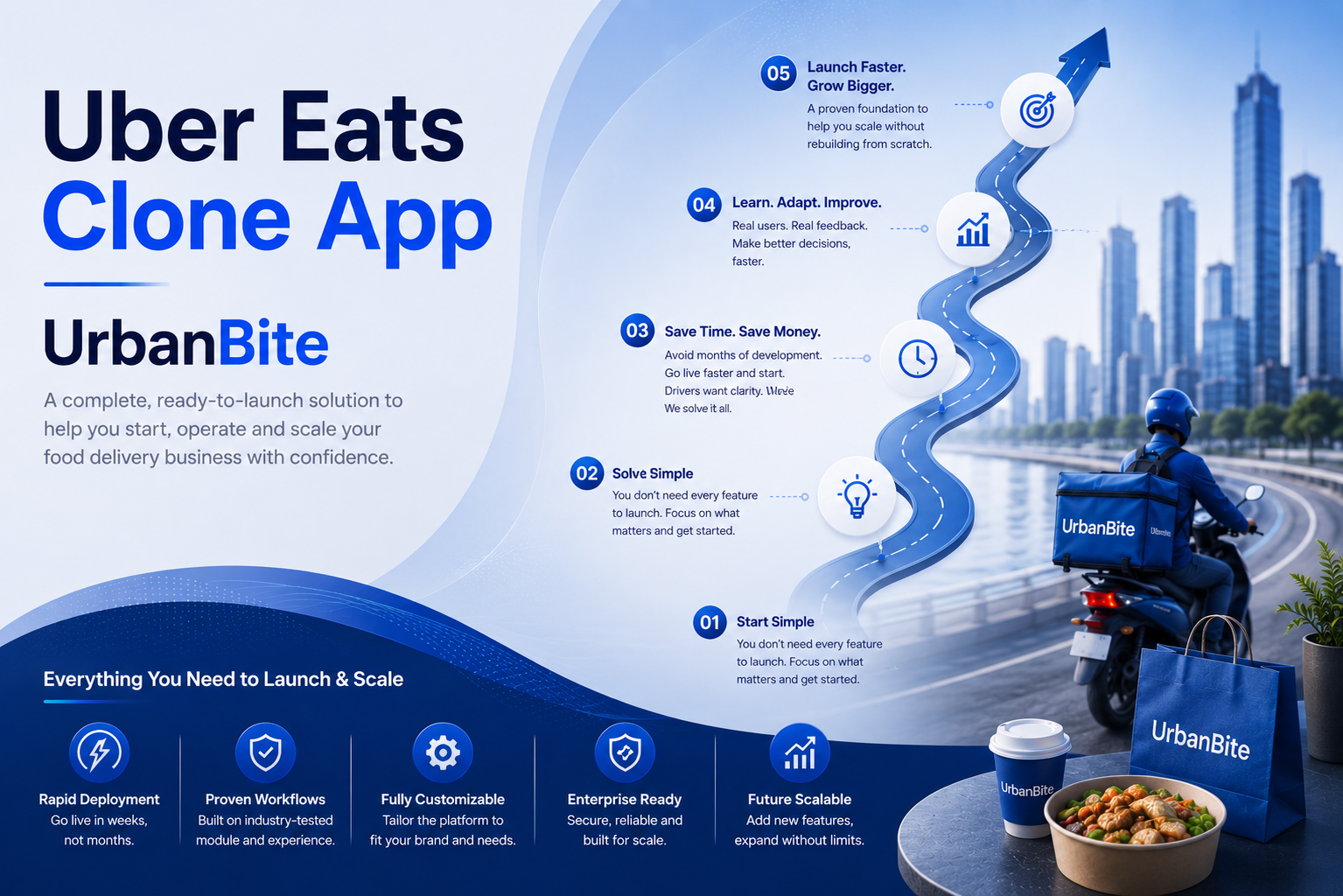
Instead of piecing together multiple systems, businesses can launch with a complete ubereats clone app that already includes the core workflows required to run a food delivery platform. Supported by the flexibility businesses expect from modern flutter app templates, the scalability associated with white label mobile apps, and a familiar uber eats ui, UrbanBite provides a practical starting point for launching and growing a food delivery business.
For founders focused on speed, efficiency, and customer experience, solutions built on flutter app templates, white label mobile apps, and an intuitive uber eats ui have become a far more practical alternative to starting from zero.
2. Why Uber Eats Clone Apps Are Becoming a Popular Business Model
A founder once described food delivery as "just an ordering app."
Three weeks later, the feature list looked completely different.
There was a customer app. A restaurant dashboard. A delivery partner app. An admin panel. Payments. Notifications. Order tracking. Refunds. Promotions.
The ordering screen was probably the easiest part.
That's why many businesses start with a proven ubereats clone app instead of trying to build every piece from scratch.
2.1 One Business, Four Different Users
Food delivery platforms serve multiple people at the same time.
Customers want convenience. Restaurants want efficiency. Delivery partners want clear instructions. Administrators want control.
A successful ubereats clone app has to satisfy all four groups without making the experience complicated for any of them.
That's harder than it sounds.
2.2 Customers Don't Care About Your Technology
Most users never ask what framework was used to build an app.
They care whether they can find a restaurant, place an order, and track delivery without frustration. A familiar uber eats ui helps because customers already understand how the flow works.
There is no learning curve.
Open the app. Order food. Track delivery.
Simple.
2.3 Building Everything Yourself Isn't Always an Advantage
A lot of founders assume custom development automatically creates a better product.
Sometimes it does.
A lot of the time, it just creates a longer project.
Months can disappear rebuilding features that already exist in established delivery platforms. That's one reason white label mobile apps continue to attract attention from startups and agencies alike.
The goal isn't to skip quality.
The goal is to skip unnecessary repetition.
2.4 Why Flutter App Templates Make Sense
Look at most successful startup launches.
Very few began by building every component from zero.
The same logic applies to flutter app templates. Instead of spending resources creating standard workflows, businesses can focus on branding, partnerships, customer acquisition, and operations.
Good flutter app templates don't remove flexibility.
They remove wasted effort.
2.5 The Real Value of the Model
The appeal of an ubereats clone app isn't that it resembles Uber Eats.
The appeal is that customers already understand the experience.
Pair a familiar uber eats ui with scalable white label mobile apps and adaptable flutter app templates, and businesses can launch much faster than they could through traditional development.
That's why the model keeps working.
Not because it's new.
Because it solves a problem businesses run into every single time they try to build a food delivery platform from scratch.
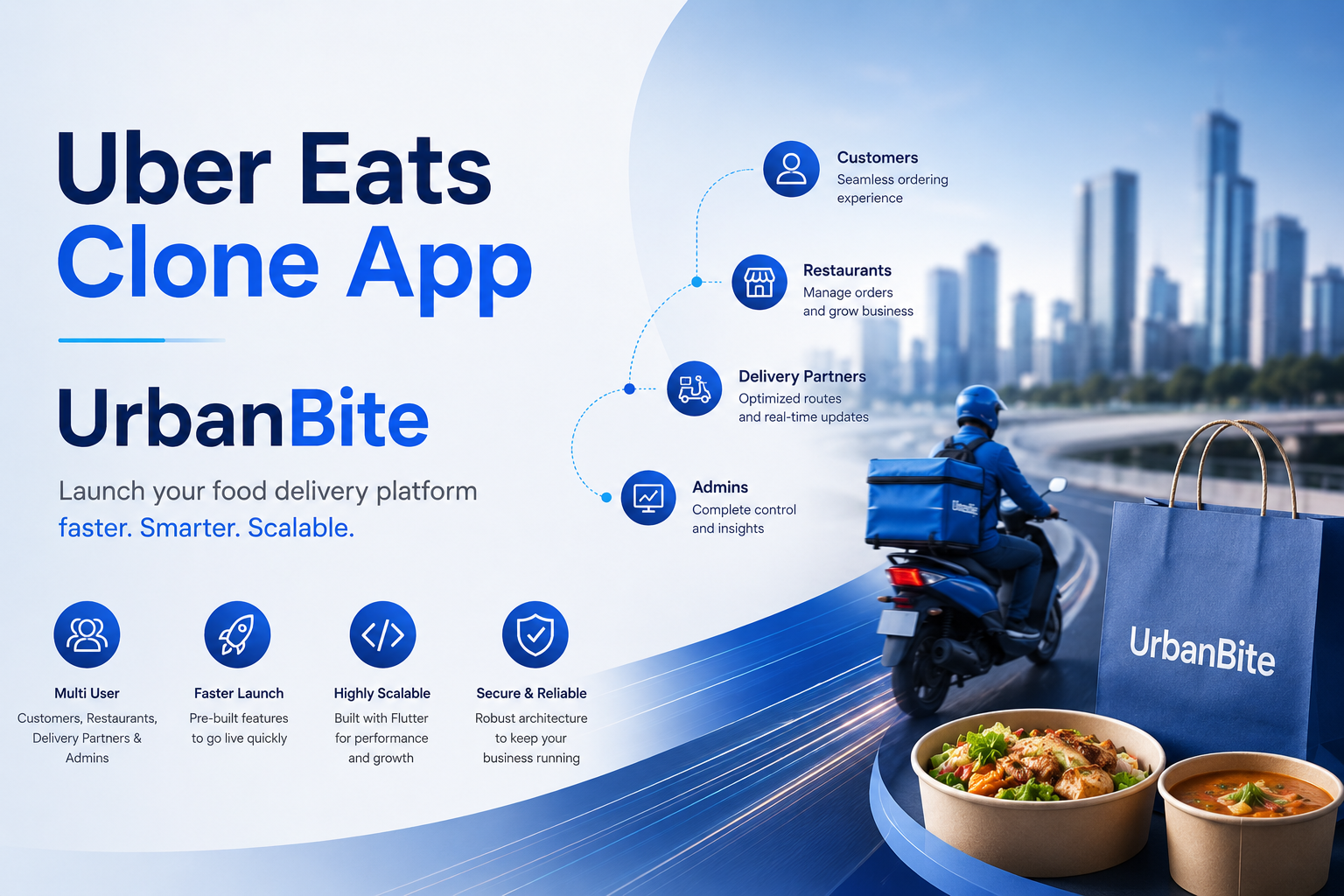
3. Customer Experience: What Users Expect From a Modern Food Delivery Platform
Most food delivery decisions aren't planned.
Someone finishes a meeting late and orders lunch. A family can't decide what to cook. Friends are watching a match and suddenly realize nobody wants to leave the house.
The decision to order food often takes less than a minute.
What happens after that determines whether customers return.
People rarely talk about apps when discussing a great delivery experience. They talk about how easy it was to find a restaurant, how quickly the order arrived, or how smoothly everything worked. That's exactly what a successful ubereats clone app needs to deliver.
3.1 The Search Usually Starts Before the Order
Ask ten customers what they want for dinner and you'll probably get ten different answers.
Some already know the restaurant they want. Others only know they're hungry.
That's why restaurant discovery matters.
Customers should be able to browse cuisines, search restaurants by name, filter options, switch between veg and non-veg preferences, and narrow choices without feeling overwhelmed. Even voice search becomes useful when someone is multitasking or ordering on the move.
A familiar uber eats ui makes these actions feel natural because users already understand how the journey should work.
The less effort required to find food, the easier it becomes to place an order.
3.2 Every Extra Step Costs Orders
People are surprisingly impatient when ordering food.
If checkout feels complicated, many won't complain. They'll simply leave.
Saving addresses, selecting delivery locations, applying promo codes, and choosing payment methods should feel effortless. Whether a customer prefers UPI, a card, a wallet balance, or cash on delivery, the platform should adapt to their preference rather than forcing a specific payment flow.
This is one area where a well-designed ubereats clone app quietly does its job. Customers may never notice a smooth checkout process, but they immediately notice a frustrating one.
3.3 Customers Don't Like Surprises After Ordering
The order is placed.
Now comes the waiting.
What customers want during that time isn't speed alone. They want visibility.
Real-time tracking changes the experience completely. Instead of wondering whether a restaurant accepted the order or whether a delivery partner has picked it up, customers can follow progress through every stage. A clear uber eats ui turns what used to be uncertainty into confidence.
People are often willing to wait a little longer when they know exactly what's happening.
3.4 The Second Order Is More Important Than the First
Acquiring a customer is expensive.
Keeping one is not.
That's why features such as order history, one-tap reordering, ratings, reviews, referral rewards, wallet management, refunds, notifications, and customer support play a larger role than many businesses expect. They make the platform easier to use every time someone comes back.
Convenience compounds.
The first order introduces the customer. The second, third, and tenth order build loyalty.
3.5 Why Customer Experience Often Determines Growth
Restaurants can attract customers once.
The platform needs to keep them.
Businesses increasingly choose white label mobile apps because customer expectations are already well understood. There is little value in rebuilding common user flows when proven alternatives already exist. The same thinking has contributed to the growth of flutter app templates, allowing businesses to focus more on branding and operations than foundational development.
When scalable white label mobile apps, flexible flutter app templates, a familiar uber eats ui, and a reliable ubereats clone app come together, the result is something customers rarely think about.
And that's usually a good sign.
It means the experience simply works.
4. Managing Restaurants, Deliveries, and Operations at Scale
When people talk about food delivery apps, they almost always talk about customers.
The customer places an order.
The customer tracks the driver.
The customer receives the food.
Simple.
What rarely gets discussed is everything happening on the other side of the order.
A restaurant owner once told us that taking the order wasn't the difficult part. Managing twenty orders arriving at the same time was.
That's where the real work starts.
4.1 Restaurants Need More Than a Menu Screen
A menu isn't something restaurants set up once and forget.
Items sell out. Prices change. New dishes are added. Promotions come and go.
During a busy evening, nobody wants to call customers explaining that a popular item is no longer available.
That's why a modern ubereats clone app needs proper menu and inventory controls. Restaurant teams should be able to update availability, manage orders, and keep operations moving without depending on technical support every time something changes.
The easier these tasks become, the easier it is to run the business.
4.2 Small Inventory Problems Become Bigger Customer Problems
Imagine receiving an order for a dish that ran out thirty minutes ago.
Now imagine receiving ten.
Restaurants deal with situations like this all the time.
Features such as stock alerts, out-of-stock indicators, daily usage tracking, and automatic item visibility aren't the most exciting parts of a platform, but they prevent countless operational headaches. This is one reason many businesses choose white label mobile apps rather than rebuilding operational workflows from scratch.
The feature nobody notices is often the feature preventing problems all day long.
4.3 Peak Hours Expose Every Weakness
Most systems work when order volume is low.
The real test starts at lunch and dinner.
Orders arrive together. Restaurants need to accept, reject, or prepare meals quickly. Delivery partners are waiting. Customers are checking updates every few minutes.
A reliable ubereats clone app helps keep everyone working from the same information instead of creating confusion between restaurants, drivers, and customers.
That's one reason businesses increasingly adopt flutter app templates. Proven workflows tend to perform better under pressure than systems built in a hurry.
4.4 Delivery Partners Don't Want Complexity
Delivery partners think differently from restaurant owners.
Their focus is simple.
Where is the pickup?
Where is the customer?
What did I earn?
A familiar uber eats ui helps keep those answers clear. Order requests, navigation, earnings history, availability controls, and delivery records should be available without forcing drivers through unnecessary screens.
Good delivery tools don't attract attention.
They remove friction.
4.5 Growth Creates New Questions
The first few orders are easy to track.
The next few thousand are not.
Businesses eventually need to understand which restaurants perform best, where refunds occur, which promotions generate results, and how revenue is changing over time.
That's why admin controls become just as important as customer features. Many white label mobile apps already include these operational foundations, allowing businesses to focus on expansion rather than rebuilding management systems later.
The same thinking applies to flutter app templates. Businesses use flutter app templates because they shorten the path to launch while still supporting long-term growth.
Combine scalable white label mobile apps, flexible flutter app templates, a familiar uber eats ui, and a proven ubereats clone app, and businesses gain something far more valuable than features.
They gain operational consistency.
And that's usually what separates growing platforms from struggling ones.
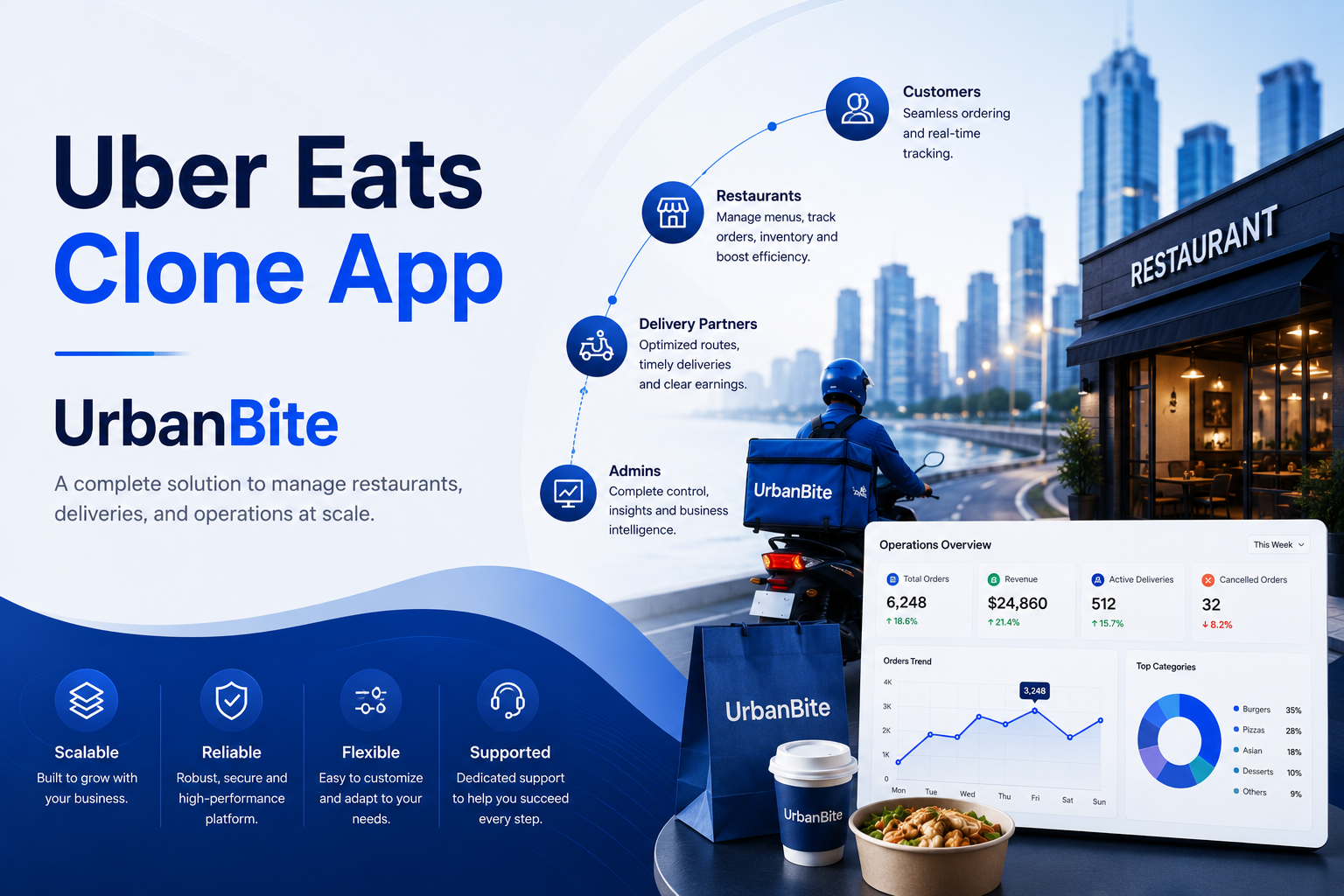
5. UrbanBite Features Breakdown: Everything Included in the Platform
Features often determine how efficiently a food delivery business operates once orders start coming in. UrbanBite brings together customer ordering, restaurant management, delivery operations, and administrative controls within a single ubereats clone app. Combined with the flexibility businesses expect from modern flutter app templates, the scalability of white label mobile apps, and a familiar uber eats ui, the platform includes the essential tools required to run a food delivery marketplace.
5.1 Customer App Features
Customers interact with a ubereats clone app every day, which is why the ordering experience needs to remain simple and intuitive. UrbanBite includes:
- Browse restaurants by cuisine
- Search restaurants by name
- Veg / non-veg mode toggle
- Sorting options
- Filter options
- Speak to search
- Real-time order tracking with live map
- Card payments
- Wallet payments
- UPI payments
- Cash on Delivery (COD)
- Order history
- One-tap reorder
- Restaurant ratings and reviews
- Delivery ratings and reviews
- Promo codes
- Discount offers
- Address management
- Home address
- Work address
- Custom address
- Call delivery partner
- Referral program
- Wallet management
- Refund management
- In-app chat support
- Order status notifications
A familiar uber eats ui helps customers navigate these features without unnecessary complexity.
5.2 Restaurant Features
Restaurant operations require constant visibility into menus, stock levels, and incoming orders. UrbanBite provides:
Menu Management
- Add menu items
- Edit menu items
- Remove menu items
Stock Management
- Low stock alerts
- Out-of-stock item management
- Daily usage alerts
- Auto-hide menu items when stock runs out
Order Management
- Accept orders
- Reject orders
- Mark orders as ready
Business Operations
- Real-time order notifications
- Business hours management
- Availability toggle
Promotions
- Promo management
- Discount management
Performance Tracking
- Revenue dashboard
- Today's orders
- Pending orders
- Earnings reports
- Payout reports
- Reports and analytics
Additional Tools
- Announcement banners
- Customer ratings and reviews
- Contact support
Many businesses choose white label mobile apps because operational features like these are already available from day one.
5.3 Delivery Partner Features
Efficient deliveries are essential for any successful ubereats clone app. UrbanBite includes:
- Accept order requests
- Reject order requests
- Multi-order support
- Live navigation to restaurant
- Live navigation to customer
- Online / offline availability toggle
- Earnings dashboard
- Payout history
- Wallet
- Delivery history
- Performance tracker
- Rating tracker
- Help and support
The familiar uber eats ui helps delivery partners manage requests and deliveries efficiently.
5.4 Admin Features
Managing customers, restaurants, drivers, and orders requires centralized control. UrbanBite provides:
User Management
- User management
- Restaurant management
- Delivery partner management
Verification & Approvals
- Restaurant verification
- Restaurant approval
- Driver verification
- Driver approval
Order & Support Management
- Order monitoring
- Dispute resolution
- Refund center
- Support chat
- Support ticket management
Financial Management
- Commission management
- Payout management
- Payment management
Marketing & Promotions
- Promo management
- Coupon management
- Promotion module
- Push notification management
Business Monitoring
- Revenue dashboard
- Live metrics
- Reports and analytics
Platform Management
- App settings
- Configuration management
This combination of tools is one of the reasons businesses continue adopting flutter app templates and scalable white label mobile apps when launching a food delivery platform. Combined with a proven ubereats clone app, flexible flutter app templates, reliable white label mobile apps, and a familiar uber eats ui, UrbanBite provides the operational foundation needed to manage a complete food delivery ecosystem.
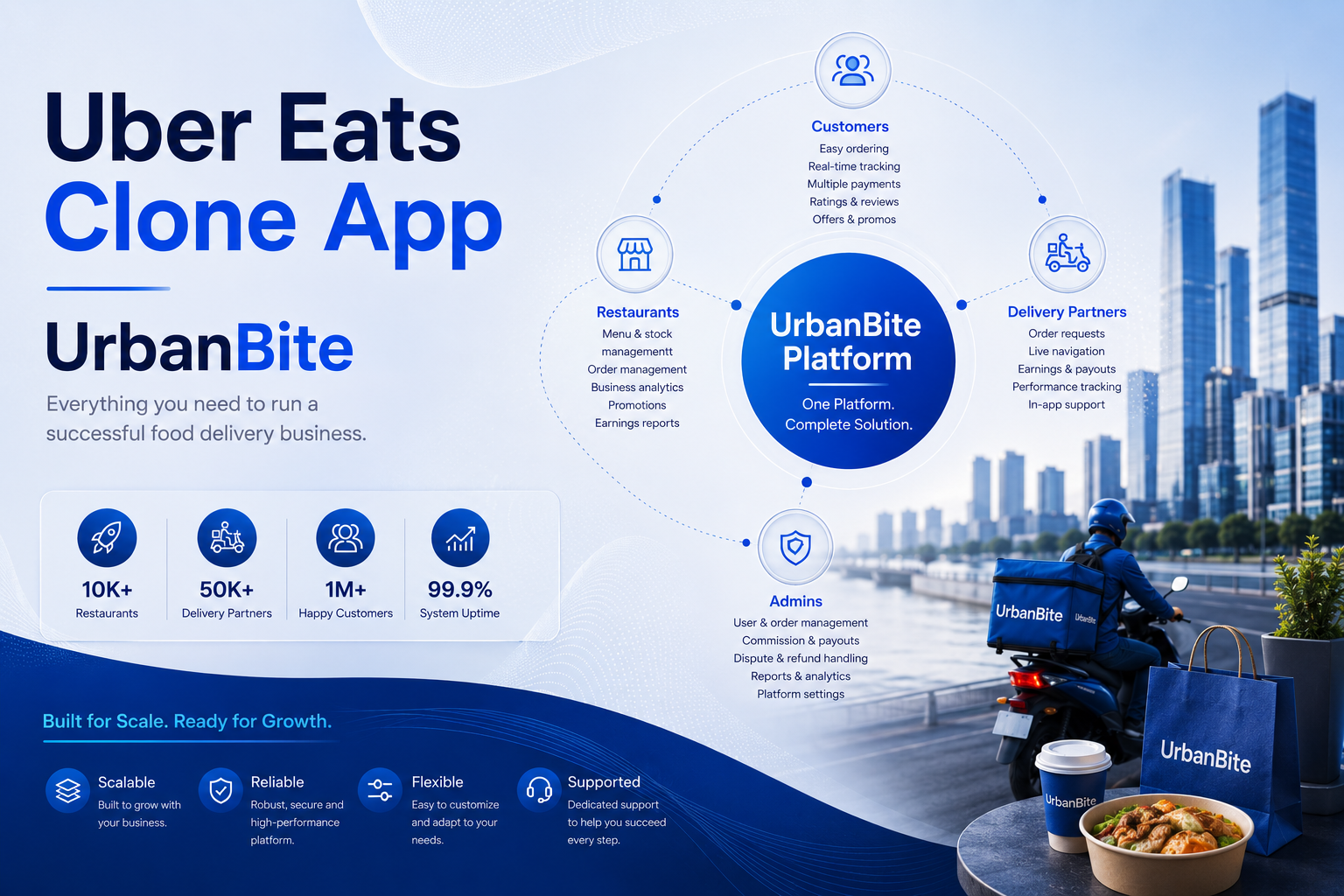
6. The Technology Behind UrbanBite and Why It Matters
Technology is usually the last thing founders ask about.
The first questions are different.
Can customers place orders without issues?
Can restaurants manage orders during busy hours?
Can delivery partners handle multiple deliveries?
Can the business grow without constantly fixing operational problems?
Only after those questions are answered does the conversation move to technology.
6.1 Building One Product Instead of Four Separate Products
One thing surprises most founders when they start planning a food delivery platform.
They're not building a single application.
They're building a customer app, a restaurant system, a delivery partner app, and an admin dashboard at the same time.
Each user has different requirements, yet the experience still needs to feel connected.
That's one reason businesses often choose flutter app templates when launching a food delivery platform. They provide a practical starting point for managing multiple user experiences without creating separate products for every stakeholder.
A familiar uber eats ui helps as well. Customers already understand how the ordering journey should work, reducing friction from the very first order.
6.2 Food Delivery Runs on Timing
A customer places an order.
The restaurant receives it.
A delivery partner accepts the request.
The customer starts tracking the delivery.
Nothing about that workflow is complicated.
Unless information arrives late.
Food delivery platforms depend on constant communication between different users. Real-time updates help ensure restaurants, customers, delivery partners, and administrators are always working with the latest information.
Every successful ubereats clone app depends on this flow.
6.3 Reliability Matters More Than Complexity
Founders sometimes assume more technology automatically creates a better product.
In reality, customers don't reward complexity.
They reward reliability.
If payments work, notifications arrive on time, tracking updates remain accurate, and orders move smoothly through the system, most users will never think about the technology behind the platform.
That's actually the goal.
A good ubereats clone app disappears into the experience.
6.4 Why Businesses Choose Ready-Made Foundations
Building from scratch sounds attractive in the beginning.
Then the feature list starts growing.
Payments. Notifications. Order management. Restaurant workflows. Delivery management. Admin controls.
Suddenly the project looks much larger than expected.
That's one reason white label mobile apps continue attracting startups and agencies. Businesses can focus on launching and operating the platform rather than rebuilding functionality that already exists.
The same pattern explains the growth of flutter app templates. Companies want flexibility, but they also want a faster path to market.
6.5 Technology Should Support Growth, Not Slow It Down
Most businesses don't launch with thousands of orders.
But they hope to get there.
The technology behind a platform needs to support that journey without becoming an obstacle. That's where scalable white label mobile apps, flexible flutter app templates, a familiar uber eats ui, and a reliable ubereats clone app become valuable.
Not because customers notice them.
Because customers don't.
Everything simply works, and the business can focus on growth instead of constantly rebuilding its foundation.
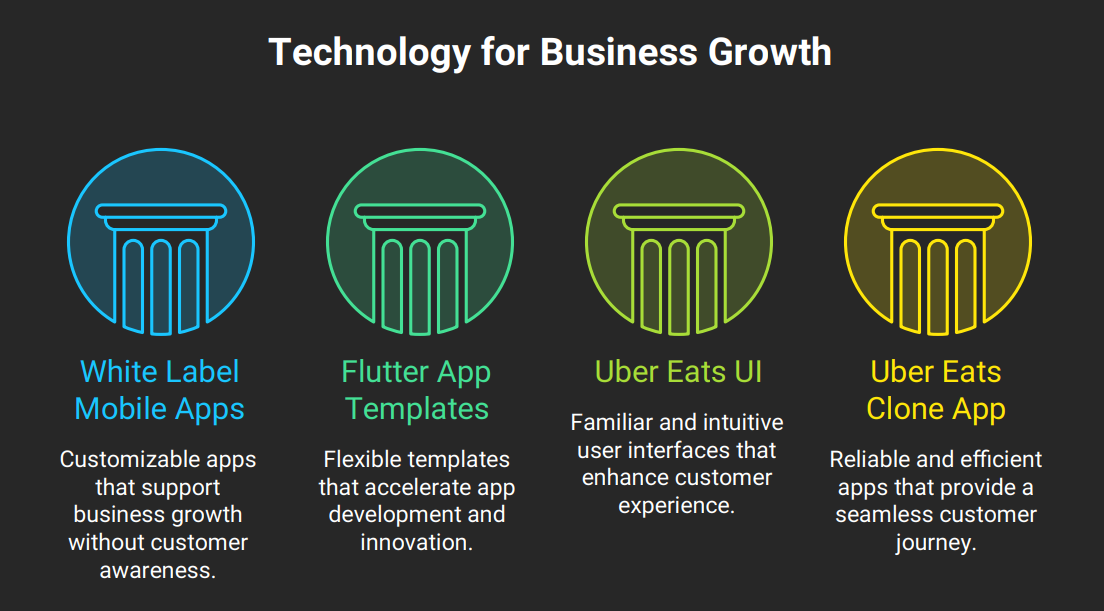
7. Why White Label Mobile Apps Help Businesses Launch Faster
A lot of founders start in the same place.
They have an idea for a food delivery business and begin listing everything they need.
An app for customers.
Something for restaurants.
Something for delivery partners.
An admin panel.
At first, it feels manageable.
Then the list keeps growing.
Payments need to work. Orders need tracking. Restaurants need menu controls. Drivers need navigation. Customers expect notifications. Support requests need handling.
The project gets bigger before a single order is placed.
7.1 The First Version Doesn't Need Everything
One thing that surprises many founders is how little customers care about the development process.
Nobody opens an app and asks whether the team spent six months or twelve months building it.
Customers care about whether they can order food easily.
That's why businesses often begin with a proven ubereats clone app. The essential workflows already exist, allowing teams to focus on launching rather than rebuilding familiar functionality.
7.2 Most Food Delivery Platforms Solve Similar Problems
Restaurants need orders.
Drivers need deliveries.
Customers need food.
The fundamentals haven't changed.
A familiar uber eats ui works because people already know how to use it. They know where to search. They know how to place an order. They know how to track delivery progress.
Starting from something customers already understand removes a surprising amount of friction.
7.3 Time Has a Cost
Development costs are easy to calculate.
Time is harder.
Three extra months of development might mean three months without customer feedback, restaurant partnerships, or revenue.
That's one reason white label mobile apps continue attracting startups. They reduce the amount of time spent building standard functionality and increase the amount of time spent operating the business.
7.4 Launching Faster Creates Better Decisions
A lot of assumptions disappear once real customers start using a product.
Features that seemed important suddenly aren't.
Problems nobody predicted suddenly become obvious.
Businesses using flutter app templates can often reach that learning stage much sooner. Instead of debating ideas internally for months, they can gather feedback from actual users and improve the platform over time.
A familiar uber eats ui helps here too because customers spend less time learning the product and more time using it.
7.5 Why More Founders Are Taking This Route
There was a time when building everything from scratch felt like the default choice.
Today, many founders look at the process differently.
If a reliable ubereats clone app already exists, if flexible flutter app templates already provide a strong foundation, and if scalable white label mobile apps already support the workflows the business needs, rebuilding everything becomes a harder decision to justify.
The goal isn't to launch with the most complicated platform.
The goal is to launch.
That's why white label mobile apps, adaptable flutter app templates, a trusted ubereats clone app, and a familiar uber eats ui continue making sense for businesses that want to get to market without spending months rebuilding the basics.
8. Conclusion: Launching a Food Delivery Business Without Starting From Zero
Talk to founders who have launched food delivery businesses and you'll hear a similar story.
The idea was usually straightforward.
The execution wasn't.
What starts as a simple plan quickly expands into customer ordering, restaurant management, delivery operations, payments, notifications, support, and administration. None of those pieces are difficult on their own, but bringing them together takes time.
That's why many businesses begin with a ubereats clone app rather than building every workflow from scratch.
Customers already know what they expect. They want to find restaurants quickly, place an order without friction, and track deliveries easily. A familiar uber eats ui helps because people don't need to learn how the platform works before using it.
For businesses, the challenge is different. The goal isn't just launching an app. The goal is launching something that restaurants can manage, delivery partners can use comfortably, and customers return to repeatedly.
This is where white label mobile apps have become a practical option. Instead of spending months rebuilding standard functionality, businesses can focus on onboarding restaurants, improving service quality, and growing their customer base. The same thinking explains why flutter app templates continue attracting startups looking for a faster route to market.
UrbanBite follows that approach.
Built as a complete ubereats clone app, it combines customer, restaurant, delivery, and admin workflows inside a single platform. Supported by scalable white label mobile apps, flexible flutter app templates, and a familiar uber eats ui, it gives businesses a starting point without forcing them to start from zero.
Because for most founders, success isn't about spending the longest time building.
It's about getting to the first order, learning from real users, and growing from there.
9. FAQs
1 What is an Uber Eats clone app?
A ubereats clone app is a ready-made food delivery platform that helps businesses launch faster with customer, restaurant, delivery, and admin workflows already in place.
2 Why choose white label mobile apps?
White label mobile apps reduce development time and allow businesses to focus on operations, branding, and customer growth instead of building everything from scratch.
3 What features does UrbanBite include?
UrbanBite includes restaurant search, order tracking, multiple payment options, menu management, delivery partner tools, and a complete admin dashboard.
4 Why are Flutter app templates popular?
Flutter app templates help startups launch products faster while still allowing customization and future scalability.
5 Does UrbanBite have a familiar user experience?
Yes. UrbanBite uses a familiar uber eats ui, making ordering, payments, and delivery tracking easy for customers to understand.


View more blogs
.jpg)

.png)


.png)

.png)
.png)
Ready to develop your own product? Get in touch today!
Get in Touch
