


.png)


1. Introduction
The emergence of Augmented Reality (AR) technology is currently transforming industries around the world, and Australia is one of the leading participants in this technological revolution in AR app development in Australia. The use of AR is currently transforming how many Australian businesses engage with their customers, view data, and provide an immersive experience to their customers through AR-based apps in Australia. AR works by creating a digital layer on top of the physical world and allows for the creation of a highly interactive and engaging experience that goes well beyond what a standard mobile application provides. As a result of increased smartphone usage and the rollout of 5G in Australia, it is anticipated that the number of AR-powered mobile apps being used in Australia will increase dramatically in the next two years, strengthening AR mobile app development in Australia, and will have a level of sophistication previously unattainable.
Although AR technology has the potential to be highly impactful for many businesses, the development of AR-enabled apps was traditionally seen as expensive, requiring specialized programming skills and advanced 3D modeling expertise. Due to these factors, the development of AR-based apps was generally limited to larger enterprises that had a significant budget allocated to AR app development. The advent of visual and no-code app development platforms — specifically FlutterFlow — is now providing businesses with the ability to develop AR-enabled mobile applications without requiring extensive programming knowledge or expertise, redefining AR app development in Australia. These visual app development platforms allow developers to develop AR-enabled mobile applications using a visual development environment and, through the use of drag and drop UI components and AI-assisted workflows, greatly reduce the time, expense, and technical barriers associated with developing AR-enabled mobile applications.
By 2026, FlutterFlow is expected to play a major role in shaping the AR ecosystem in Australia and the Future of AR apps 2026. In retail, FlutterFlow-enabled AR apps will allow retailers to provide customers with AR-enabled virtual try-on experiences for products including clothing, eyewear, and home decor items. For example, a customer may want to virtually try on sunglasses from a local retailer using their phone camera to see how they would look using AR-based apps in Australia. Real Estate companies will also be able to utilize FlutterFlow-enabled AR apps to provide customers with immersive AR property walkthroughs and site visualizations. Healthcare providers will also be able to utilize FlutterFlow-enabled AR apps for AR-assisted training, diagnostics, and patient education tools. Education providers will be able to develop interactive AR learning modules designed to align with Australia's digital-first curriculum initiatives. Even industries such as construction, mining, and field services will be able to utilize AR-enabled FlutterFlow apps for equipment visualization, safety training, and remote assistance, further accelerating AR mobile app development in Australia.
Therefore, the future of AR-based apps in Australia will be defined by speed, accessibility, and innovation, clearly outlining the Future of AR apps 2026. FlutterFlow will continue to evolve AR capabilities and enable integration with AI, cloud backend, and scalable mobile deployment. As a result, businesses will be able to prototype, test, and deploy AR experiences at a rate never before experienced. By 2026, AR-enabled FlutterFlow apps will become a major point of differentiation for Australian businesses that wish to increase user engagement and productivity and gain a competitive edge in the market, and ultimately bridge the gap between emerging technologies and tangible business results through AR app development in Australia.
1.1 Getting to Know a Little About Augmented Reality (AR)
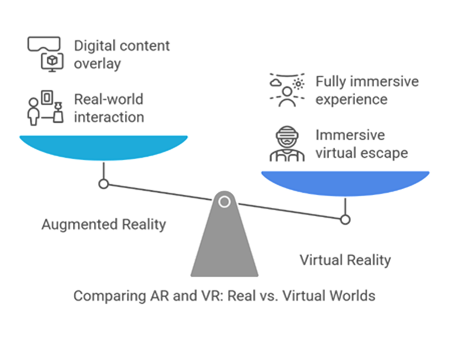
How does augmented reality (AR) work? Augmented reality (AR), enhances our real world by adding some digital components, including images, videos, and 3-D models, and is a core foundation of AR-based apps in Australia. What is augmented reality (AR)? AR combines both our real world and digital worlds, so we can see and interact with digital objects in our real environment, which is driving AR app development in Australia. As opposed to virtual reality (VR) that puts you in an entirely virtual world, AR allows you to interact with digital objects in your real world. The way AR works is that it uses cameras, sensors, and software that recognize objects and surfaces in the real world, making it ideal for AR mobile app development in Australia. AR technology identifies the location of what the user is looking at using the camera of their smartphone or AR glasses, then processes this information and displays the digital content over it. For example, if you use an AR shopping application, it will show you how a chair would look in your living room before you purchase it, a common use case for AR-based apps in Australia. Due to low-code AR development, developing AR applications has become much easier and will strongly influence the Future of AR apps 2026. Because of this, there are now platforms such as FlutterFlow, where developers can build AR-based FlutterFlow applications without having to write large amounts of complex code, accelerating AR app development in Australia. Companies are no longer required to spend months creating their AR applications with great effort, but instead are able to create AR applications quickly, using a simple drag-and-drop tool to create FlutterFlow AR development projects supporting AR mobile app development in Australia.
1.2 AR vs VR vs MR
While Augmented Reality (AR) often gets mixed up with both Virtual Reality (VR) and Mixed Reality (MR); the three technologies operate distinctly from one another and play a critical role in AR app development in Australia:
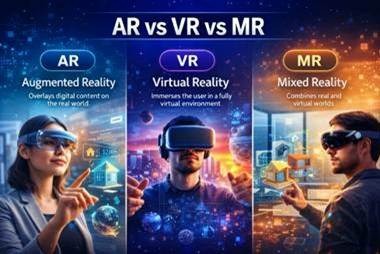
Augmented Reality (AR): Adds digital elements on top of the real world, while allowing the viewer to continue viewing the surrounding environment; however, with additional information or effects (e.g., Pokémon GO, Instagram filters), which is the foundation of AR-based apps in Australia.
Virtual Reality (VR): Creates an immersive experience by placing the user into an entirely virtual world, through the use of a headset; and since everything viewed is generated by a computer, the real world cannot be seen (i.e., Oculus Rift, PlayStation VR).
Mixed Reality (MR): Combines both AR and VR, in which digital objects can interact with the real world; for example, a 3D holographic image is not just visually realistic and interactive with other objects, but also can be touched (e.g., Microsoft HoloLens), influencing the Future of AR apps 2026.
As such, AR is more easily available as users do not require expensive headsets to enjoy AR experiences, and therefore, AR mobile applications are likely to experience rapid growth in 2025, strengthening AR mobile app development in Australia.
2. What are the Applications of AR in different sectors?
AR is no longer just a developing concept – it is now changing the way many industries in Australia operate, connect consumers, and create value through AR app development in Australia. It is expected that by 2026, mobile apps will be created utilizing AR that will become a critical component of the digital strategies of companies attempting to differentiate themselves and improve operational efficiencies, defining the Future of AR apps 2026. Since FlutterFlow was developed to enable AR applications to be built via no-code and/or low-code methods, Australian companies from various types of industries are being empowered to utilize AR at a much faster rate, at a lower cost, and with less technical complexity using AR mobile app development Australia. Here are some of the most significant impacts of AR across a variety of industries in Australia, facilitated by AR application development enabled by FlutterFlow and AR-based apps in Australia:
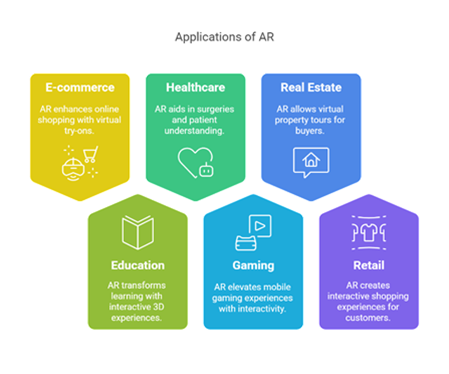
In e-commerce, AR has greatly enhanced the overall shopping experience for consumers of online retail by allowing for “try before you buy” type experiences through AR-based apps in Australia. Australian apparel manufacturers/retailers can utilize virtual try-on technology to allow potential customers to virtually “try on” clothing and accessories before purchasing them. Similarly, furniture and home goods manufacturers/retailers can allow potential customers to see what products would look like in their homes by providing a virtual visualization of products within a room they are interested in buying the products for. Many popular global examples of this include IKEA Place and Sephora who have established strong benchmarks. The ability of local Australian startups and retailers to develop similar immersive shopping experiences through AR using FlutterFlow-based app development is now possible without having to have large engineering teams, accelerating AR app development in Australia. As a result of these experiences, conversion rates should increase, product returns decrease, and customer satisfaction increases.

In education, AR is revolutionizing the traditional method of teaching and learning into a dynamic and interactive experience supported by AR mobile app development in Australia. Rather than simply reading static books about subjects such as history, science, etc., students can now interactively learn by exploring 3D representations of planets, historical sites, and biological systems directly within their classrooms. Utilizing AR for educational purposes in Australia fits well with the country’s digital education initiatives and its STEM-focused curriculum. AR technologies are utilized by medical and technical education institutions to visually represent complex anatomy, machinery, and simulation-based learning. Schools and edtech organizations are able to rapidly and inexpensively deploy AR-based learning applications using FlutterFlow’s no-code approach and AR-based apps in Australia.
In healthcare, AR applications are improving both the quality of care provided to patients and their level of understanding regarding their diagnosis and treatment options through AR app development in Australia. Healthcare providers and medical educators in Australia are incorporating AR into surgical planning, medical education/training, and diagnostic tools. Surgeons are able to perform surgery more accurately when AR overlays are used to project 3D organ models onto the actual organs that need to be operated upon. Patient-facing AR applications also assist patients in better understanding their diagnosis and treatment plan through interactive 3D visualizations. Therefore, patients are able to communicate more effectively with their healthcare providers and build more trust using AR-based apps in Australia.

In gaming and entertainment, AR continues to push the limits of engaging consumers with mobile applications, shaping the Future of AR apps 2026. Although AR has proven itself to have mass market appeal (as seen in the success of Pokémon GO), Australia's gaming and creative industries are anticipated to further integrate AR into their business model by 2026. Using FlutterFlow, developers, independent studios, and startups can develop AR-enabled mobile games and interactive experiences without requiring large-scale engineering teams, strengthening AR mobile app development Australia. The opportunities for innovation in areas such as interactive storytelling, education-based gaming, and location-based entertainment are vast.
In the area of real estate and construction, AR is revolutionizing how people explore properties and make decisions regarding them through AR-based apps in Australia. Buyers and investors of properties in Australia can use AR applications to virtually tour properties, review 3D floor plans, and visualize renovation projects prior to physically inspecting the properties. This process saves time, reduces the number of physical inspections required, and increases buyer confidence. Developers and builders also utilize AR for on-site visualization, project planning, and client presentations, making AR applications developed using FlutterFlow a valuable tool throughout the entire property lifecycle and AR app development in Australia.
In retail, AR creates both in-store and online shopping experiences that are highly interactive by allowing consumers to experience products in an interactive manner using AR-based apps in Australia. Consumers are able to test makeup looks on their face virtually, see how shoes fit virtually, and see how electronic devices work in detail virtually. Retailers in Australia that want to compete in a digital-first world economy are finding that the cost-effective use of FlutterFlow-powered AR applications provides an ideal solution to differentiate themselves, engage their consumers, and bridge the gap between physical and digital commerce through AR mobile app development in Australia.
By 2026, all of the above-mentioned industries in Australia will continue to incorporate AR to deliver richer user experiences and streamline their processes, clearly reflecting the Future of AR apps 2026. Using FlutterFlow’s continually evolving AR capabilities, AI integrations, and rapid development workflows, creating AR-based mobile applications will become faster, more scalable, and more affordable than ever. This democratization of AR development empowers all levels of businesses (startups/SMEs and corporations) to leverage augmented reality to innovate, compete, and succeed in Australia’s digital future through AR app development in Australia.
3. Rapid Growth of AR-Based Apps Leading into 2026
The use of Augmented Reality (AR) in Mobile Apps has rapidly developed from being an experimental technology to being a key driving force for innovation in mobile apps through AR app development in Australia. With AR on track to be a top influencing technology within the Australian mobile app market by 2026, many are expecting the growth of AR to accelerate at a fast pace, clearly outlining the Future of AR apps 2026. The rapid advancements of Smartphone Hardware, along with improvements to cameras and sensors, and increased availability of 5G connectivity, combined with increased consumer acceptance of immersive experiences, will drive the adoption of AR across multiple industries using AR-based apps in Australia. But what's truly unique about this acceleration is that low-code and no-code AR development platforms like FlutterFlow are bringing AR development within reach of every size business, strengthening AR mobile app development in Australia.
For quite some time, AR Development was limited to highly skilled coders with complex SDKs and expensive development teams, limiting AR development to mostly big tech companies and large enterprises. However, FlutterFlow has dramatically shifted this landscape. With its visual development environment, drag-and-drop UI components, and seamless integration with AR libraries and backend services, FlutterFlow has enabled Australian entrepreneurs, Small/Medium Enterprises (SMEs), and enterprise organizations to design, test, and deploy AR-powered mobile apps without needing to have a high level of technical knowledge, accelerating AR app development in Australia. This means AR is no longer exclusive to large tech companies but can be used by local businesses, independent creators, and innovation-driven start-ups across Australia through AR-based apps in Australia.
3.1 Market Trends Driving AR Adoption
The indications from the market clearly demonstrate that mobile AR apps are moving into a phase of widespread acceptance, with the momentum of this phase continuing through 2026, clearly signaling the Future of AR apps 2026. The global AR-market is forecasted to pass $100 Billion as a result of widespread use of mobile AR-applications in areas such as gaming, healthcare, education, e-commerce, and business-to-business applications, accelerating AR app development in Australia. With more than 1.5 billion AR-enabled smartphones available worldwide, there will be no barrier for the AR-experience to be used by consumer populations (including Australia's mobile-first consumer population) through AR-based apps in Australia.
Research conducted in the industry indicates that more than 70% of organizations intend to invest in AR-solutions in order to increase their ability to deliver superior customer experience, increase marketing effectiveness, and improve operational efficiency via AR mobile app development in Australia. As an example, in the retail/e-commerce sectors, research indicates that AR-applications have been able to demonstrate significant positive results, and as such have shown measurable increases in conversion rates of between 20-40%. This has resulted in reduced customer uncertainty and reduced product costs associated with customer purchases of physical products without prior visualization, strengthening AR-based apps in Australia.
As another example, the gaming/entertainment sector continues to be one of the largest contributors to AR-growth, and AR-revenue from gaming applications is projected to exceed $30 Billion, creating new development opportunities for Australian game developers and creative studios through AR app development in Australia.
In conclusion, these trends clearly demonstrate that AR is not a fad or temporary trend and is now a central component of next generation mobile-applications, defining the Future of AR apps 2026. As a result, AR-capabilities will increasingly become an expected element of digital commerce and the delivery of customer experiences for Australian businesses competing in a rapidly evolving, digitally mature, and experience-driven marketplace supported by AR mobile app development in Australia.
3.2 How Businesses Are Benefiting from AR with FlutterFlow
AR does not merely present a static experience to users; it actively engages users by providing an opportunity to participate in the presentation of content in the users' real-world environments through AR-based apps in Australia. Users are able to interact with virtual objects in their physical space to create a more personal connection with both the content presented and the brand behind that content, strengthening AR app development in Australia. Ultimately, this increased interaction results in greater user retention rates, extended session time, and overall improved user satisfaction with the content they have access to via an application developed using FlutterFlow AR capabilities and AR mobile app development in Australia.
For Australian businesses looking to capitalize on the advantages that come with developing an AR application without the need for prolonged development timeframes or excessive budget allocations, FlutterFlow provides a platform for businesses to develop AR applications quickly, test the AR features in-market, and then scale the applications that prove successful using AR app development in Australia. In retail environments, AR is used to improve product discovery and ultimately customer purchasing decisions; real estate firms utilize AR to provide potential buyers with highly immersive previews of homes being considered for purchase; educators use AR to improve learning outcomes for students by allowing them to explore complex visual concepts through interactive experiences; and healthcare providers utilize AR to better communicate with patients regarding various aspects of care, including but not limited to, 3D representations of patient anatomy and surgical procedures delivered via AR-based apps in Australia.
Ultimately, as Australia continues to move closer to the year 2026, the increasing adoption of AR technology combined with FlutterFlow's ease of development for AR based applications creates an environment where AR based applications become a significant tool for businesses looking to innovate, engage customers, and differentiate themselves from competitors in the mobile app market place, defining the Future of AR apps 2026.
3.3 Now let’s take a look at some of the important ways that AR is changing the game today:
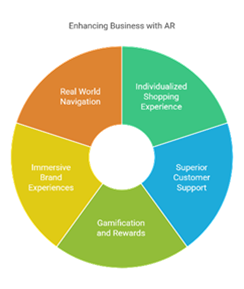
The increasing use of Augmented Reality (AR) technology throughout Australia is dramatically affecting how businesses use AR to connect with end-users, provide service to end-users, and how they can differentiate themselves from competitors through AR app development in Australia. By 2026, AR will no longer be seen as an experimental tool but rather as an essential part of every business's daily mobile application operation, clearly reflecting the Future of AR apps 2026. The following are several examples of how AR is currently changing business, and how FlutterFlow makes these changes available to organizations of all sizes using AR-based apps in Australia.
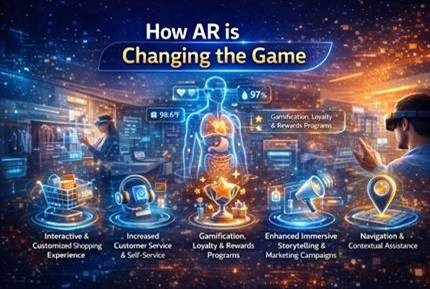
Interactive and Customized Shopping Experience
One of the primary issues with online shopping is the lack of ability for consumers to physically inspect or "try" a product prior to making a purchase, especially in the categories of fashion, beauty, and home decor. AR provides the solution to this issue by providing a means for consumers to virtually "try" products in real-time through AR-based apps in Australia. Retailers in Australia who are using AR-enabled FlutterFlow apps can significantly improve consumer confidence, improve conversion rates, and decrease product returns, resulting in a smoother and more enjoyable shopping experience for consumers, strengthening AR mobile app development in Australia.
Increased Customer Service and Self-Service
AR is revolutionizing customer service through the provision of more visual, more intuitive, and more self-service-oriented solutions supported by AR app development in Australia. Rather than solely relying on call centers or text-based instruction manuals, organizations can now provide AR-enabled, step-by-step visual guidance for the installation, maintenance, and troubleshooting of products. Organizations within Australia utilizing AR-enabled support options can decrease the cost associated with supporting consumers while simultaneously enhancing customer satisfaction and the speed at which problems are resolved using AR-based apps in Australia.
Gamification, Loyalty, and Rewards Programs
In order to promote long-term usage and engagement with their applications, many organizations are incorporating AR-based gamification into their mobile applications as part of AR mobile app development in Australia. Examples include interactive challenges, scavenger hunts, and AR-based mini-games that reward users with loyalty points, discounts, and/or exclusive content when they return to utilize their application repeatedly. Through FlutterFlow, Australian organizations can rapidly develop these types of AR-driven engagement strategies that foster stronger emotional bonds between consumers and organizations, resulting in higher retention rates and advancing AR app development in Australia.
Enhanced Immersive Storytelling and Marketing Campaigns
AR allows organizations to move beyond traditional digital marketing and develop unique and memorable experiences for their target audience through AR-based apps in Australia. From interactive packaging to location-based AR marketing campaigns, organizations can now communicate their brand stories in creative ways. Global organizations such as Coca-Cola have already shown the potential of AR storytelling, and organizations in Australia are increasingly developing similar marketing campaign strategies utilizing FlutterFlow to create cost-effective and high-impact AR marketing campaigns that help organizations stand out in a crowded digital marketplace, shaping the Future of AR apps 2026.
Navigation and Contextual Assistance
AR is also revolutionizing how users interact with their physical surroundings using AR mobile app development in Australia. AR-powered navigation applications allow users to visualize real-time directions, translations, and contextual information directly on their smartphones, thereby simplifying exploration and decision-making. Users can utilize tools such as AR maps and visual search to more intuitively explore Australian cities, tourist destinations, and retail environments by simply pointing their phone at the surrounding environment, further accelerating AR-based apps in Australia. This technology has significant applications in the tourism, retail discovery, educational, and smart city arenas.
As FlutterFlow continues to evolve its AR capabilities, Australian organizations will have additional opportunities to develop high-quality, no-code AR applications that previously required extensive technical expertise and financial investment, reinforcing AR app development in Australia. The democratization of AR development will empower organizations of all sizes (startups, small-to-medium-sized businesses, large enterprises), to improve user engagement, enhance customer experiences, and unlock new revenue streams. By 2026, AR-powered FlutterFlow applications will be playing a vital role in forming Australia's digital-first, experience-driven economy, and the Future of AR apps 2026.
4. AR App Development with FlutterFlow in 2025–2026
By 2025, Augmented Reality will no longer be considered a "nice-to-have" feature in mobile applications and will become a standard component of user experience through AR app development in Australia. In 2026, Australian users are expecting increasing levels of immersion, interactivity, and personalization in their digital experiences across e-commerce, education, healthcare, gaming, real estate, travel, and business-to-business applications, clearly defining the Future of AR apps in 2026. The way businesses connect with customers, showcase products, and add value to their lives in the real world is being fundamentally changed by AR and AR-based apps in Australia.
Historically, creating AR applications required AR framework expertise, extensive 3D modeling knowledge, and large engineering teams, which made it expensive and time-consuming. However, the rapid growth of no-code and low-code platforms, including FlutterFlow, has drastically reduced the complexity associated with creating AR applications and accelerated AR mobile app development in Australia. Today, Australian startups, small and medium-sized enterprises (SMEs), and larger businesses can create, test, and roll out AR-enabled mobile applications using no-code or low-code platforms like FlutterFlow at a faster pace and lower cost than they would have been able to historically through AR app development in Australia. This is achieved without the need for large amounts of capital investment or high-level coding expertise.
The potential of AR-powered FlutterFlow apps for companies includes providing users with immersive user experiences such as virtual product try-on capabilities, 3D property preview capabilities, interactive learning modules, location-based experiences, and AR-enabled games delivered via AR-based apps in Australia. By starting to adopt AR today, businesses can position themselves ahead of their competitors and improve customer interaction and retention, in addition to improving perceptions about their brands as part of the Future of AR apps 2026. Whether it's allowing a consumer to see how furniture looks in their home via AR, enabling a consumer to navigate around cities in Australia via AR and find their way around, or providing consumers with a fun and engaging learning experience via AR, the way users interact with mobile applications is being revolutionized by AR and AR mobile app development in Australia.
5. Why FlutterFlow Is the Ideal Platform for AR App Development
As the mobile app landscape continues to evolve, FlutterFlow has emerged as a key facilitator for developing Augmented Reality (AR) technology that is both powerful and accessible, strengthening AR app development in Australia. By creating an environment where companies can develop complex AR applications in a simplified manner, FlutterFlow creates the opportunity for organizations to implement immersive AR applications without the associated technical challenges or costs. Whether it's providing customers with virtual try-on capabilities, providing employees with AR-based training opportunities, enabling users to explore 3D product previews, or creating interactive AR-based entertainment experiences, FlutterFlow provides development teams the ability to rapidly create and test their AR applications while still being able to scale and maintain high levels of performance using AR-based apps in Australia.
By offering a low-to-no code development platform, FlutterFlow has greatly reduced the time and expense associated with the development process of AR applications, opening up this innovative form of application development to a wider variety of Australian businesses and advancing AR mobile app development in Australia. Additionally, by providing a visual builder and access to APIs, custom logic, and third-party AR integration capabilities, FlutterFlow has provided both novice founders and seasoned developers alike the flexibility to choose how they will develop their AR application. As a result, FlutterFlow has become a go-to platform for companies looking to use AR to innovate while also needing to be agile in the Future of AR apps 2026.
6. What Is FlutterFlow and Its Key Features
FlutterFlow is a modern visual app builder built on Google’s Flutter framework, designed to help teams create high-performance mobile applications for both Android and iOS from a single codebase. Its robust feature set makes it particularly well-suited for AR-enabled app development:
- Drag-and-Drop Visual Builder – Design complex mobile apps visually with an intuitive and user-friendly interface.
- Pre-Built UI Components – Accelerate development using ready-to-use widgets and layouts optimised for mobile performance.
- Backend & API Integrations – Easily connect apps to authentication services, databases, cloud functions, and AR-related APIs.
- Custom Code Support – Add custom Dart code when advanced logic or specialised AR functionality is required.
- Cross-Platform Deployment – Build once and deploy seamlessly across iOS and Android, reducing time-to-market.
As Australia moves toward 2026, FlutterFlow is set to become a cornerstone of AR-based mobile app development. By combining accessibility, scalability, and innovation, FlutterFlow enables businesses to turn ambitious AR ideas into real-world applications—faster, smarter, and more affordably than ever before.
7. Pros of FlutterFlow AR Application Development
As AR adoption accelerates across Australia, businesses are seeking faster, more cost-effective ways to build immersive mobile experiences without compromising quality or scalability through AR app development in Australia. FlutterFlow stands out as a powerful platform that democratizes AR app development, enabling startups, SMEs, and enterprises to innovate with confidence using AR-based apps in Australia. Below are some of the key advantages of building AR-based applications using FlutterFlow and advancing AR mobile app development in Australia.
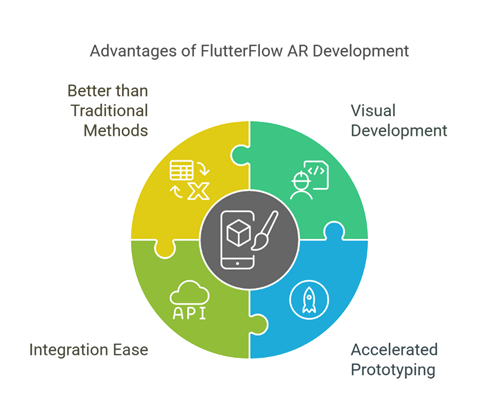
1. Visual, No-Code Development for Faster Innovation
Traditional AR app development often requires expertise in complex programming languages such as Swift, Kotlin, C#, or Unity—creating a high entry barrier for non-technical teams. FlutterFlow removes this limitation by offering a visual, no-code and low-code development environment that allows anyone to design and build AR-enabled mobile apps without writing extensive code, redefining AR app development in Australia.
With FlutterFlow AR development, Australian businesses can:
• 🚀 Reduce development costs and timelines by eliminating reliance on large, specialized engineering teams involved in AR mobile app development in Australia.
• 🎨 Focus on design, user experience, and customer journeys rather than technical implementation for AR-based apps in Australia.
• 🔗 Seamlessly integrate third-party AR APIs and services, enabling advanced functionality without complex configurations and supporting the Future of AR apps 2026.
This accessibility empowers product managers, designers, and founders to actively participate in the AR development process, fostering faster innovation and better alignment with business goals across AR app development in Australia.
2. Accelerated Prototyping and Faster Deployment
Building AR apps using traditional development methods can take several months—from concept to launch. FlutterFlow dramatically shortens this cycle by enabling rapid prototyping, real-time testing, and quick iteration of AR features for AR-based apps in Australia.
Using FlutterFlow, businesses can:
• 📌 Prototype multiple AR concepts quickly before committing to a final solution using AR mobile app development Australia.
• 📌 Collect real user feedback early and refine AR experiences based on actual usage.
• 📌 Accelerate time-to-market, giving Australian startups and businesses a competitive edge in the fast-moving AR landscape and the Future of AR apps 2026.
For startups and small businesses operating in Australia’s competitive digital economy, this speed and flexibility are critical to staying relevant and capturing market opportunities in 2025–2026 through AR app development in Australia.
3. Seamless Integration with External APIs and AI Services
Most advanced AR experiences rely on external APIs, AI-driven services, and cloud-based backends to function effectively. FlutterFlow simplifies these integrations, making it easier to connect AR apps with popular tools and platforms supporting AR-based apps in Australia.
Common AR use cases enabled through FlutterFlow include:
• 🛍️ Retail & E-commerce AR – Virtual fitting rooms and product visualization experiences powered by AR app development in Australia.
• 🎮 AR Gaming & Entertainment – Interactive, location-based, and immersive mobile games aligned with the Future of AR apps 2026.
• 🩺 Healthcare AR – Medical imaging visualization, AR-assisted diagnostics, and training simulations enabled through AR mobile app development in Australia.
• 🏫 Education AR – Interactive 3D models, immersive lessons, and experiential learning tools delivered via AR-based apps in Australia.
FlutterFlow’s flexible API architecture allows businesses to integrate AI-powered capabilities such as real-time object detection, voice recognition, image processing, and 3D content rendering with ease. This significantly lowers the complexity of building sophisticated AR applications while maintaining scalability and performance across AR app development in Australia.
By combining visual development, rapid deployment, and seamless integrations, FlutterFlow positions itself as a future-ready AR development platform—empowering Australian businesses to innovate, experiment, and scale AR experiences efficiently as we move toward the Future of AR apps 2026.
8. FlutterFlow vs Traditional AR App Development-
Traditional AR app development techniques are time-consuming and laborious when compared to using FlutterFlow to develop an application as part of AR app development in Australia. FlutterFlow uses an intuitive drag-and-drop format, allowing you to develop an app much faster (in weeks) than you would have been able to in months, accelerating AR mobile app development in Australia. When developing AR apps traditionally, you need to know how to code, but with FlutterFlow, you can create AR apps with little to no coding knowledge, enabling AR-based apps in Australia.
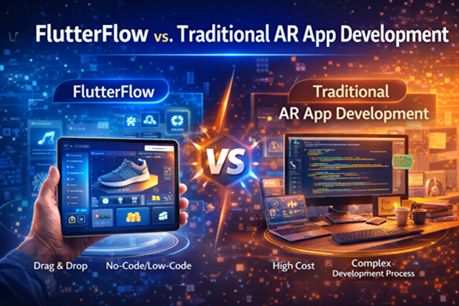
In addition, prototyping is much easier using FlutterFlow, as there is no need for manual coding, and this allows you to quickly test different designs that support the Future of AR apps 2026. In terms of costs, it is also significantly less expensive to develop an app using FlutterFlow because you do not need large teams of expensive coders to develop your AR app, making AR app development in Australia more accessible. It is also much easier to integrate APIs and other AI-enabled services into your app when using FlutterFlow to enable AR functionality, since there is no need to manually configure these features for AR mobile app development in Australia.
Another benefit of FlutterFlow is scalability; with the use of Firebase, all apps developed on FlutterFlow will automatically scale (as needed), while most traditional AR app development methods require additional resources to scale and support your growing app. Altogether, FlutterFlow is a faster, cheaper, and simpler method of creating AR apps, so that innovation has never been more accessible than it is today through AR-based apps in Australia and the Future of AR apps 2026.
9. AR-Based FlutterFlow Apps in 2025–2026
By 2025, augmented reality will no longer be an optional enhancement in mobile applications—it is rapidly becoming a core expectation for modern user experiences through AR app development in Australia. As we move toward 2026, AR-based FlutterFlow apps are gaining strong momentum across Australia, clearly defining the Future of AR apps 2026 and accelerating AR-based apps in Australia, enabling businesses to deliver immersive, interactive, and highly engaging mobile solutions. In a digital-first economy where speed, innovation, and user engagement matter most, businesses require AR development tools that are fast, scalable, and cost-effective—and FlutterFlow stands out as a clear leader in AR mobile app development in Australia.
With FlutterFlow AR development, Australian organizations can leverage AR app development in Australia to:
• ✅ Build rich and engaging AR experiences without relying on expensive, specialized development teams supporting AR-based apps in Australia.
• ✅ Accelerate AR app launches by rapidly prototyping, testing, and iterating ideas based on real user feedback as part of AR mobile app development in Australia.
• ✅ Seamlessly integrate AI, third-party APIs, and cloud services to enhance functionality and scalability aligned with the Future of AR apps in 2026.
• ✅ Develop enterprise-grade AR solutions at a lower cost, without the heavy technical overhead of traditional development, using AR app development in Australia.
Whether it’s an AR-powered shopping experience, an interactive educational platform, a healthcare visualization tool, or an immersive mobile game, FlutterFlow simplifies the AR development process while maintaining performance and flexibility across AR-based apps in Australia. Its visual development environment empowers startups, SMEs, and enterprises alike to experiment with AR use cases and bring innovative ideas to market faster through AR mobile app development in Australia.
As AR adoption continues to grow in Australia beyond 2025, FlutterFlow-based AR applications will play a pivotal role in shaping the Future of AR apps in 2026. By lowering barriers to entry and accelerating innovation, FlutterFlow enables businesses to stay competitive, enhance customer engagement, and lead the next wave of AR-driven digital transformation via AR app development in Australia.
10. Process of Building an AR App in FlutterFlow: A Step-by-Step Approach
Creating an AR-based apps in Australia using FlutterFlow is an easy-to-do process, even for individuals with little information on app development. Thanks to FlutterFlow's visual environment, developers can build powerful AR applications without too much hassle, embedding advanced features by using custom Flutter code and plugins, making it ideal for AR app development in Australia.
All you need to do is just build an immersive AR app in five simple steps aligned with AR mobile app development in Australia.
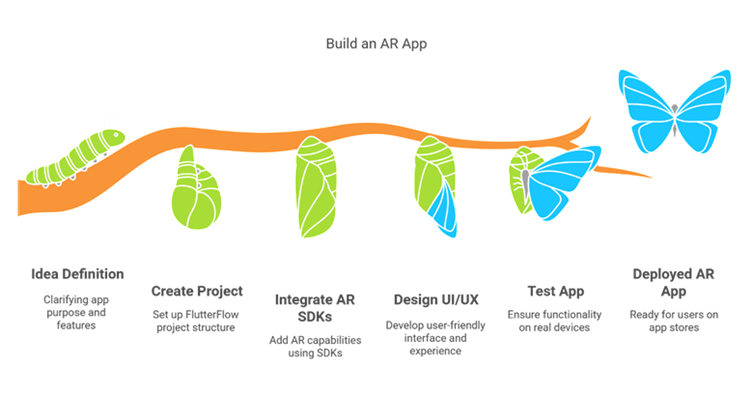
Step 1: Define the App Idea and The Scope
The first step in building any app is to define the idea and scope for AR-based apps in Australia. To ensure you stay on track and get the outcome you intend, consider these questions:
What’s your app’s main purpose? Are you building a virtual try-on solution for retail, an interactive learning experience, or maybe an AR game as part of AR app development in Australia?
Who are you writing for? Gamer, shopper, student — do they need a tool for learning?
What kind of features do you want? Consider what essential features you want to offer such as 3D object placement, real-time object recognition, or AR navigation commonly seen in AR mobile app development Australia.
Clearly defining these elements at the start helps keep your project focused and prevents it from swimming in unnecessary complexity.
Step 2: Create the FlutterFlow Project
After that, have an understanding of the concept, now it's time to create the FlutterFlow Project for AR app development in Australia.
Getting your app foundation set up is a very straightforward process:
Create a New FlutterFlow project. Choose a layout template that resembles the layout of your AR app, or start fresh for AR-based apps in Australia.
Implement any required UI elements like navigation bars, action buttons, text input fields, etc. These will be the basic building blocks of your app.
Connect the backend of your choice. Real-Time (Storing data in real-time means you can save user sessions, or AR interaction raw data using Firebase), which supports scalable AR mobile app development in Australia.
Integrate Third-Party APIs for additional capabilities. If your app needs to access 3D models, external databases, or other resources, add those integrations now to stay competitive in the Future of AR apps 2026.
Once this is done, you will have the basic structure structured to proceed with AR functionalities.
Step 3: Bringing AR SDKs into FlutterFlow
Even though FlutterFlow does not have its own native AR features, it does open itself to custom Flutter code and plugin support (including AR support) in the Flutter framework, which allows you to integrate AR capabilities into your app for AR app development in Australia. Here’s how you can do that:
Common AR SDKs That You Can Integrate:
ARCore (Android) - If you intend to develop Android devices, ARCore delivers high-end AR features such as motion tracking, environment understanding, and light estimation commonly used in AR-based apps in Australia.
ARKit (iOS) – For iOS devices, ARKit offers similar functionality as ARFoundation, supporting real-world object placement, face tracking, and much more.
Vuforia – The extremely great AR-based SDK, which allows object recognition across both iOS and Android platforms and aligns with the Future of AR apps 2026.
Add Custom Flutter Code:
We will need custom code in Flutter for advanced AR, such as object tracking, real-time image detection, and face filters. Here’s a basic flow for bringing in custom code:
Install target plugins: Download the AR SDK of your choice from the pub.dev.
Add Dart code: Navigate to the Custom Code editor in FlutterFlow and insert the required Dart code that invokes AR features for AR mobile app development in Australia.
Wire AR features to your UI: For instance, have a button click trigger an AR experience.
Test the integration: Use FlutterFlow’s preview feature to ensure all works as intended.
By customizing your Flutter code, you can integrate advanced augmented reality capabilities like those that make your app stand out above others in AR-based apps in Australia.
Step 4: Building an Immersive UI/UX of AR Applications
Not only do the best AR applications include great functionality, but they also offer a seamless/exciting user experience, especially in AR app development in Australia. Here’s how to create a good UI/UX:
UI/UX Interface for AR Apps:
Be Simple: Omit clutter on interfaces, making users lose out on the AR experience.
Instructions on screen: Many people using AR are likely unfamiliar with the technology.
Attention to accessibility: Ensure text is legible, and buttons are positioned where they’re easy to reach.
Performance optimization: AR applications usually work with large files like textures and 3D models, which is critical for AR mobile app development in Australia.
More about the Design elements:
Haptic feedback: Provide vibrations to the users whenever they interact with AR objects.
Sound cues: Used judiciously, sounds can offer audio feedback to users.
Real-time object interactions: Allow users to interact with the 3D models in real-time to enhance the experience aligned with the Future of AR apps 2026.
Confirm AR performance on various devices — Test your design across devices as AR performance differs based on hardware.
Step 5: Testing & Deploying the AR App
The testing is an essential step in releasing your app to the public as part of AR app development in Australia. Here’s how you can make sure your AR app is good to go:
Testing Your AR App
Preview in FlutterFlow: To test basic interactions in the app.
Test on real devices: Since AR depends greatly on real-world interactions, testing on real devices is mandatory for AR-based apps in Australia.
Camera permissions: AR apps require access to the camera.
Optimize performance: Make sure your app is fast and snappy and ready to meet expectations for AR mobile app development in Australia.
11. AR App Deployment
After rigorous testing, you can proceed to deployment for AR app development in Australia:
Export App: FlutterFlow lets you export your app as APK (for Android) or IPA (for iOS), making deployment seamless for AR-based apps in Australia.
Submit to app stores: Refer to Google Play Store and Apple App Store for the app submission process. Add descriptions, screenshots, and any required metadata suitable for AR mobile app development in Australia.
Beta tests: Offer the app to a limited number of users first for early feedback and resolution of any bugs before going live, which is especially important for AR-based apps in Australia.
Continuous updates: AR technology is advancing quickly, so regularly update your app to add new features and improvements to stay on top of your competitors and aligned with the Future of AR apps 2026.
Creating an AR application with FlutterFlow is not only fun but also a very rewarding process for AR app development in Australia. With this guide, you can define your app’s idea, design a great user experience, and integrate advanced AR features with a couple of lines of code. Whether you are building an AR shopping experience, a learning tool, or an interactive game, FlutterFlow makes the process simple and less intimidating so AR can finally become widely accessible across AR-based apps in Australia.
11.1 Here are the important details you should know from this guide:
• FlutterFlow provides a no-code/low-code solution to build powerful AR apps suited for AR mobile app development in Australia.
• Advanced AR features can be implemented with the use of Custom Flutter code, supporting scalable AR app development in Australia.
• Testing and optimization ensure your app performs well across all devices and remains future-ready for the Future of AR apps 2026.
If you implement these steps, you’ll develop an immersive AR experience that is user-friendly, functionally rich, and deployable in the market—positioning your product strongly among AR-based apps in Australia.
11.2 The Future of AR App Development with FlutterFlow
Augmented Reality (AR) technology is rapidly advancing as never before and will significantly change how people engage with mobile apps within the next five years—particularly within AR app development in Australia. The AR shift from novelty to necessity will have users increasingly relying on mobile apps that provide immersive, contextual experiences; therefore, platforms such as FlutterFlow will be instrumental in driving this transition by providing developers of all skill levels with access to scalable, future-ready AR development through its no-code and low-code development capabilities for AR-based apps in Australia. Below, we'll look at where we're headed with AR, and how FlutterFlow is positioned to help lead this transformation in AR mobile app development in Australia.
11.3 What to Expect from AR Technology Over the Next Five Years
Industry-Wide AR Adoption
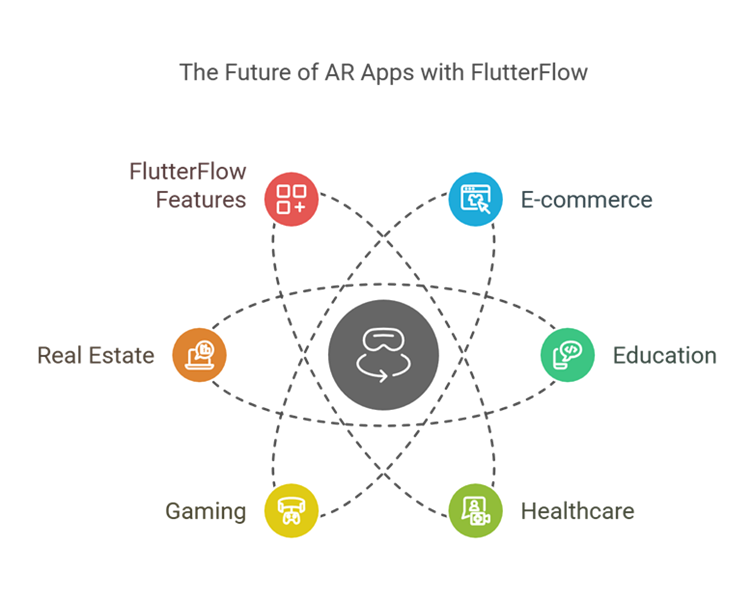
By 2028, AR will have a strong presence in many industry sectors such as Healthcare, Retail, Education, Tourism, Real Estate, Construction, and Gaming — especially in Australia's most digitally advanced markets, accelerating AR app development in Australia. Many businesses will increasingly use AR to create highly personalized and interactive customer experiences that build greater customer loyalty and engagement — from immersive retail and learning environments to in-field, real-time visualization of data delivered through AR-based apps in Australia.
Beyond Mobile Screens
Smartphones will continue to be the main AR platform, but there are many other ways of experiencing AR in the future. As more lightweight smart-glasses and wearable AR devices enter the market, users will be able to experience hands-free AR in the form of always-on experiences that complement AR mobile app development in Australia. They will also be more comfortable and socially acceptable, and will easily integrate into people's daily routines and provide new possibilities for navigation, remote assistance, training, and enterprise productivity—shaping the Future of AR apps 2026 and beyond.
More Intelligent, More Responsive
Future AR applications will be much more intelligent and responsive than today's AR-based apps in Australia. They will be able to understand their surroundings in real-time (identify objects, surfaces, and spatial relationships), and will allow users to interact with digital objects naturally (e.g., rotate 3D objects, receive live directions, etc.) using simple gaze-based interactions—further advancing AR app development in Australia.
AI-Driven AR Applications
Artificial Intelligence will play a key role in shaping the AR experience. Next-generation AR applications powered by AI will be able to recognize objects, faces, voice commands, and gestures, which will allow for more intuitive and human-like interaction between humans and technology within AR mobile app development in Australia. The combination of AI and AR will allow AR applications to dynamically adapt to user behavior — creating more personalized and smarter experiences with less friction and defining the Future of AR apps 2026 for AR-based apps in Australia.
12. How FlutterFlow Is Evolving to Support Advanced AR Experiences
FlutterFlow will continue to be at the forefront of developing cutting-edge, next-generation development environments that allow companies and developers to develop their AR solutions rapidly through AR app development in Australia, keeping up with the increasing innovations in AR. In addition to being at the forefront of AR innovations, FlutterFlow has streamlined the process of creating sophisticated AR-based apps in Australia by reducing the amount of manual coding required to create complex AR applications that perform well and are reliable.
AR Development Simplified
Developers using FlutterFlow are able to integrate seamlessly into the industry-leading AR frameworks (ARKit & ARCore) to utilize features such as surface detection, object recognition, virtual try-ons, etc., which will all be done through minimal manual coding. The result is an easier way to create advanced AR experiences, while still providing the developer the ability to control how well the application performs and works reliably for AR mobile app development in Australia.
Compatibility with New Wearable Devices
With smart glasses and wearable AR devices becoming increasingly common, FlutterFlow will expand its compatibility to support these emerging platforms. This will ensure that applications developed today will be able to be scaled to future AR hardware, allowing Australian businesses to remain in front of technological advancements in the Future of AR apps 2026.
13. The Role of AI and 5G in Accelerating AR Adoption
In addition to their individual impacts, two emerging technologies — AI and 5G — are positioned to significantly enhance the overall potential of AR app development in Australia going forward:
- AI-Powered Intelligence in AR
- 5G: Unlocking High-Performance AR
AR and AI
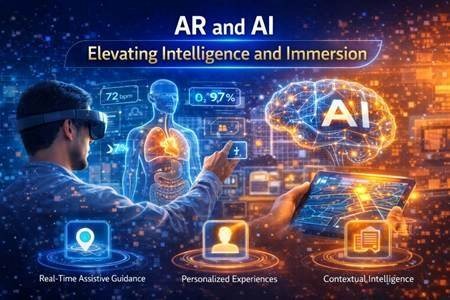
AR uses AI to better understand and interpret the world around it. The features (e.g., real-time object recognition, voice-controlled interaction, facial tracking, etc.) allow AR-based apps in Australia to become a digital extension of the user's environment and an actual digital companion. The capabilities provided by AI transform AR from a simple "visual" layer on top of the physical world into an actual, immersive, interactive experience for AR mobile app development in Australia.
AR and 5G
The upcoming rollout of 5G across Australia is expected to have a significant positive impact on AR app development in Australia. 5G has many advantages, including ultra-low latency, increased bandwidth, and faster data transfer rates. These advantages enable AR to run without delay while performing tasks that require large amounts of bandwidth (e.g., 3D modeling, streaming). A smooth and uninterrupted AR experience with real-time integration with the users' surroundings is made possible by these advantages.
In combination, AR, AI, and 5G — utilizing platforms similar to FlutterFlow — represent the new generation of AR-based apps in Australia. As Australia moves past 2026, the use of FlutterFlow for AR mobile app development in Australia will lead to continued innovation and provide businesses with a means to create a wide range of smart, fast, and highly immersive digital experiences, aligning with the Future of AR apps 2026.
14. Conclusion
AR is now a fundamental technology used for product design, customer engagement, and delivery of value as the Australian economy shifts toward a digitally focused/experience-based economy. The use of AR app development in Australia is changing the way people experience mobile by merging the digital and physical worlds in a manner that is both intuitive, immersive, and impactful. By 2026, AR-based apps in Australia will not only improve user engagement but will also increase the rate at which a business can influence purchasing decisions, operational efficiencies, and branding (across all industries) within the Australian market.
The most significant aspect of this transition is the democratization of AR development. Historically, AR innovation was typically only available to large corporations that had access to specialized talent, expensive 3D pipelines, and substantial budgets. With the introduction of FlutterFlow, this has been dramatically altered. FlutterFlow combines no-code/low-code development, visual design tools, and seamless integration with AR SDKs, APIs, AI services, and cloud backends, allowing developers (regardless of size) to create complex AR mobile app development in Australia that experiences faster and cheaper than ever before. This allows Australian businesses to test their ideas, prove feasibility, and scale their AR solutions without the risk and time constraints associated with traditional development.
The increased adoption of AR, combined with advancements in AI and 5G, will continue to amplify the effects of AR. AI will make AR-based apps in Australia more intelligent, more contextual, and more personalized, and 5G will enable AR to work in real-time, providing a frictionless experience for the end user. When combined with each other, AI and 5G will drive AR past the realm of novelty into everyday utility. For example, AR mobile app development in Australia can support hands-free workflows, provide intelligent navigation, support immersive learning, and provide real-world decision-making capabilities. Due to the nature of FlutterFlow, applications developed using FlutterFlow today will remain relevant to tomorrow's devices, platforms, and end-user expectations.
The businesses that will ultimately succeed in the highly competitive Australian digital marketplace will be those that move quickly, continually innovate, and focus solely on user experience. Applications developed using AR app development in Australia and FlutterFlow offer a strong path forward to achieving these goals. Whether AR applications are being used to allow consumers to see what they are going to buy prior to purchasing, guide consumers through a process using visual overlays, train professionals using immersive simulations, or create fun, gamified branded experiences, AR-based apps in Australia deliver tangible and measurable results.
In conclusion, the future of AR apps 2026 in Australia is not only driven by new technology but by accessibility, speed, and real-world results. FlutterFlow acts as the conduit between these concepts by empowering businesses to transform bold AR ideas into scalable and ready-to-market applications. Moving beyond 2026, AR mobile app development in Australia enabled by FlutterFlow will play a pivotal role in Australia's mobile app ecosystem by giving businesses the ability to innovate faster, engage deeper, and create meaningful experiences in an increasingly augmented world.


View more blogs
%20(1).jpg)


.jpg)
.png)
.png)

.png)

.png)
Ready to develop your own product? Get in touch today!
Get in Touch
