




1. Introduction
Australia has seen a significant shift in how people approach health, wellness, and preventive care. With rising awareness of lifestyle-related conditions such as obesity, diabetes, and heart disease, Australians are increasingly taking a proactive approach to managing their health. Combined with widespread smartphone adoption, this trend has created a strong demand for digital health solutions, making diet and nutrition app development in Australia a rapidly growing market.
Today's users are looking for more than generic fitness advice or calorie counters. They expect personalized experiences tailored to their health goals, dietary preferences, cultural habits, and medical needs. Modern nutrition apps now offer features such as meal planning, habit tracking, hydration monitoring, progress analytics, and integration with wearable devices like Apple Health, Google Fit, and Fitbit.
Preventive healthcare is also driving this growth. Australians are increasingly using digital tools to build healthier lifestyles, monitor wellness, and reduce long-term health risks. Nutrition apps play a key role in this shift by encouraging mindful eating, healthy habits, and continuous health tracking.
For startups, healthcare providers, and fitness brands, this presents a significant opportunity to build scalable digital health solutions that foster long-term user engagement and recurring revenue. As health consciousness continues to rise, diet and nutrition applications are becoming an essential part of Australia's evolving digital health ecosystem.
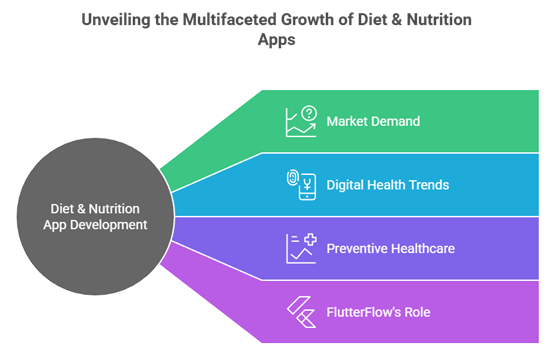
At the same time, the way apps are developed is also transforming, reflecting modern app development trends in Australia. Building traditional mobile applications is time-consuming, costly, and resource-intensive, which can be especially challenging for start-ups and small to medium-sized businesses. It is here that modern low-code and no-code platforms are revolutionizing the application development industry. Among these modern platforms, FlutterFlow app development in Australia has become very popular for delivering high-quality cross-platform applications quickly and efficiently.
Using FlutterFlow, businesses can create powerful Android, iOS, and Web Applications from a single code base and enjoy flexibility, performance, and scalability. For diet and nutrition apps, this is especially important. Start-ups can quickly test new ideas; fitness brands can quickly launch Minimum Viable Products (MVP) without large initial investments; established companies can modernize their digital health products without long development cycles. The visual development style of FlutterFlow app development in Australia makes it simpler to design intuitive User Interfaces (UI) — a key factor for health apps that require daily engagement.
Businesses in Australia choose FlutterFlow as it also easily integrates with modern back-end technologies like Firebase, Supabase, and REST APIs. This enables developers to safely store and manage user data, provide personalized nutrition recommendations, and grow applications as user demand grows. Also, FlutterFlow supports custom logic using Dart, so developers can implement complex functionalities such as the calculation of calories, meal planning algorithms, and Artificial Intelligence (AI)-driven nutrition insights – capabilities that are increasingly required in the competitive health app market today and strongly influenced by health and nutrition app development trends in Australia.
From a business perspective, FlutterFlow reduces development time and costs while maintaining the flexibility needed for long-term growth, making it the perfect choice for entrepreneurs looking to enter the digital health space and organizations wanting to expand their existing health and fitness services. With Australia’s strong digital infrastructure and growing demand for wellness-focused solutions, FlutterFlow app development in Australia provides a practical and future-ready approach to Diet & Nutrition App Development in Australia.
This blog will explore how FlutterFlow empowers businesses to build scalable, easy-to-use, high-performing diet and nutrition apps focused on the Australian market. From identifying important features and strategies for development to exploring monetization options, this guide will help you make better decisions when planning your next digital health product while staying aligned with key app development trends in Australia.
2. Market Opportunity for Diet & Nutrition Apps in Australia
Australians are becoming much more interested in healthy eating and using apps for diet and nutrition, reflecting broader health and nutrition app development trends in Australia. The last ten years have seen many Australians begin to take on a healthier and more active lifestyle because of increased awareness of diseases related to lifestyle and new wellness initiatives from governments, and an overall cultural trend towards fitness and a balanced lifestyle. Therefore, there is a growing need for developers to create diet and nutrition apps for Australians, which makes diet and nutrition apps for Australians a prime segment of the digital health and fitness market and a key opportunity within Diet & Nutrition App Development in Australia.
2.1 High Levels of Digital Usage and a Growing Interest in Healthy Living Amongst Australians
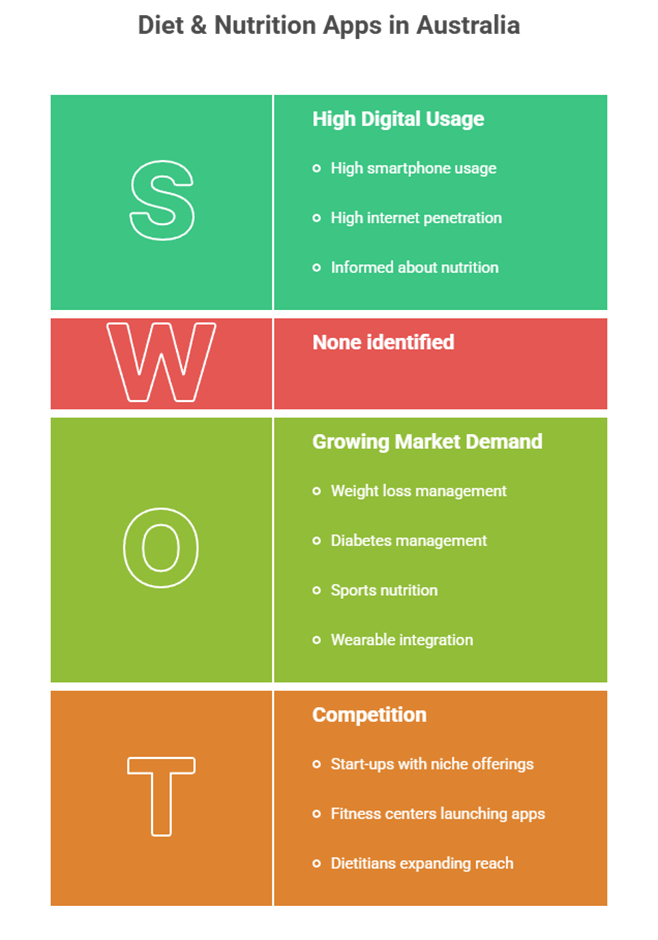
Australia has one of the highest rates of smartphone usage and internet penetration in the world, aligning closely with modern app development trends in Australia. Many Australians use their smartphones to manage their daily lives, and a large proportion of those people utilize apps to manage their health and wellness. Australians are very informed when it comes to nutrition, calories, and how to make healthy dietary choices, and Australians are utilizing digital tools more and more to assist in their decision-making processes. Whether you're a young professional counting your macronutrients or a family wanting to plan and prepare healthy meals for your children, diet and nutrition apps offer a broad base of users and represent an expanding segment of Diet & Nutrition App Development in Australia.
As a result of growing concerns regarding obesity, diabetes, heart disease, and mental health and well-being, users are seeking out ways to be proactive in managing their health and well-being. Users see nutrition apps as an easy and non-intrusive means to measure their consumption of food, develop healthier behaviors, and remain accountable; therefore, nutrition apps are a perfect match for the Australian marketplace and current health and nutrition app development trends in Australia.
2.2 Growing Demand Driven by Increasingly Popular Use Cases
There are a number of high-demand use cases driving interest in diet and nutrition apps in Australia. One of the most popular areas is weight loss management. Users are searching for apps that assist with calorie tracking, portion control, and personalized meal planning to achieve a sustainable lifestyle change, rather than achieving a quick fix via a diet—an approach increasingly seen across health and nutrition app development trends in Australia.
Another high-demand use case is diabetes and chronic condition management. There is a growing number of Australians with type II diabetes and other diet-related health conditions, and users are utilizing nutrition apps as a tool to monitor their carb intake, track blood sugar-friendly meals, and follow medically recommended diets. This has presented opportunities for more condition-specific, nutrition-focused platforms within Diet & Nutrition App Development in Australia.
Sports nutrition and performance-focusing apps are also growing in popularity. Fitness enthusiasts, athletes, and gym goers are using apps to maximize their protein intake, hydration, post-exercise meals for recovery, and nutritional support for peak performance. These users require apps with advanced analytics, apps that provide goal-based recommendations, and seamless integrations with their fitness tracking apps — all features that today’s diet and nutrition apps can deliver while following modern app development trends in Australia.
2.3 Increased Adoption of Wearables and Health Apps
The increasing adoption of wearables in Australia is also contributing to the growing demand for connected nutrition apps and shaping health and nutrition app development trends in Australia. Today, it is common for users to use their wearables to track their steps, heart rate, sleep, and calorie burn. When combined with diet and nutrition apps, this provides a more comprehensive picture of the user's health.
Integrating wearables enables features such as setting dynamic calorie goals based on activity levels, receiving activity-based meal suggestions, and tracking the user's progress in real time. For companies developing apps, this represents a unique opportunity to build more intelligent apps that provide personalized, engaging experiences for their customers. As the adoption of wearables grows, apps that provide support for integrations with platforms like Apple Health and Google Fit will have a competitive edge in the Australian marketplace and within Diet & Nutrition App Development in Australia.
2.4 Business Opportunities for Companies Creating Diet and Nutrition Apps
The growing demand for nutrition-focused digital solutions offers business opportunities for a variety of stakeholders, particularly those following emerging app development trends in Australia. Start-ups can enter the marketplace with niche offerings such as plant-based nutrition, culturally customized meal planning, or AI-powered food tracking. Fitness centers and gyms can launch their own branded nutrition apps to complement their training programs and enhance member retention. Registered dietitians and nutritionists can expand their reach and increase the effectiveness of their services through digital platforms, providing personalized guidance to a wider client base without geographical constraints.
For existing health and wellness organizations, diet and nutrition apps represent a new avenue to connect with consumers, foster longer-term relationships, and introduce additional revenue streams (e.g., subscription-based or premium) directly through their apps. As long as the appropriate technology and strategies are employed, these apps can eventually become complete digital health platforms aligned with Diet & Nutrition App Development in Australia.
In summary, the Australian marketplace offers a strong and growing demand, a wide array of use cases, and long-term growth potential for diet and nutrition apps. Businesses that invest early in user-centered, scalable, and technology-driven solutions are well-positioned to thrive in this emerging digital health ecosystem while staying aligned with health and nutrition app development trends in Australia.
3. Why Choose FlutterFlow for Diet & Nutrition App Development?
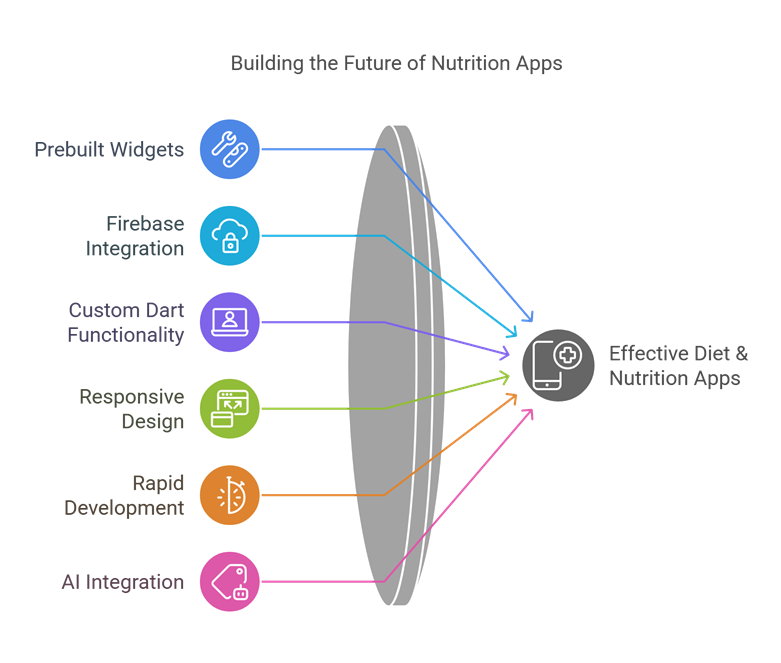
Selecting the appropriate technological environment when developing a diet and nutrition application is equally important as selecting the correct features for the application, especially within Diet & Nutrition App Development in Australia. The platform selected should provide rapid development of the application, scalability of the application, data security of the application, and a user-friendly interface across all devices. It is at this point that FlutterFlow is emerging as a highly capable and future-ready solution for diet and nutrition application development in Australia, aligning well with modern app development trends in Australia. Combining the flexibility of Flutter with the speed of low-code development, FlutterFlow app development in Australia provides businesses the ability to develop and deploy high-quality health applications rapidly and economically.
3.1 Low Code & Rapid Development
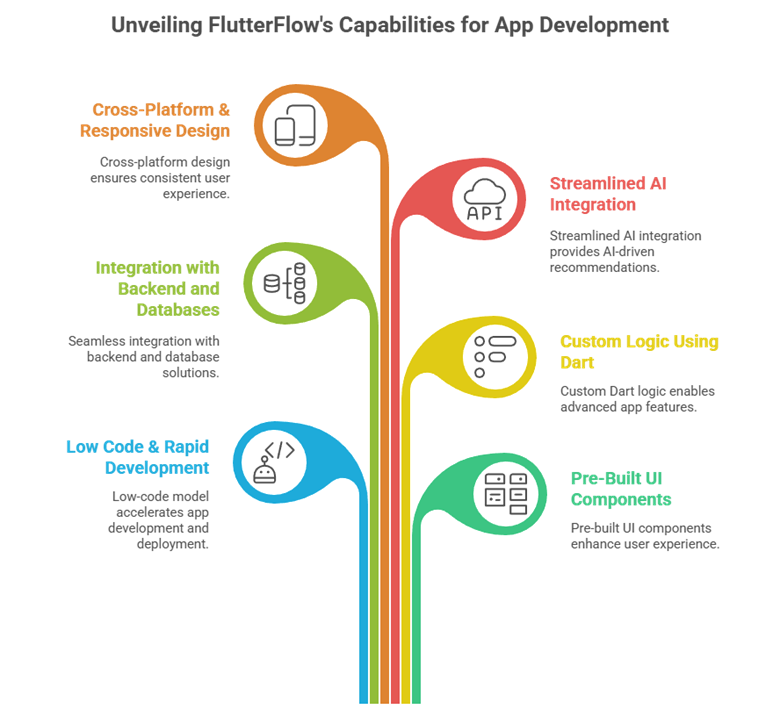
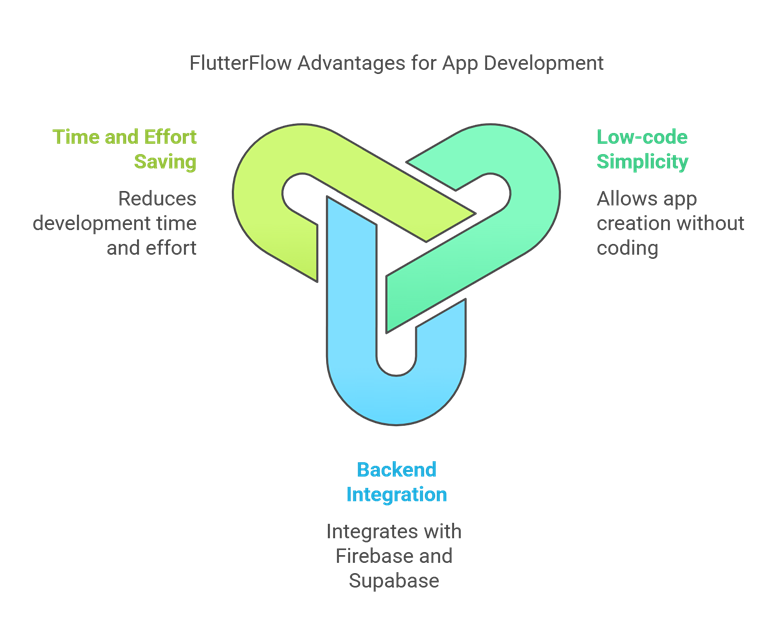
A significant advantage of FlutterFlow is its low-code development model, which greatly shortens the amount of time needed to develop and deploy applications. Rather than requiring developers to write every line of code manually, developers can visually construct screens, workflows, and logic to expedite the entire development process.
Australian startup and business companies will benefit from this by having a quicker route to market – a vital element in the very competitive health and fitness industry, and one of the key app development trends in Australia. With the ability to create and deploy MVPs (Minimum Viable Products) rapidly, Australian companies can receive genuine user feedback and make iterative changes to the application without the need to bear a large amount of technical overhead. In addition to rapid development, FlutterFlow will lower development costs by reducing the amount of manual coding needed, making FlutterFlow app development in Australia an excellent choice for companies seeking to develop and implement robust nutrition applications within a defined budget.
3.2 Pre-Built UI Components for Health Applications
In order to provide a successful diet and nutrition application, user experience is one of the most important factors. Users interact with these types of applications every day; it is essential to have clarity, simplicity, and visual appeal to the user interface. FlutterFlow has a vast array of pre-built UI components designed specifically for creating clean and simple interfaces for health-focused use cases, supporting evolving health and nutrition app development trends in Australia.
With FlutterFlow, developers can create clean dashboards to show users calories consumed, macronutrient consumption, water intake, and progress reports in seconds. Custom UI components for food logging and tracking make it effortless for users to log their food. Charts and other graphics for tracking user progress are available in FlutterFlow, enabling users to clearly see patterns, successes, and failures over time. All of these design features enable developers to create user experiences that encourage continued user engagement, a critical factor in Diet & Nutrition App Development in Australia.
3.3 Integration with Backend and Databases
Applications developed for diet and nutrition rely heavily on data, including user profile information and dietary preferences, food logs, and health metrics. FlutterFlow easily integrates with current backend and database solutions like Firebase, Supabase, and Xano, providing developers a way to securely and scaleably manage data.
Integrating with backends and databases, developers can easily accomplish user authentication, real-time updating, cloud storage, and API driven features. Securely managing user and health data is crucial for health-related applications. FlutterFlow supports best practices for securely handling data and enables developers to build applications that prioritize user data, reliability, and performance — key considerations influenced by health and nutrition app development trends in Australia.
3.4 Custom Logic Using Dart
Although FlutterFlow simplifies development using low-code tools, it doesn't restrict developers' flexibility. Developers can extend the functionality of their application using custom Dart logic and can implement advanced features specific to diet and nutrition use cases.
Examples include complex calorie calculations, macronutrient breakdowns, and dynamic nutritional values based on portion size or activity level. Companies can also build custom meal plans that meet users' health goals, dietary restrictions, or health issues. Rule-based nutrition suggestions can also be created to suggest meals based on users' daily intake or activity data and provide a more personalized experience—capabilities that are increasingly expected within Diet & Nutrition App Development in Australia.
3.5 Cross-Platform & Responsive Design
Using FlutterFlow, companies can develop applications for Android, iOS, and Web using a single codebase. FlutterFlow app development in Australia enables companies to maintain a consistent look and feel of their application across all platforms, while also increasing development efficiency. FlutterFlow's responsive design will also allow companies to develop diet and nutrition applications that will function seamlessly across multiple devices and screen sizes, in line with modern app development trends in Australia.
3.6 Streamlined AI Integration
AI is becoming a staple feature in many modern diet and nutrition applications, particularly as part of emerging health and nutrition app development trends in Australia. FlutterFlow provides developers a streamlined path to integrate AI models and APIs to provide users with AI-driven meal recommendations and provide users with better and healthier options.
More advanced use cases, such as image-based food recognition, will allow users to log meals by simply taking a photo of the food they ate. This will increase usability and decrease errors in logging meals. FlutterFlow will also enable developers to create personalized nutrition insights and provide users with actionable recommendations based on user input and evolving user data. Both of these features will enable companies to develop next-generation nutrition applications that differentiate them in the Australian market.
Overall, FlutterFlow provides a unique combination of speed, flexibility, and scalability to build diet and nutrition applications. Its low-code development model, extensive integration capabilities, and support for complex features position FlutterFlow app development in Australia as the ideal strategic choice for companies aiming to succeed in Diet & Nutrition App Development in Australia and compete effectively in the rapidly evolving digital health ecosystem.
4. Core Features of a Diet & Nutrition App
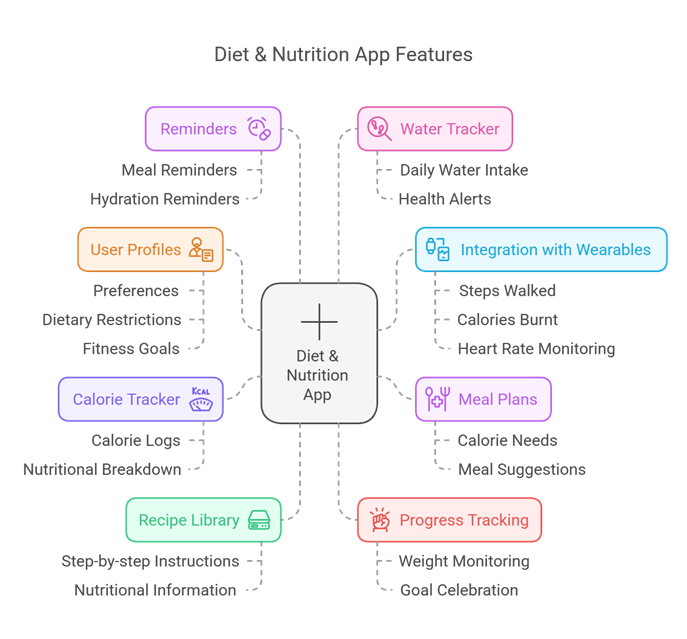
A successful Diet and Nutrition App is developed based on features that provide real value to users and foster long term engagement and measurable results. In the Australian Market, there are user expectations of Apps being intuitive, personalized, and integrated into the broader Health Ecosystem, which strongly reflects current health and nutrition app development trends in Australia. The core features that characterize a High-Performing Diet and Nutrition Application are outlined below, along with some practical examples to illustrate how they add value to the end-user and support Diet & Nutrition App Development in Australia.
4.1 User Profiles and Health Preferences
The User Profile is the backbone of all Diet and Nutrition Applications. The User Profile feature allows the creation of individual user profiles by allowing users to input various types of information about themselves, including but not limited to Age, Weight, Height, Dietary Preferences (Vegetarian, Vegan, Keto) Allergies and Health Goals.
For example, an Australian User who has Diabetes will be able to enter specific Dietary Restrictions and Daily Carb Limits, and therefore the App can tailor the Recommendations based on this Information. As a result of capturing the Users' Preferences from the beginning of the App Experience, the App can provide the User with More Relevant Meal Plans, Calorie Targets, and Reminders, providing a User Centric Experience and More Personalized Recommendations aligned with Diet & Nutrition App Development in Australia.
4.2 Personalized Meal Planning
Personalized Meal Planning is one of the Most Valued Features in Nutrition Apps and a key element of modern health and nutrition app development trends in Australia. The App will generate Meal Plans based on User Goals such as Weight Loss, Muscle Gain, or General Wellness, and Calorie Requirements and Nutritional Balance.
For Example, A Fitness Focused User Will Receive a High-Protein Weekly Meal Plan, whereas Someone Looking to Manage Their Weight Will Receive Balanced Portion Controlled Meals. This Feature Reduces Decision Fatigue and Helps the User Stay Consistent with Their Dietary Goals, Making It Especially Useful for Busy Professionals Across Australia.
4.3 Calorie & Macro Tracker
A Calorie and Macronutrient Tracker Enables the User to Log Their Food Intake and Monitor Calories, Proteins, Fats and Carbohydrates in Real Time. This Feature Increases Awareness and Accountability, Which Are Key Components in Building Habits and are widely adopted across app development trends in Australia.
For Example, After Logging Breakfast and Lunch the App Can Display Remaining Calories and Macros for the Day Helping the User Make Informed Choices for Dinner. Some Apps Can Also Automatically Adjust the Daily Target Based on Activity Levels or Workout Data, Providing a Dynamic and Responsive Nutrition Experience within Diet & Nutrition App Development in Australia.
4.4 Recipe Library & Nutrition Breakdown
A Recipe Library Is Another Feature That Provides Practical Value to Diet and Nutrition Apps by Offering Users Healthy Easy to Prepare Meals. Each Recipe Includes Detailed Nutritional Information Such as Calories, Macros, Vitamins and Portion Sizes.
For Example, If a User Searches for "High-Protein Vegetarian Meals," They Will Be Able to Browse Curated Recipes Including Step-by-Step Instructions and Nutritional Insights. This Feature Encourages Home Cooking, Supports Healthier Eating Habits, and Keeps the User Engaged with Fresh Content, aligning with health and nutrition app development trends in Australia.
4.5 Progress Tracking & Analytics
Tracking Progress Allows Users to Visualize Their Journey Over Time Using Charts, Graphs, and Summaries. Users Can Track Weight Changes, Calorie Consistency, Hydration Levels and Adherence to Meal Plans.
For Example, A Weekly Progress Chart Showing Improved Calorie Balance or Weight Trends Can Motivate Users to Continue on Track. The Analytical Insights Provided to Users Help Them Understand What Is Working and Where Adjustments Need to Be Made, Reinforcing Long-Term Engagement and Trust in the App — a critical success factor in Diet & Nutrition App Development in Australia.
4.6 Reminders & Notifications
Consistency Is Key When Managing Nutrition, and Reminders Play a Critical Role in Reaffirming Healthy Habits. Push Notifications Can Remind Users to Log Meals, Drink Water, or Follow Meal Plans at Scheduled Times.
For Example, A Lunchtime Reminder Can Prompt Users to Log Their Meal Whereas an Evening Notification Can Remind Users to Hydrate or Prepare Meals for the Next Day. These Timely Nudges Can Keep Users Engaged Without Feeling Overwhelmed, and are commonly seen across app development trends in Australia.
4.7 Water Intake Tracker
Tracking Hydration Is a Simple Yet Powerful Feature That Complements Nutrition Management. Users Can Log Their Daily Water Intake and Receive Reminders to Stay Hydrated Throughout the Day.
For Example, The App May Recommend a Daily Water Goal Based on Body Weight and Activity Level and Show Users Progress Using Visual Indicators. This Feature Supports Overall Wellness and Is Particularly Beneficial for Fitness Enthusiasts and Active Users, reinforcing health and nutrition app development trends in Australia.
4.8 Wearable & Health API Integration
Integrating Wearable Devices and Health Platforms Enhances the Accuracy and Value of Diet and Nutrition Apps. By connecting to Apple Health, Google Fit, or Fitbit, the App Can Sync Activity Data, Calorie Burn, and Heart Rate Data Automatically — a growing requirement within Diet & Nutrition App Development in Australia.
For Instance, If a User Completes a Workout Tracked Via a Smartwatch, the App Can Automatically Update the User's Daily Calorie Requirements. This Seamless Flow of Data Creates a Holistic View of the User's Health and Allows for More Accurate and Personalized Nutrition Recommendations, aligned with evolving health and nutrition app development trends in Australia.
Together, These Core Features Create a Comprehensive and User-Friendly Diet and Nutrition App That Aligns with Modern Expectations of Health in Australia. By focusing on Personalization, Data Driven Insights, and Seamless Integration with Other Health and Wearable Systems, Businesses Can Develop Meaningful Digital Health Experiences That Support Engagement and Long-Term Success while staying aligned with app development trends in Australia.
5. How to Build a Diet & Nutrition App Using FlutterFlow
Building a diet and nutrition app requires a structured approach that balances user needs, business goals, and technical scalability, especially within Diet & Nutrition App Development in Australia. FlutterFlow simplifies this journey by offering a low-code environment that accelerates development without compromising quality. Below is a step-by-step guide to building a diet & nutrition app using FlutterFlow, tailored for the Australian market and aligned with modern app development trends in Australia.
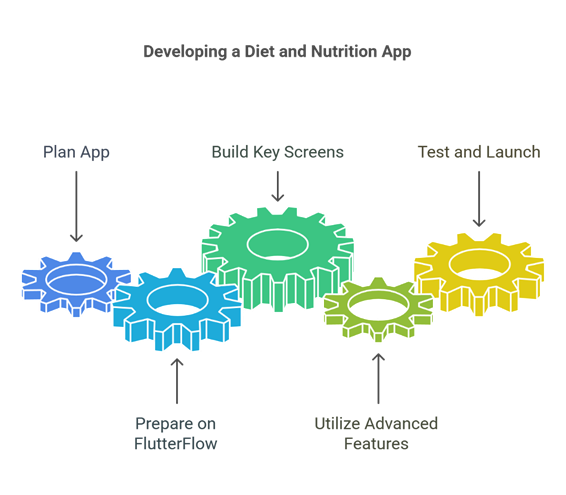
Step 1: Define App Goals & Target Audience
The first and most critical step is to define the purpose of your app and identify the target audience. A clear vision helps shape features, user experience, and monetization strategies—key foundations of successful diet and nutrition app development in Australia.
Diet and nutrition apps can cater to different user groups, such as:
• Fitness users seeking calorie tracking, meal planning, and performance nutrition
• Dieticians and nutritionists looking to scale personalized guidance digitally
• Gyms and fitness centers offering branded nutrition solutions to members
• Startups and health brands launching innovative digital wellness products
For example, an app designed for gyms may focus on high-protein meal plans and wearable integration, while one aimed at dieticians may prioritize client management and personalized recommendations. Defining these goals early ensures that development remains focused and efficient while staying aligned with health and nutrition app development trends in Australia.
Step 2: Set Up the FlutterFlow Project
Once the app’s goals are clear, the next step is setting up the project in FlutterFlow. This phase establishes the technical foundation of the application and is a key stage in FlutterFlow app development in Australia.
• Authentication:
Implement secure sign-up and login using email, phone number, or social login options. FlutterFlow integrates easily with authentication providers such as Firebase, enabling safe and seamless user access.
• Database Structure:
Design a structured database to store user profiles, meal logs, recipes, and progress data. Proper data modeling ensures scalability and smooth app performance as the user base grows—an important consideration within Diet & Nutrition App Development in Australia.
• API Connections:
Connect external APIs for nutrition databases, wearable devices, or AI services. This allows the app to fetch real-time food data, sync activity metrics, and support advanced features aligned with health and nutrition app development trends in Australia.
This setup phase ensures that the app is ready to handle real-world usage from day one.
Step 3: Build Core Screens
With the backend in place, development moves to designing and building the core screens that users interact with daily.
• Sign-Up / Login Screen:
Create a clean and simple onboarding flow that reduces friction and encourages user registration.
• Dashboard:
Design a central dashboard displaying key metrics such as daily calories, macros, water intake, and progress summaries.
• Food Logging Screen:
Enable users to log meals easily using search, barcode scanning, or manual entry.
• Meal Planner:
Provide users with daily or weekly meal plans aligned with their health goals.
• Recipe Library:
Offer a searchable collection of recipes with nutritional breakdowns and preparation steps.
FlutterFlow’s visual builder and prebuilt widgets make it easy to design these screens with consistency and usability in mind, reinforcing the benefits of FlutterFlow app development in Australia.
Step 4: Integrate Advanced Features
After building the core functionality, advanced features can be integrated to enhance user engagement and personalization, in line with emerging health and nutrition app development trends in Australia.
• Push Notifications:
Remind users to log meals, drink water, or follow meal plans, helping build consistent habits.
• AI-Based Recommendations:
Use AI to suggest meals, adjust calorie goals, or provide personalized nutrition insights based on user behavior.
• Wearables Integration:
Connect with platforms like Apple Health, Google Fit, or Fitbit to sync activity data and improve accuracy.
These features differentiate the app and deliver a more intelligent, connected user experience while supporting scalable Diet & Nutrition App Development in Australia.
Step 5: Testing, Deployment & Launch
Before launching, thorough testing is essential to ensure a smooth user experience. Test functionality, performance, and usability across devices and platforms.
Prepare the app for App Store and Play Store readiness, including compliance with platform guidelines, privacy policies, and performance requirements. Once approved, the app can be launched and monitored for user feedback and continuous improvement.
By following these steps, businesses can efficiently build and launch a scalable diet and nutrition app using FlutterFlow app development in Australia, positioning themselves for success in Australia’s growing digital health market and staying aligned with long-term app development trends in Australia.
6. Advantages of Building a Diet & Nutrition App
The potential of developing a diet and nutrition app has the capacity to positively impact users and businesses, especially within Diet & Nutrition App Development in Australia. In a culture as health-conscious as Australia's, the trend towards digital wellness has taken on a much larger role in everyday life and closely follows emerging health and nutrition app development trends in Australia. While apps have evolved into being optional aids toward supporting a healthier way of living, they now serve as comprehensive platforms to support a healthier way of living and create scalable business opportunities.
Below are some of the key advantages of developing a diet and nutrition app in Australia, aligned with modern app development trends in Australia:
6.1 Encourages healthy eating habits
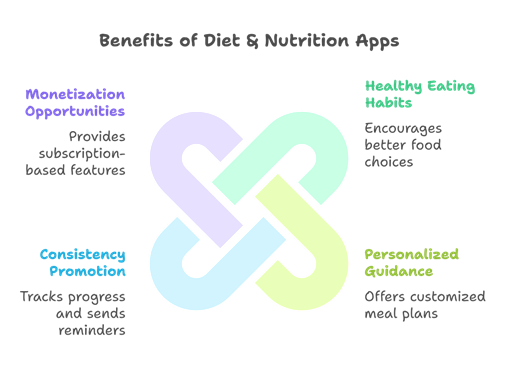
A major advantage of a diet and nutrition app is promoting healthier food choices via awareness and routine. Users can monitor their daily intake of food, calories, and nutrients; therefore, understanding what they consume daily and how it affects their overall health.
Users who log their food and view the nutritional information of each item they eat are able to develop more awareness of their food choices and portion sizes. Over time, users will develop healthier eating habits, achieve a balanced diet, and experience long-term health and wellness changes—outcomes strongly associated with health and nutrition app development trends in Australia.
6.2 Personalized guidance without hiring a nutritionist
While personalized nutrition is highly successful, it is typically costly and inaccessible to most users. Developing a diet and nutrition app provides the opportunity for users to access high-quality, personalized guidance at scale as part of Diet & Nutrition App Development in Australia.
Using user profiles, objectives, and preferences, a diet and nutrition app can provide users with meal plan options, calorie targets, and dietary modifications based on these characteristics. For example, a user trying to lose weight can be given meal plans with portion-controlled foods, while an active user can be given meal plans that focus on protein. The amount of customization provided by a diet and nutrition app would provide similar benefits of hiring a registered dietician at a significantly lower cost than hiring a registered dietician. Therefore, diet and nutrition apps will make healthy eating more affordable for a greater population.
6.3 Improves consistency with reminders & progress tracking
One of the largest obstacles to maintaining a healthy diet is consistency. Diet and nutrition apps help users maintain a healthy diet by providing reminders, notifications, and progress tracking to help users remain accountable and motivated—features that are now standard across app development trends in Australia.
Reminders and notifications prompt users to record their food intake, drink water, and adhere to their meal plans. Providing users with visual representations of their progress (e.g., calorie balance, hydration levels) provides motivation and demonstrates that their efforts are yielding results. Demonstrating to users that they are consistently meeting their health-related goals will encourage users to continue working toward those same goals, reinforcing health and nutrition app development trends in Australia.
6.4 Scalable business model
Developing a diet and nutrition app creates a scalable digital business model. Upon the initial development of a diet and nutrition app, the app can support an increasing number of users with minimal increases in operational costs—an important advantage of Diet & Nutrition App Development in Australia.
Companies can create subscription-based models, provide premium content, or use artificial intelligence (AI) to create recommendations to generate recurring income. Companies can also continually update and add new features to a diet and nutrition app to meet the changing needs of users. The scalability of a diet and nutrition app creates a compelling reason for companies to invest in developing an app for long-term success, in line with app development trends in Australia.
6.5 Ideal for fitness startups & health brands
Diet and nutrition apps create a tremendous opportunity for fitness startups, gyms, registered dietitians, and health-focused brands to create a strong online presence. A diet and nutrition app enables companies to directly connect with customers, foster customer loyalty, and deliver additional services outside of brick-and-mortar stores and/or individual consultation services—key benefits within Diet & Nutrition App Development in Australia.
Fitness companies can utilize a branded diet and nutrition app along with a fitness program to create a total wellness solution for customers. This integration between services creates stronger relationships with customers and sets the company apart from other competitors in a crowded marketplace, while remaining aligned with health and nutrition app development trends in Australia.
In conclusion, developing a diet and nutrition app creates clear benefits for both the health and wellness of users and the financial viability of businesses. With the right strategy and technology, diet and nutrition apps can become leading digital solutions in Australia's rapidly developing digital health landscape, while staying aligned with long-term app development trends in Australia.
7. Monetization Strategies for Diet & Nutrition Apps
Revenue models are critical to the long-term success of a diet and nutrition app; revenue models ensure that a diet and nutrition app is sustainable over time and supports the growth of the app. While user engagement, health outcomes, and monetization strategies are all important elements of a successful diet and nutrition app, the most important element is a diversified revenue strategy—especially for businesses focused on Diet & Nutrition App Development in Australia.
Australia’s growing digital health market provides a great opportunity for diet and nutrition apps to monetize through multiple revenue streams that can be targeted at individual consumers, businesses, and professionals. These opportunities align closely with current health and nutrition app development trends in Australia and broader app development trends in Australia. Below are the most effective monetization strategies used by successful nutrition apps.
7.1 Subscription-Based Revenue Models
Subscription-based revenue models are one of the most popular and stable revenue streams for monetizing diet and nutrition apps developed as part of Diet & Nutrition App Development in Australia initiatives. A subscription provides users with a recurring month-to-month or year-to-year payment model for access to core features, including personalized meal planning, food diary tracking, and progress metrics.
For example, a free version may provide limited food diary logging and general insights, while a paid subscription will unlock more advanced meal planning, AI-driven recommendations, wearable integrations, etc. This type of model creates predictable recurring revenue and encourages users to continue using your app over the long term, which makes it ideal for health-focused applications where continuous usage is common—particularly those built using FlutterFlow app development in Australia.
7.2 Premium Features and In-App Purchases
In-app purchases enable users to purchase features or content within your app without having to commit to a full subscription. This provides a great deal of flexibility for users to purchase specific upgrades based on their own needs and reflects evolving app development trends in Australia.
Some examples include one-time purchases for personalized diet plans, premium recipe packs, advanced analytics dashboards, etc. Some apps also have the option to purchase a short-term premium pass for users who want the premium features available for a specified period of time, for example, during a weight loss program or training cycle. This allows you to maximize your revenue potential while providing users with control over how much they spend.
7.3 Affiliate Marketing (Supplements, Fitness Equipment, Healthy Food Products)
Affiliate marketing is a very effective monetization strategy for diet and nutrition apps, especially since it aligns so well with the types of services that these apps provide within health and nutrition app development trends in Australia. Partnering with brands that manufacture supplements, fitness equipment, and healthy foods allows you to earn a commission on sales generated through the promotion of these products through your app.
An example of this would be when a user views a protein-focused meal plan, the app could suggest relevant supplements or healthy food options along with affiliate links. Affiliate marketing adds value to the user experience by promoting relevant products while allowing you to generate passive income through the sale of those products. It is crucial to maintain transparency and relevance to avoid losing user trust when utilizing affiliate marketing.
7.4 Business-To-Business Licensing for Gyms & Dieticians
Business-to-business licensing is a very effective monetization strategy, but it is often underutilized in Diet & Nutrition App Development in Australia. Diet and nutrition apps can be licensed to gyms, fitness studios, dieticians, and wellness clinics as either a branded or white-labeled version of the app.
For example, a gym may license a branded version of a diet and nutrition app to its members as part of a premium membership package, while dieticians can use the platform to digitally manage all of their clients. This model generates high-value contracts that allow you to reduce your dependence on individual users, while at the same time scaling up your growth through partnerships with professionals—an approach commonly supported by scalable solutions built via FlutterFlow app development in Australia.
By combining these monetization strategies, companies can develop a diversified revenue model that supports both user satisfaction and long-term profitability. What monetization strategy combination is right for your company depends on who your target audience is, what your goals are with your app, and ultimately, how you want to grow your business. When implemented correctly, diet and nutrition apps can become highly profitable and sustainable digital health products in Australia.
8. Why Choose FlutterFlowDevs for Diet & Nutrition App Development in Australia?
To succeed in a rapidly changing and highly competitive Australian marketplace, selecting a suitable development partner is essential when developing a diet and nutrition application as part of Diet & Nutrition App Development in Australia. The combined technical expertise, experience in the health and fitness space, and results-driven methodology of FlutterFlowDevs enable companies to develop high-quality, scalable, and user-centered applications to meet their business needs. Below outlines why FlutterFlowDevs is an ideal choice as a trusted partner to provide diet and nutrition app development services in Australia, aligned with current health and nutrition app development trends in Australia.
8.1 Established Expertise in FlutterFlow Development
As a company specializing in FlutterFlow app development in Australia, FlutterFlowDevs utilizes the full range of the platform's benefits to create reliable, cross-platform applications. With extensive low-code and no-code development experience, the team understands how to achieve a balance between developing rapidly and meeting custom functional needs. This creates an environment where your diet and nutrition app will be developed efficiently, yet will be capable of scaling and adapting to your growing business in line with modern app development trends in Australia.
Through utilizing FlutterFlow's visual development tools and custom Dart logic, FlutterFlowDevs is able to create applications that are both flexible and maintainable, yet prepared for the future.
8.2 Comprehensive Experience Developing Health & Fitness Apps
Developing diet and nutrition apps requires an acute awareness of health and fitness-based user behaviors and how users interact with health-focused data workflows. Through years of providing health and fitness-based application development services within Diet & Nutrition App Development in Australia, FlutterFlowDevs has the required domain experience to understand the characteristics of successful features within the context of real-world wellness use cases.
Whether it be calorie tracking, meal planning, integration with wearables, or displaying a user's progression, FlutterFlowDevs understands what contributes to a successful and engaging nutrition application. This experience in creating health and fitness apps assists in reducing risk, improving usability, and accelerating product-market fit while keeping pace with health and nutrition app development trends in Australia.
8.3 Designing Secure & Scalable Architectures
In addition to being effective and engaging, health-related applications need to be both secure and scalable in regard to handling sensitive user data. FlutterFlowDevs develops applications with scalable, secure architectures that can adapt to growth, while maintaining data integrity and user privacy—an essential requirement in app development trends in Australia.
FlutterFlowDevs incorporates multiple back-end solutions, including Firebase, Supabase, and Xano, to enable secure user authentication, data storage, and real-time updates. As your user base expands, the app will remain stable, scalable, and adhere to best practices for digital health platforms in Australia.
8.4 Faster Application Deployment at Reduced Costs
Another significant advantage of working with FlutterFlowDevs is its ability to deliver high-quality apps in less time than other application development methods, at a reduced cost. Due to the low-code nature of FlutterFlow and expertise in FlutterFlow app development in Australia, the development cycle is significantly shortened while maintaining the same level of quality that is produced during a traditional development process.
This increased velocity of delivery allows start-ups, fitness companies, and health companies in Australia to deploy applications faster, test their ideas quicker, and utilize their budget more effectively, without sacrificing on quality or performance.
8.5 Long-Term Ongoing Support & Maintenance
While launching the application represents a milestone for many businesses, this typically represents only the beginning of the relationship with FlutterFlowDevs. FlutterFlowDevs provides ongoing support and maintenance to ensure that your diet and nutrition application will continue to operate smoothly post-launch as part of long-term Diet & Nutrition App Development in Australia strategies.
FlutterFlowDevs offers a wide variety of ongoing support and maintenance options, including feature enhancement and performance optimization, security updates, and scalability improvements. The team will act as a long-term technology partner to ensure that your application will continue to meet the needs of your users, the changes in the market, and the emerging digital health requirements.
With a focus on quality, speed, and scalability, FlutterFlowDevs empowers businesses to take their diet and nutrition application ideas and transform them into successful digital products. Through the combination of FlutterFlow expertise with health and fitness industry insights and leadership in FlutterFlow app development in Australia, FlutterFlowDevs is well-positioned to assist you in developing impactful and future-proof diet and nutrition applications for the Australian market.
9. Conclusion
Demand for diet and nutrition apps is growing in Australia, as users, businesses, and health providers increasingly embrace digital solutions for healthy living. As part of the rapid growth in Diet & Nutrition App Development in Australia, modern nutrition apps now provide a wide range of features, including personalized meal planning, calorie tracking, wearable integrations, and AI-based data analytics. These capabilities support preventive care, accountability, and long-term health and wellness. For businesses, nutrition apps are more than just health platforms—they are scalable digital products that deliver high engagement and recurring revenue opportunities in line with emerging health and nutrition app development trends in Australia.
FlutterFlow has become one of the most innovative technologies for diet and nutrition app development in Australia, enabling faster development timelines, reduced costs, and seamless cross-platform deployment without compromising performance or flexibility. The low-code development process offered by FlutterFlow allows startups to rapidly launch MVPs, fitness companies to build innovative wellness solutions, and health professionals to digitize their services efficiently. These applications can be seamlessly integrated with backend systems, advanced business logic, AI-driven insights, and wearable devices—making FlutterFlow a future-ready choice aligned with current app development trends in Australia.
Choosing the right development partner further amplifies the benefits of FlutterFlow. By leveraging expert FlutterFlow app development in Australia, businesses can build secure, user-friendly, and scalable diet and nutrition apps that meet the high expectations of today’s health-conscious Australian consumers. Whether you are a startup validating a new idea, a gym aiming to improve member engagement, or a healthcare provider expanding your digital footprint, there has never been a better time to invest in Diet & Nutrition App Development in Australia.
Investing in a FlutterFlow-powered diet and nutrition app positions your business for long-term success in a market driven by wellness, personalization, and digital convenience. By combining a clear strategy, modern technology, and expert implementation, businesses can deliver meaningful value to users while creating profitable and sustainable digital health products for Australia’s evolving health ecosystem.


View more blogs


.png)
.png)
.png)

.png)
.png)
.png)

%20(1).png)
Ready to develop your own product? Get in touch today!
Get in Touch
