

.png)

.png)


1. Introduction
Home services is one of those industries that changed quietly.
People didn't wake up one day and decide they wanted apps for plumbing, cleaning, appliance repair, or electrical work. They simply got used to convenience everywhere else. Food delivery became easier. Transportation became easier. Booking a hotel became easier.
Naturally, expectations changed.
This shift has also created opportunities for platforms like Homezy. As an on demand home services app template, Homezy is designed for businesses looking to enter the growing home services market without starting from scratch.
When something breaks at home, most people don't want to spend an hour searching for providers, comparing options, and making calls. They want to find someone reliable, choose a suitable time, and get the job done.
That's why businesses continue to invest in clone apps like urban company.
The opportunity is straightforward, but building the platform behind it is a different challenge. Customer management, provider onboarding, booking workflows, payments, reviews, notifications, and daily operations all need to work together from day one.
Rather than developing an urban company clone script feature by feature, businesses can start with a platform that already supports customer, provider, and admin experiences. Combined with the flexibility expected from modern white label mobile apps, Homezy provides a practical foundation for launching and growing a home services marketplace.
2. Why Are Clone Apps Like Urban Company Becoming So Popular?
There's a reason people rarely keep a plumber's number saved anymore.
Not because home services have become less important.
Because finding a service professional has become easier than remembering one.
A customer needs help, opens an app, checks a few profiles, reads reviews, books a time slot, and moves on. The process feels normal today, but ten years ago it would have sounded surprisingly convenient.
2.1 Customer Expectations Have Changed
That's what makes the rise of clone apps like urban company interesting.
The technology itself isn't new. Online marketplaces have existed for years.
What changed was customer behavior.
People became comfortable managing everyday tasks through apps, and eventually the same expectation reached home services. Customers now expect convenience, transparency, and quick access to trusted professionals.
The opportunity created by that shift is difficult to ignore.
2.2 The Marketplace Model Solves a Real Problem
Every city has electricians, cleaners, painters, appliance technicians, and dozens of other professionals looking for customers.
At the same time, customers are looking for trusted providers.
A marketplace simply brings both groups together more efficiently.
That's why entrepreneurs continue exploring clone apps like urban company across different regions and service categories. The model removes friction from both sides of the transaction and creates a better experience for everyone involved.
2.3 The Challenge Is Bigger Than Bookings
At first glance, the idea seems straightforward.
A customer books a service.
A provider accepts the request.
The job gets completed.
But the business model becomes much more complicated once development begins.
Most founders initially focus on bookings. Then they realize customers need profiles, reviews, notifications, payments, booking history, and support. Providers need availability management, service pricing, earnings tracking, and communication tools. Administrators need oversight across the entire platform.
Suddenly, the project is no longer a booking application.
It's an ecosystem.
2.4 Why Businesses Explore Ready-Made Solutions
This is one reason businesses increasingly evaluate an on demand home services app template before committing to custom development.
A modern on demand home services app template already includes many of the workflows that marketplaces depend on every day. Instead of spending months rebuilding common functionality, businesses can focus on launching, acquiring providers, and serving customers.
For many founders, that becomes a much more practical approach than starting from an empty codebase.
2.5 The Rise of White Label Mobile Apps
The same trend can be seen in the growing adoption of white label mobile apps.
Businesses want faster launches, but they don't want to sacrifice flexibility.
Modern white label mobile apps help bridge that gap by providing a foundation that can still be customized around a specific brand, business model, or market. This balance between speed and ownership is one reason marketplace businesses continue adopting them.
2.6 Why Homezy Fits This Shift
Homezy was built around that reality.
Instead of approaching the problem as another urban company clone script, the goal was to create a platform capable of supporting the operational side of a home services marketplace from day one.
For businesses evaluating clone apps like urban company, that means spending less time rebuilding common functionality and more time focusing on providers, customers, and growth.
Because the challenge isn't proving that customers want the service.
The challenge is launching before the opportunity passes by.
3. Why We Built Homezy
After seeing the complexity behind a modern home services marketplace, a natural question comes up.
If businesses already understand the opportunity, why does launching a platform still take so much time?
The answer is simple.
Most companies are not building an app.
They are building an entire ecosystem.
Customers expect a smooth booking experience. Service providers expect tools that help them manage their work efficiently. Administrators need complete visibility into operations. What starts as an idea for clone apps like urban company quickly expands into provider management, booking workflows, payments, notifications, reviews, analytics, and support systems.
This is where many businesses get stuck.
They begin planning clone apps like urban company only to realize that every feature introduces additional development, testing, and maintenance requirements. Building reliable clone apps like urban company requires much more than creating screens and forms. The challenge is ensuring everything works together seamlessly from day one.
That's exactly why we built Homezy.
We noticed that businesses were repeatedly spending months rebuilding the same marketplace infrastructure. Instead of focusing on customer acquisition and growth, teams were dedicating resources to creating a new urban company clone script every time a marketplace idea emerged. The goal was rarely innovation. Most companies simply needed a functional urban company clone script capable of supporting real marketplace operations.
Homezy was designed to provide a better starting point.
As an on demand home services app template, it includes the core workflows required to launch and manage a service marketplace. Rather than developing an urban company clone script feature by feature, businesses can begin with an on demand home services app template that already supports customer, provider, and admin experiences. For many founders, an on demand home services app template significantly reduces the time required to move from concept to launch.
Flexibility was another major priority during development.
Many people assume templates limit customization. Modern white label mobile apps prove the opposite. Businesses want launch speed, but they also want control over branding, services, and customer experiences. The best white label mobile apps provide both. Homezy follows the same philosophy by giving businesses the freedom expected from white label mobile apps while reducing the complexity associated with building everything from scratch.
Ultimately, Homezy was created for businesses that want to launch clone apps like urban company faster, avoid rebuilding another urban company clone script, benefit from an on demand home services app template, and leverage the flexibility that has made white label mobile apps increasingly popular among modern marketplace businesses.
4. Why Businesses Choose Homezy Instead of Building From Scratch
Every marketplace starts with a simple idea.
Connect customers with service providers.
That's usually the easy part.
The difficult part begins when businesses start mapping everything required to make that idea work in the real world.
4.1 The Marketplace Is Bigger Than It First Appears
A customer needs to discover services.
A provider needs to manage availability.
Bookings need confirmations.
Payments need processing.
Reviews need moderation.
Notifications need delivery.
Support requests need handling.
Before long, what looked like a straightforward project starts expanding into dozens of interconnected systems.
This is often where development timelines begin to grow.
Many businesses exploring clone apps like urban company initially assume they need a booking system and a mobile application. A few planning sessions later, they realize the platform also requires provider onboarding, booking management, payment workflows, communication tools, analytics, customer support systems, and administrative controls.
4.2 Development Complexity Grows Faster Than Expected
Building all of these components independently takes time.
A lot of time.
Every new feature introduces additional planning, development, testing, and maintenance requirements. What starts as a small project can quickly become a large-scale marketplace platform.
That is one reason demand for clone apps like urban company continues increasing. Businesses already understand the marketplace model. What they need is a faster path to execution.
The challenge isn't validating the idea.
The challenge is building everything required to support it.
4.3 Why Businesses Turn to Ready-Made Foundations
This is where an on demand home services app template becomes valuable.
Instead of spending months creating common marketplace functionality, businesses can start with an on demand home services app template that already includes the operational foundation required to support customers, providers, and administrators.
A well-structured on demand home services app template reduces development effort while allowing teams to focus on business growth rather than rebuilding standard workflows.
For many entrepreneurs, that shift in focus becomes one of the biggest advantages.
4.4 The Growing Appeal of White Label Solutions
The same trend can be seen in the growing popularity of white label mobile apps.
Companies want launch speed, but they also want ownership over their platform.
Modern white label mobile apps provide that balance by allowing businesses to customize branding, services, and customer experiences without starting from zero.
This flexibility is one reason white label mobile apps have become increasingly attractive for marketplace businesses. They help reduce development timelines while still giving companies the freedom to build a unique brand.
4.5 Why Homezy Was Built
Homezy was built around these realities.
Rather than approaching the market with another basic urban company clone script, the goal was to provide businesses with a practical launch foundation.
Many companies evaluating an urban company clone script eventually discover that development isn't their biggest challenge. Launching, acquiring customers, onboarding providers, and scaling operations are where long-term success is determined.
That's why speed matters.
Every month spent developing common marketplace functionality is a month not spent learning from customers, improving services, or growing the business.
4.6 Reaching the Market Faster Creates an Advantage
Businesses using clone apps like urban company often gain their biggest advantage not from technology, but from reaching the market sooner.
Launching earlier means collecting feedback earlier.
It means understanding customer behavior earlier.
It means improving services earlier.
By combining the efficiency of an on demand home services app template, the flexibility associated with white label mobile apps, and the operational structure expected from a modern urban company clone script, Homezy gives businesses a practical starting point for launching and scaling a home services marketplace.
5. Inside Homezy — Features That Power a Modern Home Services Marketplace
Most home services marketplaces succeed or fail based on one thing.
The experience they create for customers, service providers, and administrators.
Customers want convenience. Providers want efficiency. Businesses want visibility and control. When all three groups can accomplish their goals without friction, the marketplace becomes easier to scale.
That's exactly what Homezy was built to support.
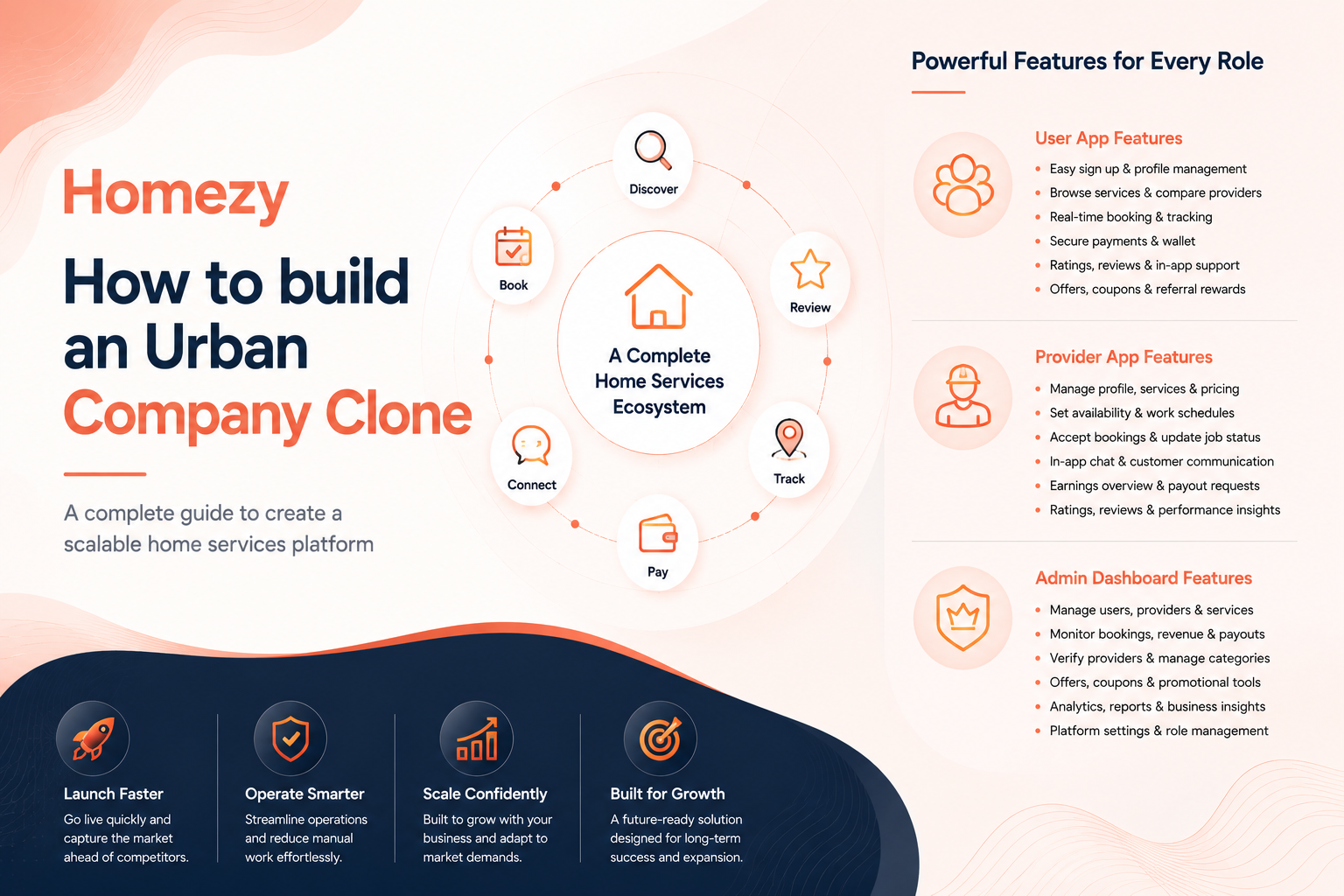
As an on demand home services app template, Homezy combines customer, provider, and admin experiences into a single ecosystem. Businesses evaluating clone apps like urban company often discover that success depends on much more than a booking screen. Every interaction must work together seamlessly.
User App Features
For customers, the platform is designed to make service discovery and booking simple.
- Sign up using phone number, email, or social login
- Create and manage personal profiles
- Save addresses and frequently used locations
- Browse service categories and subcategories
- Search services using filters and discovery tools
- View provider profiles, ratings, reviews, certifications, and portfolio images
- Book services by selecting preferred dates, time slots, and locations
- Communicate with providers through in-app chat and calls
- Make payments using supported payment methods
- Track booking status in real time
- Access booking history
- Submit ratings and reviews after service completion
- Apply offers, coupons, and referral codes
- Receive push notifications for confirmations, reminders, and provider updates
- Access support directly from the application
These customer-facing experiences are one reason businesses continue investing in clone apps like urban company.
Provider App Features
A marketplace only works when service providers can manage their operations efficiently.
Homezy gives providers the tools needed to handle daily workflows without relying on external systems.
- Sign up and create professional profiles
- Add service categories, certifications, and portfolio photos
- Configure pricing and service offerings
- Manage working hours, leave schedules, and availability
- Accept or reject incoming booking requests
- Update job statuses throughout service delivery
- Communicate directly with customers
- Monitor daily, weekly, and monthly earnings
- View payout history
- Submit withdrawal requests
- Track ratings and customer reviews
- Receive notifications for bookings, cancellations, and reminders
- Manage job execution workflows
- Access support when required
These capabilities help transform an urban company clone script from a simple booking platform into a complete service marketplace.
Admin Dashboard Features
Running a marketplace requires visibility across every part of the business.
The Homezy admin dashboard provides centralized control over users, providers, bookings, and platform performance.
- Manage customers and service providers
- View, edit, suspend, or remove accounts
- Verify provider applications and certifications
- Create and manage service categories and subcategories
- Monitor booking activity and disputes
- Track revenue, commissions, and provider payouts
- Create and manage offers and coupons
- Moderate ratings and reviews
- Send push notification broadcasts
- Monitor booking, revenue, and service analytics
- Configure platform settings, branding, policies, and terms
- Review activity logs and audit trails
- Manage support operations
This level of control is one reason many businesses choose an on demand home services app template instead of building from scratch. Rather than developing every workflow individually through an urban company clone script, businesses can start with a proven foundation.
Combined with the flexibility expected from modern white label mobile apps, Homezy provides the structure businesses need to launch, operate, and grow a home services marketplace. For entrepreneurs exploring clone apps like urban company, it offers a practical path to market while retaining the customization advantages associated with white label mobile apps.
6. The Technology Behind Homezy — And Why It Matters
Ask most customers what technology powers the apps they use every day and you'll probably get the same answer.
They don't know.
And they don't need to.
Nobody books a cleaner because an app uses Flutter. Nobody hires an electrician because a platform runs on Supabase. Customers care about something much simpler.
Does everything work when they need it to?
6.1 Technology Becomes Noticeable When It Fails
Think about the last app that frustrated you.
Maybe a payment failed.
Maybe a booking never appeared.
Maybe an important notification arrived too late.
Most people never think about technology when everything works correctly. They only notice it when something breaks.
Home services marketplaces are no different.
A customer books a service.
A provider receives the request.
The booking status changes.
A notification is sent.
A payment is processed.
What appears to be a simple interaction is actually a chain of systems working together behind the scenes.
That's one reason building clone apps like urban company is often far more complex than it initially appears.
6.2 Building for Three Different Audiences
Most applications serve a single audience.
Marketplaces don't.
Customers want a simple booking experience.
Providers need tools for managing availability, jobs, and earnings.
Administrators need visibility into bookings, providers, reviews, and platform activity.
Supporting all three groups simultaneously requires technology that can handle much more than screens and forms.
This is one reason businesses evaluating clone apps like urban company often discover that marketplace development is larger than expected.
6.3 The Foundation Behind Homezy
Homezy was designed around the realities of marketplace businesses.
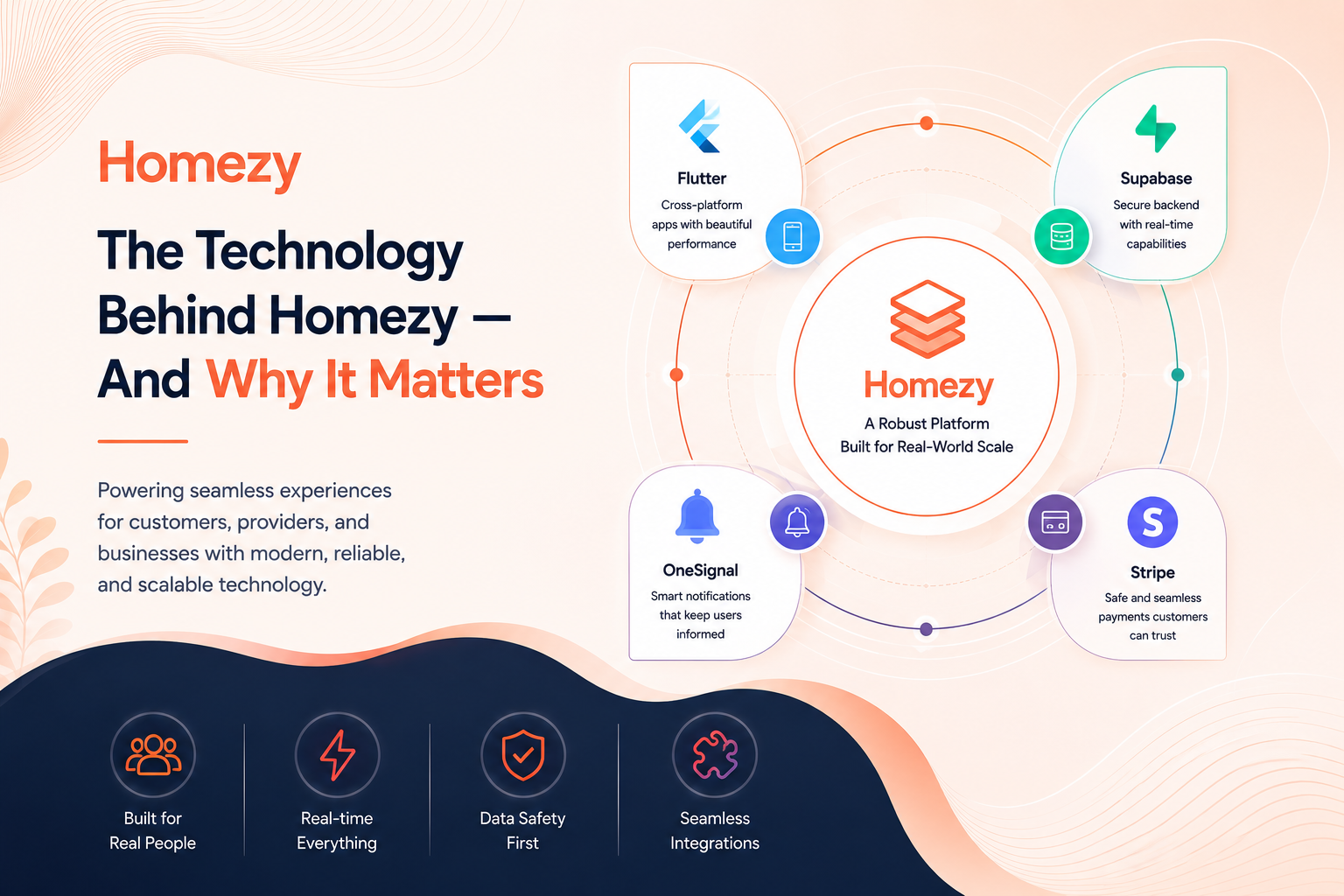
The platform is built using Flutter for the application experience, Supabase for backend operations, OneSignal for notifications, and Stripe for payment processing.
Those choices weren't made because they were trendy.
They were made because marketplace platforms depend on reliability.
As an on demand home services app template, Homezy needs to support customer bookings, provider workflows, administrative operations, notifications, and payments without creating unnecessary complexity for the business running the platform.
6.4 The Systems Most Users Never See
When a customer completes a booking, several things happen immediately.
Booking information is stored.
Provider availability is updated.
Notifications are triggered.
Payment records are created.
Status updates become available.
Most users never see these processes.
But they influence every experience on the platform.
Businesses using an on demand home services app template often discover that these operational systems take a significant amount of time to build from scratch. This is one reason many companies prefer starting with an on demand home services app template rather than recreating marketplace infrastructure independently.
6.5 Small Interactions Create Trust
Trust isn't built through a single feature.
It's built through consistency.
A booking confirmation arriving instantly.
A provider receiving updates on time.
A payment completing without issues.
A reminder appearing before an appointment.
Many successful white label mobile apps focus heavily on these small interactions because they directly influence customer confidence. The same principle applies to modern white label mobile apps operating in the home services industry.
6.6 Technology Should Accelerate Growth
Technology should support business growth, not slow it down.
That's why Homezy combines a structured urban company clone script with a carefully selected technology foundation. Instead of spending months connecting infrastructure, businesses can start with an urban company clone script that already supports real marketplace operations.
For entrepreneurs exploring clone apps like urban company, the advantage isn't simply having access to Flutter, Supabase, OneSignal, and Stripe.
The advantage is having those technologies already working together inside a platform designed to help businesses launch, operate, and scale more efficiently.
7. The Real Cost of Building an Urban Company Clone From Scratch
People often ask how much it costs to build a home services marketplace.
The honest answer?
That depends on what you include in the calculation.
Most founders immediately think about development budgets. Few think about the months spent planning, testing, revising, and waiting before the platform reaches its first customer.
And that's where the conversation becomes more interesting.
7.1 The Meter Starts Running Long Before Launch
Imagine spending six months building a platform.
The apps are progressing.
The designs are approved.
The backend is taking shape.
Everything seems to be moving forward.
The problem is that the business still hasn't launched.
No customers are booking services.
No providers are joining the platform.
No real-world feedback is being collected.
For businesses building clone apps like urban company, this delay often becomes one of the most expensive parts of the entire process.
7.2 Every New Requirement Changes the Timeline
Most marketplace projects start with a simple vision.
Then reality arrives.
Customers need profiles.
Providers need onboarding.
Bookings need tracking.
Payments need processing.
Reviews need moderation.
Notifications need delivery.
Administrators need visibility into everything.
Suddenly, the project is no longer a mobile app.
It's an ecosystem.
This is why many founders underestimate the complexity involved in building clone apps like urban company from the ground up.
7.3 What Businesses Usually Discover Midway Through Development
There is a point in many projects where priorities begin to change.
The original goal was to build technology.
The new goal becomes launching the business.
That's often when teams start evaluating an on demand home services app template. A modern on demand home services app template already includes many of the workflows marketplace businesses depend on every day.
The conversation shifts from "How do we build this?" to "How quickly can we get this into the market?"
7.4 Speed Creates Its Own Advantage
A platform launched today starts learning today.
Customer behavior becomes visible.
Provider activity becomes measurable.
Marketplace trends become easier to understand.
A platform still under development learns none of those things.
This is one reason white label mobile apps continue gaining popularity. Businesses want the flexibility to build their own brand, but they also want the ability to move quickly. Modern white label mobile apps help reduce the gap between idea and execution.
7.5 The Question Most Founders Eventually Ask
At some point, many businesses reach the same question.
"Do we really need to build everything ourselves?"
For some companies, the answer is yes.
For many others, the answer is different.
A structured urban company clone script already provides much of the operational foundation required to launch a marketplace. An established urban company clone script allows businesses to focus on providers, customers, and growth rather than rebuilding common functionality.
7.6 Looking Beyond Development Costs
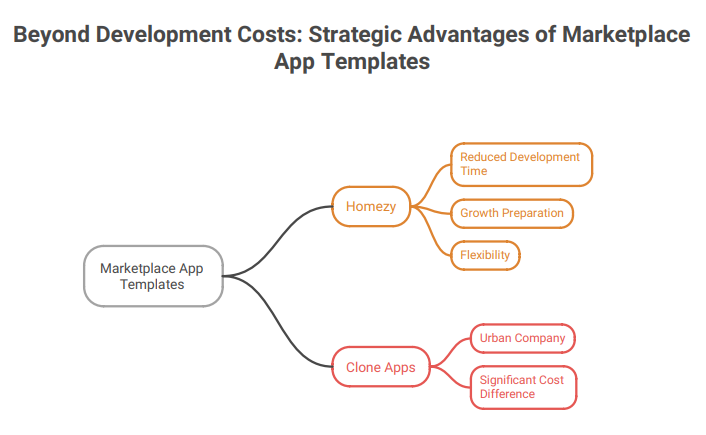
Platforms like Homezy exist because marketplace businesses face the same challenge repeatedly.
As an on demand home services app template, Homezy helps businesses spend less time recreating familiar workflows and more time preparing for growth. Combined with the flexibility expected from modern white label mobile apps, it offers a practical alternative to building every component from scratch.
Ultimately, the biggest cost isn't always development.
Sometimes it's the opportunity lost while development is still happening.
And for businesses exploring clone apps like urban company, that difference can be significant.
8. Launch Is the Beginning, Not the Finish Line
Getting a home services marketplace live feels like a major milestone.
And it is.
But launch day is usually where the real work starts.
Many businesses spend months planning features, refining designs, and preparing operations. Then the platform goes live, customers arrive, providers start signing up, and something interesting happens.
Reality takes over.
8.1 The Market Will Tell You What Matters
Before launch, it's easy to make assumptions.
You might believe appliance repair will become your most popular category. Customers may end up booking cleaning services three times more often. You may expect one city to generate the highest demand only to discover another region grows faster.
This is why many businesses building clone apps like urban company focus on getting into the market sooner rather than waiting for perfection.
Real customers provide better feedback than planning sessions ever can.
8.2 Early Feedback Creates Better Decisions
Every booking generates information.
Every review highlights something customers value.
Every provider interaction reveals operational improvements.
Businesses using an on demand home services app template often gain an advantage because they can begin collecting this feedback earlier. Instead of spending months building common marketplace workflows, they can focus on understanding how customers actually use the platform.
Over time, those insights become one of the most valuable assets a marketplace can have.
8.3 Growth Depends on Providers as Much as Customers
Many founders think growth is primarily a marketing challenge.
In reality, marketplace growth requires balance.
More customers create demand. More providers create supply.
If one side grows significantly faster than the other, the experience begins to suffer. Long wait times, unavailable services, and inconsistent quality can quickly slow momentum.
Successful clone apps like urban company invest heavily in both customer acquisition and provider onboarding because both sides influence marketplace performance.
8.4 Scaling Becomes an Operational Challenge
The first hundred bookings feel exciting.
The first thousand bookings feel different.
Processes that worked during the early stages often require refinement as activity increases. Provider management becomes more important. Customer support volumes increase. Analytics become more valuable. Operational visibility becomes essential.
This is one reason businesses often prefer an urban company clone script that already includes structured workflows. As activity grows, operational consistency becomes increasingly important.
8.5 Speed Creates Opportunities
Every month spent building is a month not spent learning.
That doesn't mean businesses should rush.
It means they should focus on launching with a strong foundation and improving through real-world feedback.
The popularity of white label mobile apps is closely tied to this idea. Businesses want flexibility, but they also want momentum. Modern white label mobile apps help reduce development timelines while still allowing companies to create a marketplace that reflects their brand and business model.
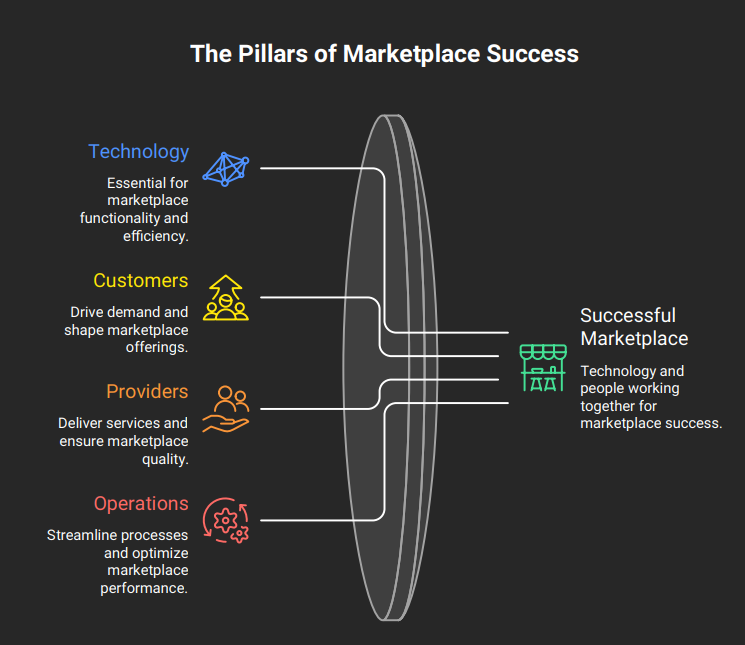
8.6 Building the Business Matters More Than Building Everything
Technology is important.
But technology alone doesn't create a successful marketplace.
Customers do.
Providers do.
Operations do.
Businesses exploring an on demand home services app template are often trying to solve a practical problem: how to spend less time rebuilding common systems and more time growing the business itself.
That's where Homezy fits into the picture.
Instead of approaching the market with another urban company clone script built entirely from scratch, businesses can begin with a foundation designed around real marketplace operations. Combined with the flexibility expected from modern white label mobile apps and the operational structure businesses expect from clone apps like urban company, Homezy helps entrepreneurs focus on what happens after launch—the stage where long-term success is actually determined.
9. Conclusion
The home services industry didn't change because customers suddenly started looking for new services.
The services were already there.
What changed was how people wanted to access them.
Customers became accustomed to convenience in almost every part of their lives. Over time, those expectations reached home services as well. Finding a provider, comparing options, scheduling an appointment, making a payment, and tracking progress through a mobile application now feels completely normal.
That's one reason clone apps like urban company continue attracting attention from entrepreneurs and businesses around the world. The demand already exists. Customers are actively looking for easier ways to connect with trusted professionals, while service providers are looking for more efficient ways to reach customers.
The challenge isn't identifying the opportunity.
The challenge is building the platform required to support it.
Many businesses begin their journey by evaluating clone apps like urban company, only to discover that a marketplace involves much more than a booking workflow. Customer management, provider onboarding, reviews, notifications, payments, analytics, and operational oversight all need to work together seamlessly.
This is where an on demand home services app template can provide a significant advantage. Instead of spending months rebuilding common marketplace functionality, businesses can focus on launching, acquiring providers, and growing their customer base. A modern on demand home services app template reduces development complexity while helping businesses move from concept to execution more efficiently.
The growing popularity of white label mobile apps reflects the same mindset. Businesses want speed, but they also want flexibility. Modern white label mobile apps allow companies to customize branding and customer experiences while avoiding the lengthy timelines often associated with custom development.
Homezy was built around these realities.
Rather than approaching the market with another urban company clone script, the goal was to create a foundation capable of supporting real marketplace operations from day one. Businesses evaluating an urban company clone script often discover that success depends less on building technology and more on launching, learning, and improving over time.
Ultimately, successful clone apps like urban company are not defined by the number of features they include. They are defined by how effectively they connect customers and providers.
For entrepreneurs looking for a faster path to market, the combination of an on demand home services app template, the flexibility associated with white label mobile apps, and the operational structure of a scalable urban company clone script provides a practical starting point for building and growing a modern home services marketplace.
10. FAQ
1 Is an Urban Company Clone Profitable?
Yes. Clone apps like urban company can generate revenue through commissions, service fees, and marketplace transactions.
2 How Long Does It Take to Launch a Home Services App?
Using an on demand home services app template is typically much faster than building a platform from scratch.
3 Can I Add New Service Categories Later?
Yes. A scalable urban company clone script allows businesses to add services as demand grows.
4 Do I Need Separate Apps for Customers and Service Providers?
Yes. Separate experiences help customers and providers manage their activities more efficiently.
5 How Do Payments and Provider Payouts Work?
Customers make payments through the platform, while providers can track earnings and manage payouts.


View more blogs
.png)

.png)
.png)

.png)
.png)
.png)

.png)

Ready to develop your own product? Get in touch today!
Get in Touch
