

.png)

.png)


1. Introduction
Most founders don't realize they're building three products.
The first is for customers.
The second is for sellers.
And the third is for the team running the platform.
That's where marketplace projects become complicated.
A customer wants to discover products, save favorites, apply coupons, track orders, and leave reviews. A seller wants inventory controls, order management, payouts, and visibility into store performance. Meanwhile, the platform owner needs tools to manage users, verify sellers, monitor orders, handle disputes, track revenue, and keep everything running smoothly.
ShopEase was built around this reality.
Instead of treating a marketplace as a simple shopping application, ShopEase brings together a customer app, seller app, and admin dashboard into a single ecosystem. Built with Flutter, Supabase, OneSignal, and Stripe, it gives businesses the core foundation needed to launch an Amazon Clone App without spending months assembling marketplace workflows from scratch.
And that's usually where the challenge begins.
Many businesses start with the goal of creating an Amazon Like App, only to discover that product listings are a small part of the overall system. Seller operations, order management, payments, returns, notifications, analytics, and platform administration often require far more effort than expected. A complete App Marketplace depends on all of these moving parts working together every day.
This growing complexity is one reason demand for ready-made marketplace solutions continues to rise. Rather than building every component independently, businesses often begin with an Amazon Script that already includes the essential infrastructure needed to launch and scale.
In this guide, we'll explore what makes a successful Amazon Clone App, the features users and sellers expect, and how ShopEase helps businesses launch a modern App Marketplace more efficiently.
2. Why Are More Businesses Exploring Marketplace Models Like ShopEase?
Picture this.
You launch an online store with 500 products.
A few months later, sales start growing. Traffic increases. Customers spend more time browsing. Everything looks promising until a new challenge appears.
Customers want more choices.
They want additional brands, more price points, better product comparisons, and larger catalogs. Suddenly, growth is no longer about getting visitors. It's about giving those visitors enough reasons to stay, browse, and buy.
This is where many ecommerce businesses hit a wall.
Every new product requires sourcing. Every new category requires management. Every expansion creates additional operational work. Growth depends entirely on how quickly the business can keep adding inventory and maintaining it.
Now imagine a different model.
Instead of adding products yourself, sellers bring them to your platform. New merchants join, upload products, manage inventory, fulfill orders, and expand the catalog continuously. The marketplace grows because the ecosystem grows.
That's one reason the Amazon Clone App model continues attracting startups and established businesses. A successful Amazon Clone App creates an environment where customers, sellers, and platform owners all benefit from the same growth cycle. Rather than operating as a traditional online store, an Amazon Clone App supports a marketplace ecosystem that can scale far more efficiently.
Customer expectations are another major factor.
Modern shoppers rarely purchase the first product they see. They compare options, evaluate reviews, check seller ratings, and explore alternatives before making a decision. An Amazon Like App naturally supports this behavior because it allows multiple sellers to compete within the same platform. A well-designed Amazon Like App gives customers more choices, while another Amazon Like App advantage is the ability to create a richer shopping experience through product variety and seller competition.
The benefits don't stop with customers.
For sellers, visibility is often the biggest challenge. Building traffic independently can take significant time and investment. An App Marketplace changes that equation by creating a shared environment where buyers are already active. Instead of focusing entirely on attracting visitors, sellers can focus on products, fulfillment, and customer service. As more merchants join, the App Marketplace becomes increasingly valuable. This network effect is one of the strongest advantages of an App Marketplace business model.
This is exactly why solutions like ShopEase are gaining attention.
Many businesses understand the value of marketplace commerce, but building one from scratch can be overwhelming. Seller onboarding, product management, order workflows, payments, commissions, analytics, and administration all need to work together. A modern Amazon Script helps solve that challenge by providing the foundation needed to launch a marketplace faster. Rather than spending months developing infrastructure, businesses can begin with an Amazon Script that already supports core marketplace operations.
ShopEase was built around the same idea.
Instead of functioning as a simple ecommerce application, it brings customers, sellers, and administrators into a single ecosystem. For businesses exploring an Amazon Clone App, ShopEase provides a practical starting point. For founders considering an Amazon Like App, it removes much of the complexity that slows marketplace development. And for companies evaluating an Amazon Clone Script, it offers a ready-made foundation for building a scalable App Marketplace designed for long-term growth.
And that's exactly what we'll explore next.
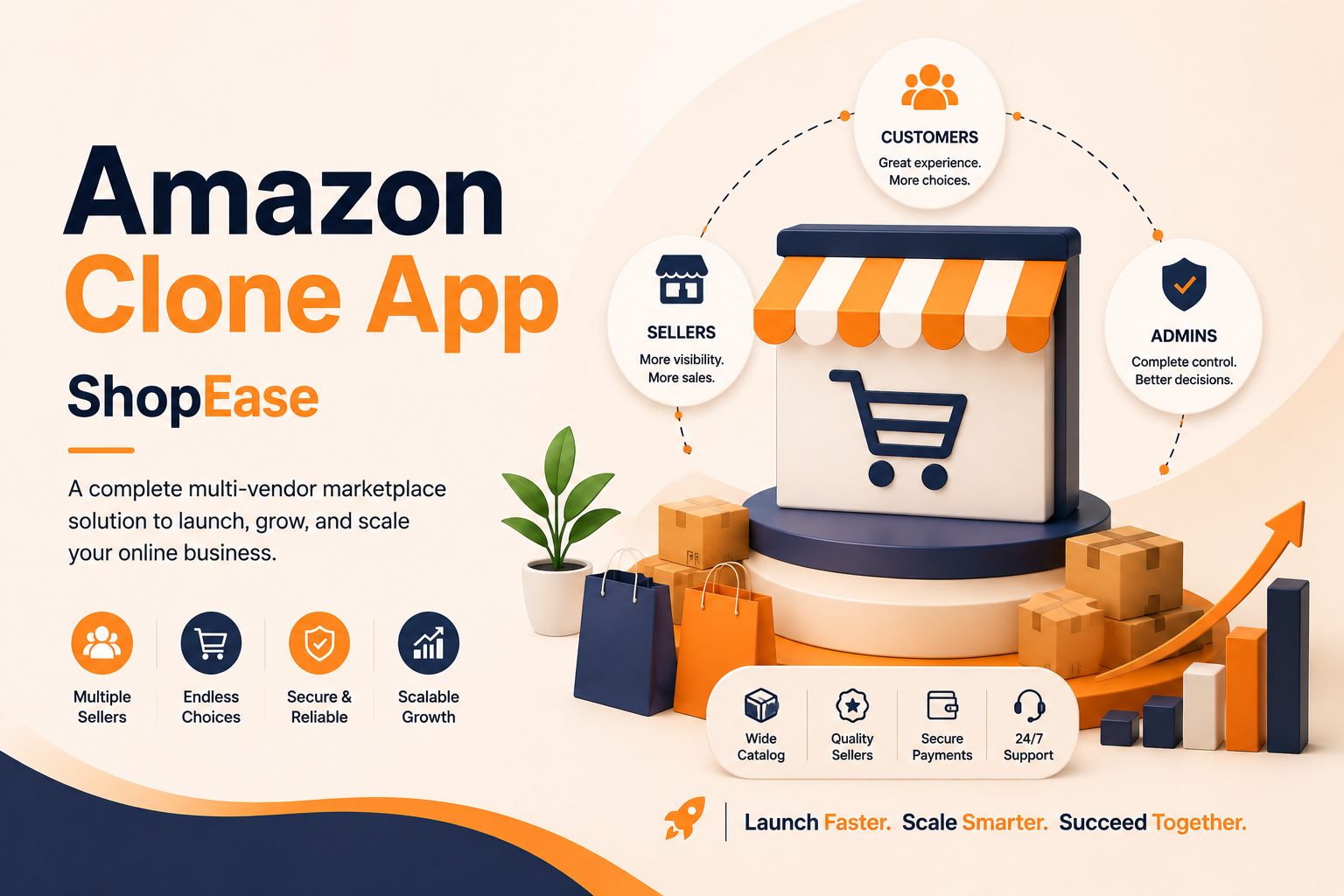
3. The Hidden Challenges Behind Every Successful Marketplace
From the outside, marketplaces often look simple.
Customers browse products.
Sellers list inventory.
Orders get delivered.
Everything seems straightforward.
But ask anyone who has built a marketplace, and they'll tell you a very different story.
The real challenge isn't launching the platform.
It's making everything work together.
This is something many businesses discover after they start planning an Amazon Clone App. Initially, the focus is usually on product listings, categories, and storefront design. Then new requirements begin to appear. Customers want reviews, wishlists, order tracking, secure payments, coupons, and smooth checkout experiences. Sellers need inventory management, order processing, earnings visibility, and return management. Administrators need complete control over users, products, transactions, and marketplace activity.
Suddenly, the Amazon Clone App becomes much bigger than expected.
Customer expectations make things even more challenging.
Modern shoppers compare every platform against the best shopping experiences they have already used. They expect products to be easy to find, seller information to be transparent, payments to be seamless, and order updates to be available at every stage. Building an Amazon Like App isn't simply about displaying products on a screen. A successful Amazon Like App must create confidence throughout the customer journey, from product discovery to final delivery.
And customers are only one part of the equation.
Every marketplace depends on sellers.
Without sellers, there is no inventory.
Without inventory, there is no marketplace.
That's why businesses building an App Marketplace quickly realize that seller operations are just as important as customer experiences. Product uploads, inventory updates, order management, returns, payouts, and seller performance all need dedicated workflows. A growing App Marketplace cannot rely on manual processes if it wants to scale efficiently.
This is where many founders begin exploring an Amazon Clone Script. They realize the challenge isn't creating a storefront. The challenge is building the infrastructure required to support multiple users, multiple sellers, and thousands of transactions. A reliable Amazon Script helps businesses avoid rebuilding common marketplace systems from the ground up.
At ShopEase, this is something we considered from the beginning.
While many marketplace projects focus heavily on customer-facing screens, the reality is that marketplaces succeed when customers, sellers, and administrators can all operate efficiently. ShopEase was designed around this balance, helping businesses launch an Amazon Clone App without overlooking the operational side of marketplace growth.
Another hidden challenge is coordination.
Orders, payments, inventory, reviews, returns, notifications, and seller activity are all connected. A small issue in one area can quickly affect the overall marketplace experience. That's one reason building an Amazon Like App often becomes more complicated than founders initially expect. Every part of the ecosystem must work together consistently.
The same applies to scalability.
A marketplace with ten sellers behaves very differently from a marketplace with hundreds of sellers. As activity increases, the App Marketplace must continue delivering a reliable experience for customers while giving sellers the tools they need to manage growth. This is why many businesses choose an Amazon Script rather than building every workflow independently.
The most successful marketplaces aren't successful because they have more products.
They're successful because the entire ecosystem works together.
And that's exactly the philosophy behind ShopEase. Instead of focusing on a single part of the marketplace journey, it was built to support the complete experience. For businesses exploring an Amazon Clone App, evaluating an Amazon Like App, or researching an Amazon Clone Script, understanding these hidden marketplace challenges is often the first step toward building a scalable App Marketplace that can grow over time.
4. Inside ShopEase — Features, Architecture, and Why It Speeds Up Marketplace Launches
Most marketplace projects don't struggle because of a lack of ideas.
They struggle because the feature requirements become much larger than expected.
Customers need a smooth shopping experience. Sellers need operational tools to manage products and orders. Administrators need complete visibility across the platform. Building all of these systems from scratch can significantly increase development timelines.
That's exactly why we built ShopEase.
Instead of creating another basic ecommerce application, we focused on building a complete Amazon Clone App that businesses can launch, customize, and grow without rebuilding common marketplace workflows repeatedly. For founders exploring an Amazon Clone App, the goal is rarely just launching a storefront. The goal is launching a marketplace that can support customers, sellers, and platform operations from day one.
User App Features
The customer experience sits at the center of every successful marketplace.
ShopEase includes a complete user-side experience expected from a modern Amazon Like App.
Users can:
- Sign up using phone, email, or social login
- Create profiles with names, photos, and saved delivery addresses
- Browse products through categories and subcategories
- Search products and apply filters
- View detailed product pages with images, descriptions, variants, seller information, ratings, and reviews
- Add products to carts and wishlists
- Complete checkout with address selection, delivery estimates, coupon codes, and order summaries
- Pay using cards, UPI, net banking, or cash on delivery
- Track orders with live status updates from placement to delivery
- Raise return and refund requests
- Rate and review products and sellers
- Access offers, coupons, and referral codes
- Receive push notifications for order confirmations, shipping updates, and deliveries
- Manage profile settings
These capabilities are essential for businesses building an Amazon Like App because customer expectations continue increasing every year. A successful Amazon Like App must provide convenience, transparency, and visibility throughout the shopping journey.
Seller App Features
A marketplace grows when sellers succeed.
That's why ShopEase includes a dedicated seller application rather than treating merchants as an afterthought. For businesses evaluating an App Marketplace, seller tools are just as important as customer-facing experiences.
Sellers can:
- Register and create stores
- Configure store names, logos, descriptions, GST information, and bank details
- Add and manage product listings
- Upload product images
- Manage pricing, stock levels, and variants
- Monitor inventory with stock updates and low-stock alerts
- Accept or reject incoming orders
- Update order statuses from processing to delivery
- Manage return requests
- Access earnings dashboards with daily, weekly, and monthly performance breakdowns
- Review payout history
- Submit withdrawal requests
- View ratings and reviews received from customers
- Receive notifications for orders, returns, and payouts
- Manage account settings and support requests
These seller capabilities are one reason many founders choose an Amazon Script instead of developing seller infrastructure independently. A modern Amazon Script must support both marketplace growth and seller efficiency.
Admin Dashboard Features
Every successful marketplace requires strong administration.
As customer activity and seller participation increase, businesses need visibility into every part of the ecosystem. This is where ShopEase provides the operational controls expected from a scalable App Marketplace.
Administrators can:
- Manage buyers and sellers
- Approve, reject, and verify sellers
- Moderate products before publication
- Manage categories and subcategories
- Monitor orders across all sellers
- Resolve disputes and oversee order statuses
- Track GMV, commissions, and seller payouts
- Create and manage offers and coupons
- Configure commission percentages by category
- Moderate ratings and reviews
- Broadcast push notifications
- Monitor analytics including DAU, MAU, revenue trends, top products, and top sellers
- Manage platform settings, branding, terms, and policies
- Access activity logs and audit trails
- Handle support operations
These administrative capabilities help businesses operate a scalable Amazon Clone App while maintaining quality across the platform.
Why We Built ShopEase This Way
While working with marketplace founders, we repeatedly noticed the same challenge.
Businesses spent months rebuilding customer workflows, seller operations, moderation systems, commission management, analytics dashboards, and marketplace administration tools. The same infrastructure problems appeared again and again.
That experience shaped ShopEase.
Instead of treating it as a simple Amazon Clone Script, we designed it as reusable marketplace infrastructure. Businesses can launch an Amazon Like App faster, customize the platform around their business model, and focus more on growth rather than rebuilding common marketplace systems.
And honestly, that's the biggest advantage of ShopEase.
It helps businesses launch a scalable App Marketplace without starting from zero.
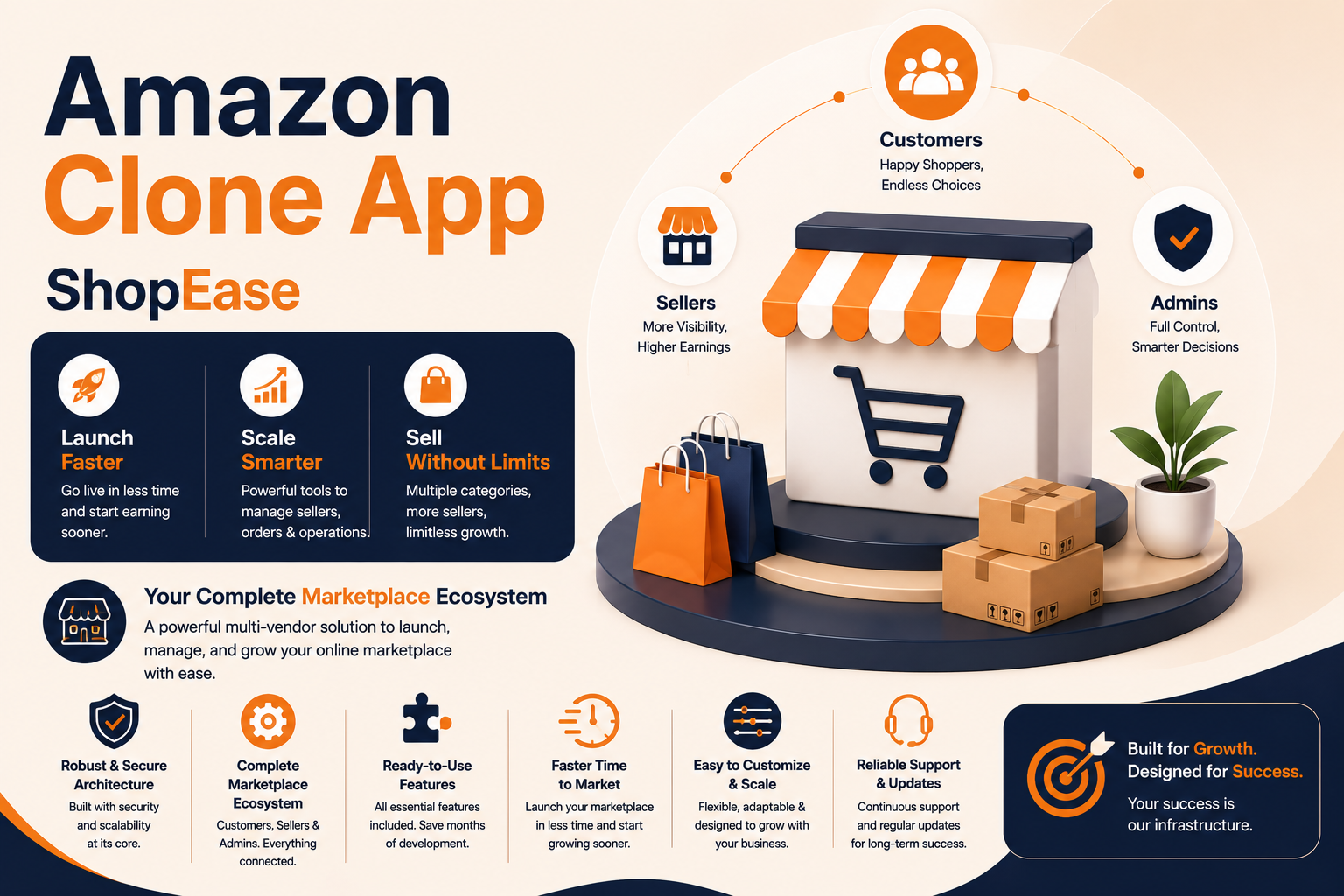
5. How Much Does It Cost to Build an Amazon Clone App?
Most founders think they're building a shopping app.
Then the requirements document starts growing.
First comes product browsing.
Then search.
Then payments.
Then order tracking.
A few days later someone asks:
"What about sellers?"
Now you need store creation, product management, inventory controls, order processing, payouts, and seller support.
Then comes another question.
"How will we manage the platform?"
Suddenly there are discussions around seller verification, product moderation, commission management, analytics dashboards, category management, support systems, and marketplace reporting.
That's usually the moment businesses realize an Amazon Clone App is much larger than it appeared at the beginning. A modern Amazon Clone App isn't a single application. It's a collection of connected systems designed to support customers, sellers, and administrators simultaneously.
And every system affects cost.
Customers expect a polished experience. A competitive Amazon Like App needs product discovery, detailed product information, wishlists, coupons, reviews, payments, order tracking, returns, and notifications. What looks simple from the outside often requires dozens of workflows operating together behind the scenes. Building an Amazon Like App means building the complete customer journey, not just the storefront.
The same challenge exists on the seller side.
A marketplace without sellers is simply another ecommerce store.
This is why every successful App Marketplace invests heavily in merchant operations. Sellers need tools to manage products, update inventory, process orders, review earnings, handle returns, and monitor performance. As the App Marketplace grows, these systems become increasingly important because marketplace expansion depends on seller participation.
Then there is the administration layer.
Most founders underestimate it.
A scalable App Marketplace requires oversight. Someone needs to manage users, approve sellers, moderate products, monitor revenue, configure commissions, review analytics, and resolve disputes. These capabilities are rarely visible to customers, but they play a major role in development timelines and project costs.
This is one reason many businesses start exploring an Amazon Script instead of building everything from scratch. The challenge isn't creating screens. The challenge is creating the infrastructure that connects every part of the marketplace. A reliable Amazon Script helps reduce that burden by providing workflows that would otherwise require months of development effort.
That's also why ShopEase exists.
While working with marketplace founders, we repeatedly saw teams rebuilding the same systems over and over again. Customer journeys, seller operations, notifications, commissions, analytics, and administrative tools kept appearing in project after project.
ShopEase was designed to help businesses avoid that cycle.
Instead of starting from zero, founders can begin with a production-ready Amazon Script that already supports the core functionality expected from an Amazon Clone App. Businesses evaluating an Amazon Like App can focus more on customization and growth, while launching an App Marketplace significantly faster than building everything independently.
And honestly, that's often where the biggest cost savings come from.
Not just writing less code.
Getting to market sooner.
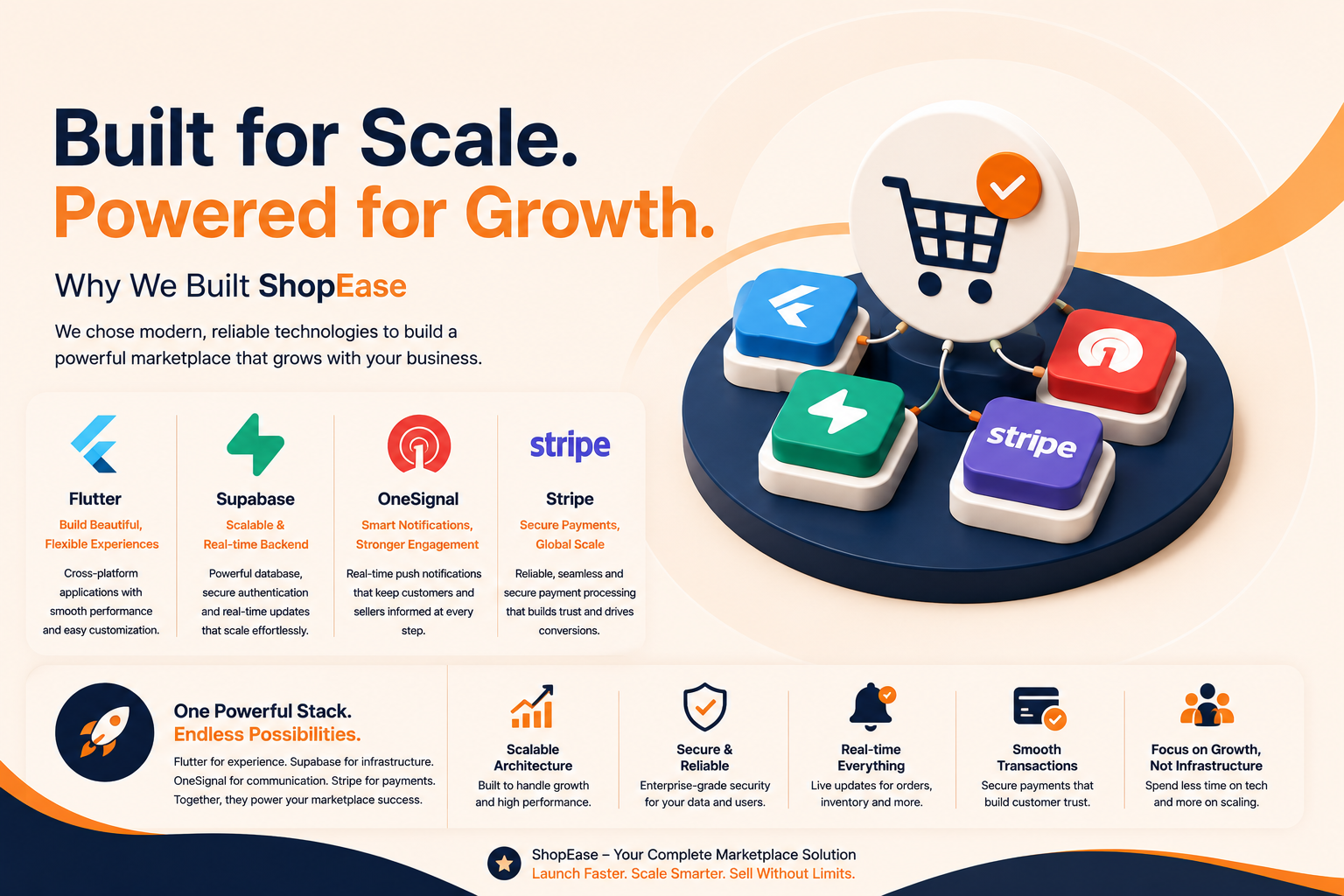
6. Why We Built ShopEase on Flutter, Supabase, OneSignal, and Stripe
One of the biggest mistakes businesses make when planning an Amazon Clone App is assuming the challenge ends once the design is finished.
In reality, that's usually where the difficult part begins.
Products need updating.
Orders need processing.
Sellers need managing.
Customers expect instant updates.
Payments need to work reliably.
And all of it has to happen at the same time.
That's why technology choices matter more than most founders initially realize.
While building ShopEase, we weren't looking for technologies that simply worked. We wanted technologies that could support a growing marketplace without creating unnecessary complexity for businesses later.
Flutter became a natural choice because marketplace platforms constantly evolve. New categories are added. New sellers join. New features appear over time. Businesses launching an Amazon Clone App often need flexibility, and Flutter makes it easier to customize the marketplace experience without rebuilding the entire application.
The backend presented a different challenge.
A marketplace isn't just storing products. It's constantly processing activity. Inventory changes. Orders move through different stages. Sellers update listings. Customers leave reviews. Every action creates data that needs to be managed efficiently.
That's one reason ShopEase uses Supabase. A growing Amazon Like App generates activity from multiple directions simultaneously, and backend systems need to keep pace with that growth. As an Amazon Like App expands, reliable data management becomes increasingly important.
Notifications were another area we paid close attention to.
Think about how many updates happen inside a marketplace every day.
An order gets placed.
A seller accepts it.
The package ships.
The delivery arrives.
Customers expect visibility throughout the process. Sellers expect the same visibility for orders, returns, and payouts. This is where OneSignal plays an important role inside ShopEase, helping keep communication flowing across the platform.
Payments create another layer of responsibility.
Trust can disappear quickly if transactions feel complicated or unreliable. That's why ShopEase integrates Stripe. Businesses evaluating an Amazon Script often focus on storefront functionality, but payment experiences can have just as much impact on customer satisfaction. A dependable Amazon Script should simplify transactions rather than create additional friction.
The reason these technologies work well together is simple.
They support the realities of marketplace operations.
Flutter supports the experience.
Supabase supports the infrastructure.
OneSignal supports communication.
Stripe supports transactions.
Together they provide the foundation needed for a scalable App Marketplace. More importantly, they allow businesses to spend less time solving infrastructure challenges and more time focusing on growth. That's one reason founders exploring an Amazon Clone App often choose ShopEase instead of assembling technologies independently.
Because at the end of the day, the goal isn't choosing technology.
The goal is launching an App Marketplace that customers enjoy using, sellers can rely on, and businesses can continue growing over time.
7. Launch Your Marketplace Faster With ShopEase
Most marketplace businesses don't fail because the idea is bad.
They fail because launching takes longer than expected.
What begins as a simple ecommerce concept quickly turns into a much larger project. Customer experiences need to be designed. Seller workflows need to be built. Administrative systems need to be configured. Payments, notifications, analytics, reviews, returns, and marketplace operations all need to work together before the platform is ready for real users.
By the time everything is planned, designed, developed, tested, and deployed, months have often passed.
That's one reason many businesses exploring an Amazon Clone App are moving toward launch-ready solutions instead of starting from scratch. A modern Amazon Clone App requires much more than product listings and checkout functionality. It requires a complete marketplace ecosystem capable of supporting customers, sellers, and administrators simultaneously.
This is exactly where ShopEase helps.
Instead of spending months rebuilding common marketplace infrastructure, businesses can start with a proven foundation and focus on what matters most — launching, validating the idea, and growing the business. If you're exploring marketplace-ready solutions, you can discover ShopEase and other templates on the Arixlabs Marketplace: https://www.arixlabs.com/marketplace.
Rather than starting with a blank screen, businesses can begin with workflows that modern marketplaces already depend on. Customer onboarding, product discovery, seller management, inventory controls, order processing, commission management, analytics, notifications, and administration are already part of the platform.
For founders evaluating an Amazon Like App, that creates a significant advantage.
Instead of investing valuable time rebuilding standard marketplace functionality, teams can focus on branding, customization, marketing, customer acquisition, and business growth. A successful Amazon Like App isn't defined by how long it takes to build. It's defined by how quickly it reaches the market, attracts users, and starts generating traction.
The same principle applies to scalability.
Many marketplace projects launch with modest goals and later discover they need additional infrastructure to support growth. Sellers increase. Orders increase. Products increase. Marketplace operations become more complex. ShopEase was designed with these realities in mind, helping businesses launch an Amazon Clone App that can evolve as the marketplace grows.
This is one reason founders researching an Amazon Clone Script often prefer marketplace-ready solutions. A production-ready Amazon Clone Script can significantly reduce development timelines while helping businesses avoid many of the challenges that repeatedly appear during custom marketplace projects. Rather than solving the same infrastructure problems over and over again, teams can start with a framework that already supports marketplace operations.
And speed matters.
Every month spent rebuilding common systems is a month not spent acquiring customers.
Every delay pushes validation further into the future.
Every additional development cycle increases overall project costs.
That's why businesses launching an App Marketplace increasingly focus on acceleration rather than reinvention. A scalable App Marketplace needs strong foundations, but those foundations don't always need to be built from zero.
ShopEase was created around that philosophy.
Instead of functioning as another generic Amazon Clone Script, it provides reusable marketplace infrastructure that businesses can customize around their own vision. For entrepreneurs planning an Amazon Like App, it offers a practical route to launch. For businesses building an Amazon Clone App, it helps reduce complexity while maintaining flexibility. And for founders creating an App Marketplace, it provides the foundation needed to move from idea to launch significantly faster.
Because in today's market, speed is often one of the biggest competitive advantages a business can have.
8. Conclusion
A lot of marketplace projects begin with a simple idea.
"We want something similar to Amazon."
A few weeks later, that idea turns into discussions about sellers, inventory, payments, commissions, notifications, analytics, moderation, order management, and platform operations.
That's usually when businesses realize an Amazon Clone App is much more than an ecommerce application.
It's an ecosystem.
Customers expect convenience.
Sellers expect tools that help them run their businesses.
Administrators need visibility across the entire platform.
And all of those moving parts need to work together consistently.
That's why building a successful Amazon Like App is often more challenging than it appears from the outside. The customer only sees the storefront, but behind every transaction sits a network of systems responsible for keeping the marketplace running smoothly.
Throughout this article, we've looked at the opportunity behind marketplace businesses, the hidden complexity involved in launching them, and the infrastructure required to support long-term growth. We've also explored why many founders now prefer a ready-made Amazon Clone Script rather than spending months rebuilding marketplace workflows from scratch.
And honestly, that shift makes sense.
Most businesses don't gain a competitive advantage by rebuilding authentication systems, seller dashboards, payout workflows, notifications, or administration tools.
They gain an advantage by launching faster.
Testing ideas sooner.
Acquiring customers earlier.
And improving the platform based on real market feedback.
That's exactly the thinking behind ShopEase.
Instead of approaching marketplace development as a blank slate, ShopEase provides the foundation businesses typically need when launching an Amazon Clone App. Customer experiences, seller operations, platform management, notifications, payments, and marketplace workflows are already in place, allowing teams to focus on growth rather than infrastructure.
For founders evaluating an Amazon Like App, that can mean significantly shorter development cycles. For businesses researching an Amazon Clone Script, it can mean avoiding months of repeated engineering work. And for entrepreneurs building an App Marketplace, it can mean getting to market while competitors are still planning requirements.
Because in the end, marketplace success rarely comes from being the first team to write the code.
It comes from being one of the first teams to launch, learn, and adapt.
If you're planning an Amazon Clone App, exploring an Amazon Like App, or searching for an Amazon Clone Script, ShopEase gives you a practical starting point for building a scalable App Marketplace without starting from zero.
And in a market that moves as quickly as ecommerce, that head start can make all the difference.
FAQs
1. What is an Amazon Clone App?
An Amazon Clone App is a multi-vendor marketplace platform that allows customers to shop from multiple sellers within a single application.
2. What is included in ShopEase?
ShopEase includes a customer app, seller app, and admin dashboard with product management, order processing, payments, reviews, notifications, and analytics.
3. Why choose an App Marketplace model?
An App Marketplace allows multiple sellers to join the platform, increasing product variety and supporting long-term growth.
4. Can ShopEase be customized?
Yes. ShopEase can be customized for different industries, categories, branding, and business requirements.


View more blogs
.png)

.png)
_a_change__2025__to__20.png)

.png)


.png)

Ready to develop your own product? Get in touch today!
Get in Touch
