




1. Introduction
Australia's beverage and café industry is among the most dynamic and competitive in the world. From global coffee chains to independent cafés, Australians have embraced beverages not just as products, but as experiences centered around convenience, personalization, and brand loyalty.
Today's consumers expect far more than quality coffee or drinks—they seek seamless digital experiences such as mobile ordering, personalized rewards, contactless payments, and loyalty programs that strengthen their connection with their favorite brands. As a result, cafés and beverage businesses are increasingly investing in digital solutions to enhance customer engagement and drive long-term retention.
This shift has significantly accelerated the demand for mobile app development for cafés in Australia and modern loyalty applications that help businesses differentiate themselves in an increasingly competitive market.
By leveraging mobile technology, beverage brands can offer features such as order-ahead functionality, digital memberships, reward points, personalized promotions, and real-time notifications. These capabilities not only improve customer convenience but also generate valuable insights into purchasing behavior and preferences.
As consumer expectations continue to evolve, businesses that embrace digital innovation will be better positioned to build stronger customer relationships, increase repeat purchases, and create memorable brand experiences in Australia's thriving beverage industry.
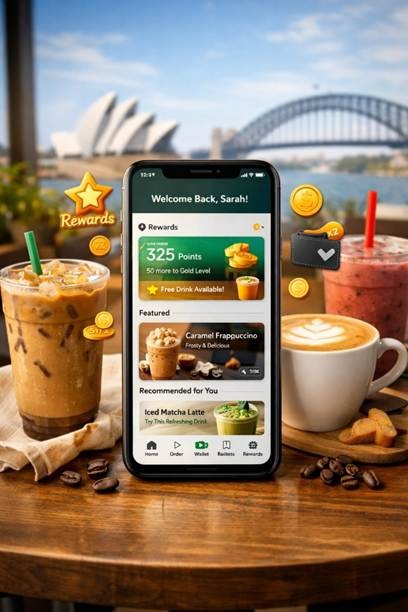
Among the main drivers of this shift is the emergence of mobile beverage ordering combined with loyalty and rewards programs. In today's Australian marketplace, consumers are demanding greater convenience, flexibility, and value. Consumers expect to be able to order their favorite beverages ahead of time, customize every element of their drink, pay digitally, and earn rewards each time they make a purchase, all from one mobile application. Modern beverage loyalty applications use data, automation, and personalization to encourage repeat visits by the same customer, increase the average order value, and establish an emotional connection between the customer and the brand through a robust coffee shop loyalty program app. These types of applications are no longer discretionary tools for cafes and beverage companies; rather, they are strategic tools for growth, especially for businesses investing in Loyalty app development Australia.
The most well-known example of how technology and loyalty can create significant business results is Starbucks. The Starbucks mobile application integrates beverage ordering, cashless payment systems, artificial intelligence (AI)-powered personalization, and a strong rewards system into a single seamless user experience, making it a benchmark starbucks-like app for global and Australian brands alike. Using data on a customer's past purchases, purchasing history, and previous beverage orders, Starbucks makes recommendations on personalized beverages and provides targeted rewards to continue to attract the customer back. The resulting highly engaged customer base has resulted in higher rates of purchase frequency and a very successful loyalty program in the global food and beverage industry.
While Starbucks is a good model for Australian beverage brands, simply replicating it is not sufficient. A number of factors, including local consumer behaviors, payment options, expectations regarding sustainability, and regulatory requirements, also play a critical role in determining what type of successful application will exist in the Australian market. This is where a customized beverage rewards and loyalty application, developed through mobile app development for cafes in Australia, that is tailored to the Australian marketplace, creates a competitive advantage.
This blog outlines all of the information required to build a beverage rewards and loyalty application similar to the Starbucks model for the Australian marketplace. You will learn about key features, loyalty mechanics, AI-powered personalization, technology stacks, estimated development costs, expected timelines, regulations related to compliance, and emerging trends involved in building a scalable starbucks-like app. This article provides a roadmap to creating a scalable, customer-focused loyalty application that generates long-term growth in 2026 and beyond for cafe chains, beverage start-ups, and operators of franchises looking to launch a next-generation coffee shop loyalty program app through expert loyalty app development in Australia.
2. Starbucks Beverage & Loyalty App: Feature Breakdown
The Starbucks mobile app is so much more than a simple way for you to order beverages on your phone. It is, in fact, an all-encompassing digital ecosystem that influences consumer behavior through increasing the number of times customers purchase at Starbucks as well as developing long-term brand loyalty, making it a global benchmark starbucks-like app. At the heart of the app is the integration of mobile ordering, payment, rewards, personalized communication, and engagement into one seamless experience. The ecosystem model utilized by Starbucks is the difference between Starbucks' mobile app and those of traditional coffee shops and has set the global standard for beverage loyalty platforms, inspiring loyalty app development in Australia initiatives.
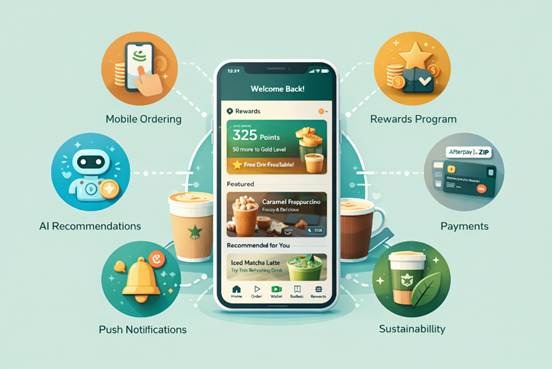
The greatest strength in the Starbucks app environment is the manner in which the interaction process has become a natural part of a customer's routine for interacting with the brand. Customers can browse through the beverage menu, modify their beverage orders, put orders on hold for future pick-up, make digital payments, and redeem reward points all from a couple of screen touches through a sophisticated coffee shop loyalty program app. In addition, by removing the barriers that exist throughout the beverage purchasing experience, Starbucks has been able to convert one-time users to repeat customers. The app has become the primary way to communicate with the brand, as opposed to simply being another option for communicating with the brand, a strategy now widely adopted through mobile app development for cafes in Australia.
2.1 Core Pillars of the Starbucks App Experience
Starbucks' mobile application's success can be attributed to four fundamental components: ordering, rewards, personalization, and engagement, which together define a global starbucks-like app experience.
The ability for consumers to place orders via their mobile device allows them to bypass queues and gives them more control over their use of time, which is particularly important when it comes to rapidly changing urban lifestyles. In fact, the mere convenience of mobile ordering is enough to generate high levels of repeated usage, making it a key focus area for mobile app development for cafes in Australia. Rewards and loyalty are the core emotional elements of the mobile application. With each beverage purchased, customers earn points to unlock tier-based rewards, special offers, and other incentives to encourage them to visit again and again through a powerful coffee shop loyalty program app. The rewards program is very easy to comprehend and track, and provides immediate gratification, which is a core objective of Loyalty app development Australia.
It is at the level of personalization where Starbucks differentiates itself from its competitors. Using customer data—such as order history, favorite beverages, daily routines, and location—Starbucks uses the information collected to provide customers with targeted drink recommendations and promotions. As a result, customers begin to feel understood and valued by the brand, leading to a greater emotional attachment to Starbucks. Engagement is provided via push notifications, seasonal promotional activities, limited-time rewards, and games or contests to make the mobile application stay current and relevant to customers throughout the year, a strategy increasingly adopted in mobile app development for cafes in Australia.
2.2. What Makes These Features Successful? The Habit and Reward Loop
The Starbucks mobile application has been developed with a psychological habit and reward loop that generates a powerful and sustainable user engagement model, setting the benchmark for a global starbucks-like app. The cycle begins with a trigger, a consumer’s normal morning coffee routine, or a notification informing them they have sufficient points to qualify for bonus reward points. A subsequent action—ordering a beverage through the mobile application—is followed immediately by a reward—the points or a personalized offer, delivered through an advanced coffee shop loyalty program app. Over time, these loops reinforce habitual actions to promote customers choosing Starbucks over competing beverage companies, all without requiring significant conscious effort from customers, a principle now guiding loyalty app development in Australia.
Starbucks has successfully generated a loyalty-driven model of consumption for both the customer and the business by providing a convenient, rewarding, and emotionally engaging experience that is low maintenance for the customer and highly profitable for Starbucks. Understanding how the above components of the Starbucks mobile application have worked together will be essential for the development of a loyalty mobile application for Australian beverage businesses that do not simply sell drinks but build lasting relationships with customers through mobile app development for cafes in Australia.
3. Essential Features of a Beverage Rewards & Loyalty App
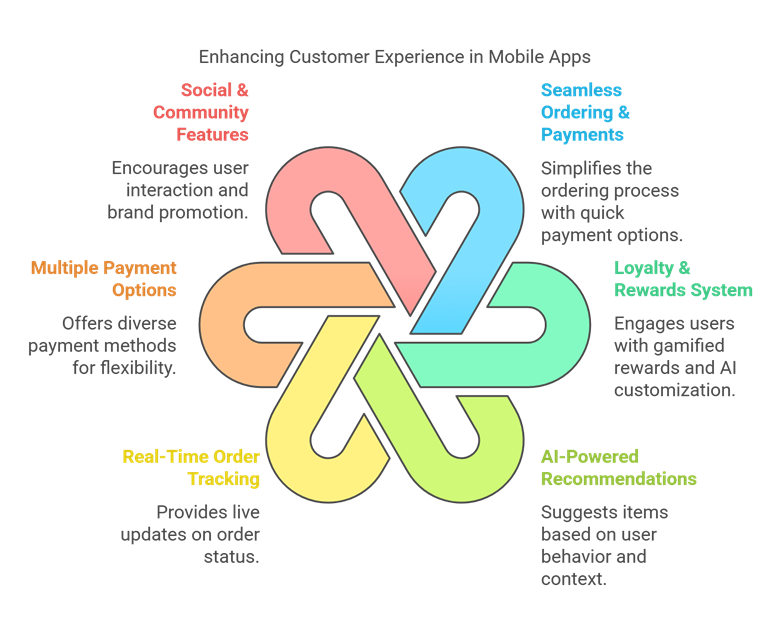
A beverage loyalty app that provides an excellent customer experience is much more than simply a digital ordering process. A successful beverage loyalty app combines personalization, convenience, emotional connection, and community building, as well as providing users with relevant data and insights using artificial intelligence (AI) for the ultimate goal of encouraging repeat business and developing long-term customer loyalty to your brand through a robust coffee shop loyalty program app. The Starbucks model has been used as inspiration for all beverage apps designed to reward loyal customers, setting the benchmark for a global starbucks-like app and influencing loyalty app development in Australia. There are many features you need to consider when designing a beverage app to compete in Australia, particularly when investing in mobile app development for cafes in Australia. Below, we have outlined the most important features required to be included within a Starbucks-style beverage app to be successful in the Australian marketplace.
3.1 Seamless Mobile Ordering & Payments
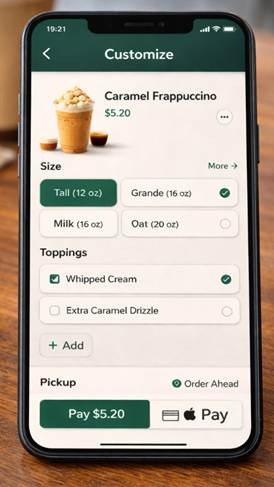
The core function of every loyalty app for beverages relies on frictionless mobile ordering & payment options, forming the foundation of a modern coffee shop loyalty program app. The most important things to an average consumer in Australia are speed, flexibility & control; especially when they have less than 10 minutes to get to work, school, or a meeting before they can take a break (during busy times). If you design your mobile ordering system well, users will be able to view the beverage menu, customize their drinks by choosing size, type of milk alternative, amount of sugar, add-ins & save favorite combinations so they don't have to do the same thing again, a core requirement for mobile app development for cafes in Australia.
Customizing a beverage is a key part of the overall user experience. Customization includes allowing users to choose the size of the drink, the type of milk, adjust how sweet they want the drink to be, whether they want to add anything to the drink, and saving previous combinations for faster ordering in the future. As much as possible, users want to feel as though they are having the same experience using the app as they would if they were standing in front of the counter making their selection, a principle borrowed from every successful starbucks-like app.
Using the app's "order ahead" & "pickup" functionality will allow customers to avoid lines and pick up their beverages at a pre-determined time. Both benefits improve customer satisfaction and assist businesses with managing orders during busy periods. Using the apps with real-time inventory and POS integration will help ensure that all orders are processed accurately and ready to go when customers arrive, a best practice in loyalty app development in Australia.
Integration of POS is required to synchronize in-app orders with in-store operations. Integration with POS platforms, including Square, Lightspeed, Tyro, etc., will facilitate seamless order processing, centralized reporting, and consistent tracking of points earned through loyalty programs, both in the store and online, supporting scalable loyalty app development in Australia.
3.2 Loyalty & Rewards System (Core Feature)
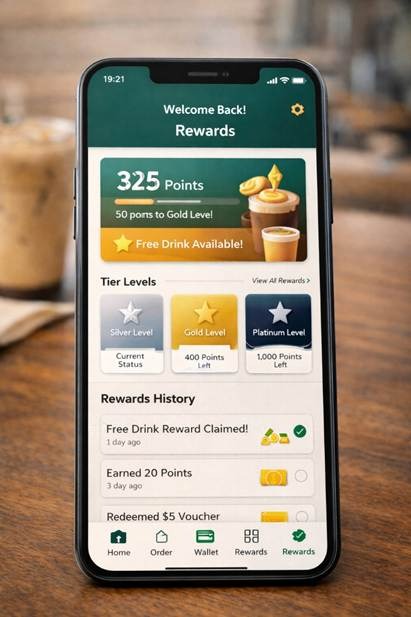
The loyalty and reward aspect of an application is the emotional engine of a beverage app and will drive repeat use, forming the foundation of a successful coffee shop loyalty program app. A well-crafted loyalty program drives repeat behavior (habitual) and increases purchase frequency; ultimately, it will help grow the relationship between the customer and brand, which is a core objective of Loyalty app development Australia.
The rewards aspect of a loyalty program is based on earning points for every beverage purchased. Those earned points can be used in exchange for free beverages, beverage upgrades, or special offers. The most important thing to remember when creating a rewards-based loyalty program is to keep it simple, easy to understand, and track via the application, as demonstrated by every leading starbucks-like app.
Engagement and rewards at the tier level provide the ultimate experience for the long-term customer. Each time a user progresses up a tier (Silver, Gold, VIP), they receive enhanced rewards that include but are not limited to: bonus points, early access to new beverages, birthday rewards, etc. Ultimately, this provides a feeling of accomplishment and exclusivity, which is now a standard expectation in mobile app development for cafes in Australia.
Referral and birthday rewards provide a social and emotional element to a loyalty program. Referral rewards encourage users to share their application with their friends by providing either bonus points or free beverages, thus driving organic growth of your customer base. Birthday rewards build on emotional goodwill and build the relationship you have established with your customers, a proven tactic within Loyalty app development Australia.
Ultimately, the logic behind redeeming points must be both intuitive and instantaneous. The user should clearly know how many points they have earned, what rewards are available, and how to redeem those rewards with the least amount of friction possible. If the logic behind redeeming points is confusing or too restrictive, you risk losing both the trust and engagement of your users, a risk every coffee shop loyalty program app must avoid.
3. 3 AI-Powered Recommendations
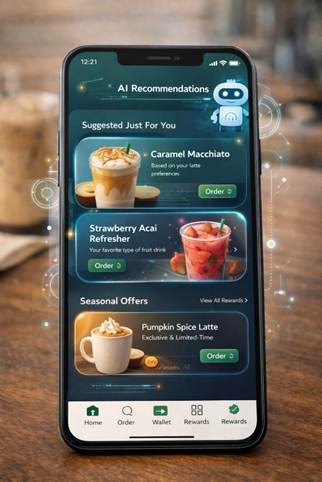
Recommendations, created with artificial intelligence (AI), take a beverage loyalty app from being a transaction-based application to becoming a personalized digital assistant, a defining capability of a modern starbucks-like app. AI analyzes the behavior of users, history of orders, and preferences of users, and will create relevant beverage recommendations at the right time, which are perceived to be thoughtful, forming a key component of advanced loyalty app development in Australia.
Examples of personalized beverage recommendations may be for an app to suggest a user's preferred coffee at the user's regular ordering time, or to recommend a new drink to the user based on the user's previous purchasing history of the user through a data-driven coffee shop loyalty program app. Both of these examples reduce the mental burden of making decisions and increase the number of orders placed, an outcome highly valued in mobile app development for cafes in Australia.
Upselling, driven by artificial intelligence, provides users with suggestions to purchase items such as pastries, upgrade the size of an item, or purchase a product with premium ingredients in a non-intrusive manner. If done properly, up-selling is viewed positively and is considered to be helpful, as proven by leading starbucks-like app implementations.
Promotions, seasonally driven by artificial intelligence, provide the ability to adjust to local conditions, including weather, holidays, and other events. For example, cold beverages may be promoted during warmer weather months, holiday beverages during holidays, etc., resulting in increased engagement, relevancy, and opportunities to generate additional sales through intelligent Loyalty app development Australia.
3. 4 Real-Time Order Tracking
Tracking your real-time orders will make it possible to have a more transparent process and reduce the stress of waiting for your order. When you place an order, you will be able to see the different stages of getting your order prepared and ready, a capability expected from any modern coffee shop loyalty program app.
You can get live information about where your order is at all times, which helps build confidence with the customer and improve their satisfaction. Customers are able to better plan out their day by knowing approximately how long it will take for them to pick up their order, a key usability benefit emphasized in mobile app development for cafes in Australia.
To communicate this, push notifications will allow the app to send the user messages stating that their order is being made, available for pickup, or if there is going to be some type of delay. These communications will enhance the overall user experience and minimize the number of people waiting inside stores, aligning with best practices seen in every successful starbucks-like app.
3.5 Multiple Payment Options
To be effective in an Australian digital marketplace, a beverage loyalty app must support a variety of consumer payment methods, which is a core requirement of loyalty app development in Australia.
Supporting payment methods will include standard payment methods of credit and debit cards, as well as the use of Apple Pay and Google Pay to provide fast and secure transaction experiences. Supporting multiple payment methods has the potential to create less friction at the point of sale, increase conversion rates by providing consumers with choices, and increase convenience, especially in mobile app development for cafes in Australia.
The integration of Buy Now, Pay Later (BNPL) services, such as Afterpay and Zip, will continue to grow in popularity in Australia and provide additional options for customers looking to purchase large orders, subscription plans, or bundles of beverages. The option of BNPL allows for greater flexibility for consumers while potentially increasing average order value, a growing trend in loyalty app development in Australia.
Supporting wallet-based payment methods in your app will enable consumers to pre-load funds into the app for faster checkout experiences and increased brand loyalty. In addition, wallet-based payments will also provide seamless integration between loyalty program points and rewards redemption within a comprehensive coffee shop loyalty program app.
3.6 Social & Community Features
Turning an app for beverages into a social experience by adding social/community elements will increase organic user acquisition and user engagement, a strategy increasingly adopted in mobile app development for cafes in Australia.
Referral programs create incentives for users to invite their friends, which creates a powerful vehicle of word-of-mouth marketing. The gamification element in the loyalty experience makes it fun/interactive through using challenges, streaks, or achievement badges, features commonly found in a starbucks-like app.
By allowing users to share rewards/achievements/favorite beverages on social media platforms, the brands are getting free exposure, and the users are creating content that is promoting the brand, reinforcing the value of Loyalty app development Australia.
3.7 Sustainability & Eco-Friendly Choices
Consumers in Australia are increasingly considering the environmental impact of their purchases; therefore, providing consumers with options to make their beverage consumption experience "eco-friendly" will be important to creating a successful and competitive modern beverage application, especially within mobile app development for cafes in Australia.
Receiving incentives (bonus points or discounts) through reusable cup rewards creates an incentive to be environmentally responsible, a growing feature within a next-generation coffee shop loyalty program app.
A green badge to recognize the consumer's choice to consume beverages sustainably adds a form of social recognition and pride in their sustainable choice.
Displaying carbon-neutral practices (offsetting, etc.), and/or displaying information on suppliers that provide eco-friendly products/services within your beverage application helps build brand values, and increases customer trust, which both add value to your beverage application and strengthen Loyalty app development Australia initiatives.
The combination of convenience, personalization, rewards, and sustainability provides a strong foundation to develop a digital ecosystem for beverage rewards and loyalty applications that drives engagement, retention, and long term growth, similar to what has been accomplished by Starbucks through a proven starbucks-like app, however, tailored to meet the needs of consumers in the Australian market.
4. Technology Stack & Tools
Creating a rewarding beverage loyalty app as successful as Starbucks is about more than creating an attractive UI and offering some core features. The tech stack for a high-performing app has to be capable of supporting real-time ordering, payment security, large-scale loyalty systems, AI personalization of experience, and continued customer engagement while being cost-effective and quick to roll out, as expected from a modern starbucks-like app. Your choice of tools will have a direct impact on how quickly you can develop your app, how efficient you are operationally, and how scalable you are over time, which is why Loyalty app development Australia requires careful planning. In a highly competitive Australian market, this will be even more critical, particularly for businesses investing in mobile app development for cafes in Australia and building a scalable coffee shop loyalty program app.
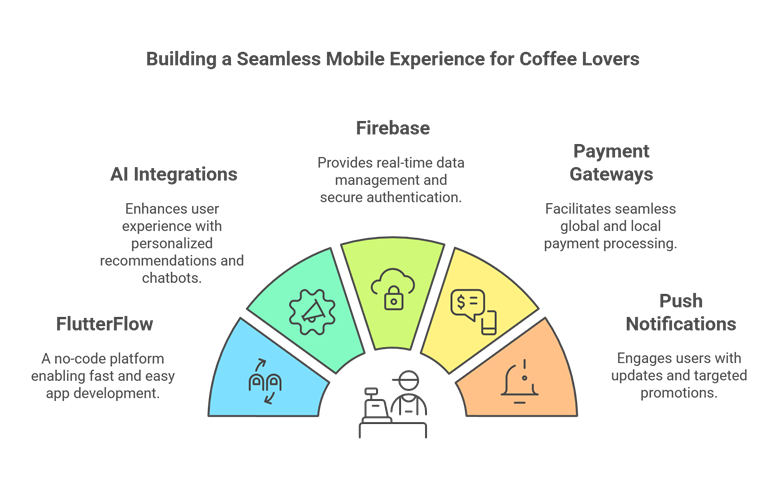
Below is a modern, production-ready technology stack designed specifically for beverage ordering and loyalty applications.
4.1 FlutterFlow (Visual App Development)
Developing with FlutterFlow provides you with the best of both worlds when building your next beverage loyalty application – speed, versatility, and performance, making it an ideal choice for mobile app development for cafes in Australia.
Advantages Of Cross Platform Development
Using FlutterFlow allows developers to write a single piece of code for their iOS, Android, and Web apps so they can have the same user experience no matter what device they are using. Beverage companies typically target mobile users, but can use the same code base to create tablet-based in-store ordering and administrative dashboards, a key advantage when building a scalable coffee shop loyalty program app.
Cross-platform development eliminates the need for multiple code bases and the subsequent increased maintenance and update cycle times that come with them. The business logic that surrounds loyalty programs (i.e., how many points, rewards, etc.) will remain the same in all versions of your app, which is essential for Loyalty app development Australia.
Faster MVP Deployment
The faster you get your MVP out the door, the better off you'll be when launching a new beverage loyalty application. Using FlutterFlow's drag-and-drop builder and native components, teams can quickly develop, test, deploy, and iterate on MVPs. Items such as menu items, order flows, loyalty dashboard, and redeem screens can now take weeks instead of months to develop, similar to the development speed required for a starbucks-like app.
Having a faster MVP process gives you the ability to validate user adoption, refine your loyalty mechanics, and receive real user feedback before deciding to scale your product.
Cost Savings
When developing a traditional native application, you require two different teams to work on the development of your iOS and Android versions. As the number of teams grows, so does the cost of the project. When you develop using FlutterFlow, you can eliminate one team and consolidate the work under one roof. For this reason alone, FlutterFlow is a very attractive option for coffee shops, franchises, and start-ups that want to build a loyalty program similar to Starbucks but don't have the budget of larger enterprises, a common challenge addressed through Loyalty app development Australia.
4.2 AI Integrations
Beverage loyalty apps today are driven primarily by Artificial Intelligence (AI) for their ability to personalize each user's experience; to engage them; and to optimize revenue, particularly within advanced coffee shop loyalty program app solutions.
The AI within these apps enables the app to continuously collect information about how the user interacts with the app and continuously adjust the user's experience based upon that interaction, a defining feature of any modern starbucks-like app.
Recommendation Engines
Recommendation engines powered by AI will analyze a number of factors, including purchase history, time of day, the user's location, and seasonal trends, to recommend beverages that the user is most likely to purchase. An example would be suggesting iced coffee to users who have purchased it before on hot summer days or highlighting a user's favorite latte on the user's morning visits to the app.
By using an AI-powered recommendation engine, the app reduces decision fatigue for the user, increases the user's average order frequency, and gives the user the perception that the app is intuitive and personalized, a critical outcome of mobile app development for cafes in Australia.
Analytics & Behavior Tracking
Analyzing the behavior of users through AI allows Beverage Brands to understand exactly what users are doing within the app—what they browse, what they order, what they choose to skip, and what they decide to abandon. The collected data can then be analyzed to improve the loyalty program(s); identify where users are dropping off, and trigger customized offers, strengthening Loyalty app development Australia strategies.
Behavior tracking also allows Beverage Brands to gain valuable insight into their customers' preferences—thereby allowing for better marketing campaigns, optimized menus, and the creation of dynamic reward programs within a coffee shop loyalty program app.
4.3 Cloud & Database Management
When you want to create a mobile application with a similar style to a Starbucks app, your application will need to be able to process large amounts of data at one time, as well as handle a large number of users accessing the application simultaneously, as expected from a scalable starbucks-like app. Therefore, a cloud-based backend infrastructure is necessary.
Firebase/Supabase
Both Firebase and Supabase are cloud-based backend services that can perform tasks such as user authentication, database operations, and create cloud functions for server-side programming. As they offer real-time syncing of data, they are also suitable for beverage applications where immediate synchronization of orders, rewards earned, and redeemed is required, especially in mobile app development for cafes in Australia.
In terms of functionality, both Firebase and Supabase have their strengths and weaknesses. While Firebase is very good for handling real-time operations and sending push notifications, Supabase has the ability to be used with SQL, which gives developers much more control over how the data is related.
Also, both Firebase and Supabase allow developers to securely authenticate users and build scalable backend logic, which is critical for loyalty app development in Australia.
Real Time Syncing
Real-time syncing enables an application to update all of its views, screens, etc., immediately upon a user updating information. This includes things like when a customer places an order and receives points for the purchase, and then immediately sees those points added to their account (or when a customer redeems a reward). This is important for establishing credibility with customers and keeping them informed about their points balance within a coffee shop loyalty program app.
Scalability
A cloud-based application can grow quickly to meet increasing demand for usage of the application from an ever-increasing number of users. For example, if there was a holiday promotion that generated a lot of interest and activity on the application, the auto-scaling features of the cloud would automatically increase the capacity of the servers supporting the application so that the performance is still available and accessible to the users, supporting long-term loyalty app development in Australia.
4.4 Payment Gateway Integration
Beverage Loyalty App’s Payment Processing Options: Secure and Flexible
The integration of secure and flexible payment options into Beverage Loyalty Apps can provide consumers with an assurance of the integrity of their loyalty program and the company, especially for businesses investing in mobile app development for cafes in Australia.
For example, Stripe, Square, and Tyro are examples of gateway providers (payment gateways) that can be integrated into your Beverage Loyalty App to facilitate secure online or in-app payments, as well as POS (point-of-sale) in-store purchases.
For example, Stripe provides developers with a wide range of APIs and offers robust security to support a developer's ability to create a seamless consumer experience. Square and Tyro offer similar capabilities to developers but are specifically designed to integrate POS solutions and in-store purchases for businesses in Australia.
By integrating one or both of these payment gateways into your Beverage Loyalty App, you will be able to ensure that any payments made via your app will accurately reflect in-store purchases. This integration also enables you to maintain up-to-date financial and loyalty account records within a scalable coffee shop loyalty program app.
Security of Transactions
All of the above-mentioned payment gateways encrypt sensitive financial data through the use of tokenization and compliance with security standards (e.g., PCI DSS). By using a reputable and compliant payment gateway provider, you will reduce the risk of unauthorized access to your customers' payment information and protect the integrity of their financial accounts, which is fundamental to Loyalty app development Australia.
4.5 Push Notifications & Customer Engagement
Beverage Loyalty Apps using Push Notifications to Increase User Engagement & Retention
Reminder of Rewards
Timely automated reminders by Beverage Loyalty Apps via mobile devices (push notifications) remind users of expiring loyalty rewards, unlocked rewards, and/or loyalty program level upgrades, a feature standard in every starbucks-like app.
Reminders to Return Users to Visit Again
These reminder notifications ensure users do not forget they have loyalty rewards and also encourage repeat visits by reminding them to use their loyalty rewards, which results in increased app usage and loyalty program participation in mobile app development for cafes in Australia.
Abandoned Cart Notifications
If a user has initiated an order but does not complete it, timely push notifications may be sent to attempt to get the user to return to their order – sometimes with an additional incentive such as bonus loyalty points or a limited-time offer/discount on their order.
When used in conjunction with AI, push notifications can be targeted and relevant to each user's specific needs and interests, resulting in higher push notification open rates and increased conversions without sending too many notifications to the users, reinforcing Loyalty app development Australia best practices.
Combining the ability to quickly create Beverage Rewards and Loyalty Apps using FlutterFlow's development capabilities, with AI integration, cloud based infrastructure, secure payment options and AI driven customer engagement tools enables Beverage Rewards and Loyalty App developers to develop scalable and high performance apps similar to those developed for Starbucks through a proven starbucks-like app approach, while maintaining a cost efficient model and being prepared for future growth opportunities in the Australian market.
5. How to Develop a Starbucks-Like Beverage Ordering & Loyalty App
Developing an app like a Starbuck's beverage ordering and customer loyalty app will require much more than just replicating similar features; it will demand a greater understanding of how users behave; how the local market expects to see their data used; how to develop scalable technology; and a sophisticated means of personalizing the experience for the user, as demonstrated by every successful starbucks-like app. The development process will consist of several key components, from research through UX Design to backend architecture, and finally integrating AI into the application. Each step is equally important to create an app that is utilized by customers daily, particularly within mobile app development for cafes in Australia. A structured approach to developing a successful beverage rewards and loyalty app specifically for the Australian market is outlined below, supporting best practices in Loyalty app development Australia and the creation of a scalable coffee shop loyalty program app.
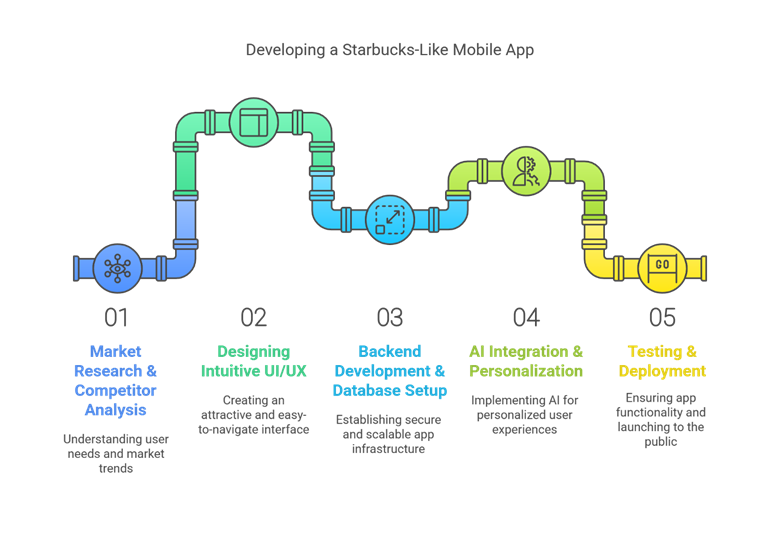
5.1 Market Research & Competitor Analysis
Before you write a single line of code for your beverage loyalty app, you need to do market research and analyze competitors as part of a successful Loyalty app development Australia strategy. There's no substitute for understanding how today's customers interact with beverage brands, as well as what they want from a loyalty-driven mobile experience.
Research the beverage brands that operate locally in Australia - this includes, but isn't limited to: café chains, quick service restaurant (QSR) operators, juice bars, and specialty coffee shops. Research how these beverage brands utilize mobile apps, loyalty programs, and/or third-party platforms. Note their pricing strategies, menu presentation, ordering workflow, and methods of engagement. Identifying what is already working within the Australian market will help you find areas of opportunity when planning mobile app development for cafes in Australia.
Following that, identify the customer loyalty expectations in Australia. Consumers here are digitally savvy; they want transparent communications, fast delivery, and tangible rewards. Customers expect real-time tracking of their points, simple redemption of those points, personalized offers, flexibility in making payments, and to be able to make purchases quickly and easily. Conduct surveys, conduct user interviews, and read app reviews to gain a better insight into what customers like and dislike about current offerings and what they feel is missing from current offerings, especially in a coffee shop loyalty program app.
Lastly, identify gaps in the features of competing apps. Typical gaps include a lack of customization, unclear loyalty program rules, poor user experience, lack of incentives related to sustainability, and little to no engagement beyond the discount. Gaps in features provide an opportunity to distinguish your app through providing a more intuitive, rewarding, and emotionally connected experience for customers inspired by a proven starbucks-like app.
5.2 Intuitive Interface & UX Design
Ease of use for a consumer in an application (i.e., User Experience) is perhaps the key factor that determines whether a loyalty program for an application similar to a Starbucks will ultimately succeed, as seen in every successful starbucks-like app. Regardless of how effective your loyalty program may be, it will still ultimately fail if consumers find using your app to order beverages and track rewards is frustrating or requires too much effort.
Therefore, a primary function of UX design is to create the impression that both beverage ordering and rewards tracking are simple and fun to do, which is a core principle of mobile app development for cafes in Australia.
To provide a solid beverage discovery experience for a user of the app, you need to allow them to easily locate the items they wish to purchase. These elements include menu organization, rich images representing each drink (drink cards), filters that enable users to search by their dietary needs/requirements, and intelligent recommendations based upon past beverage purchases. Additionally, users should have a means of accessing customization options for their beverages without feeling overwhelmed, a standard expectation in Loyalty app development Australia.
Your loyalty dashboard is typically the emotional center of your app; therefore, users should clearly see how many points they currently have, which tier they are at in the current program, which rewards are available to them now, and how close they are to earning the next reward. Visual representations such as a progress bar, badge or countdown further motivate users and cause them to continue to use the application, reinforcing the value of a strong coffee shop loyalty program app.
Ultimately, the one-tap reorder feature is necessary for users who frequently purchase the same beverages. When users have this option, it removes friction from the user experience and makes it easier for the application to become a habit-forming part of the user's daily routine. Therefore, this feature causes a significant increase in repeat purchases and customer retention, a hallmark of a starbucks-like app.
5.3 Backend Development & Database Setup
A successful drink loyalty app is dependent on strong back-end technology (architecture) to efficiently process orders, rewards, and customer data; and that the information is processed in real-time, and that the information is both accurate and secure, which is critical for Loyalty app development Australia.
The "order logic" covers all aspects of the ordering process, from the menu options selected by customers to any modifications to their selections, to the payment options chosen by customers, and then finally to any updates related to the status of an order. The "order logic" needs to be able to communicate effectively with a Point-of-Sale (POS) system, so there will be no discrepancies in what is ordered in-store versus online, a requirement in mobile app development for cafes in Australia.
The "rewards engine" is the core piece of technology within a loyalty app. The rewards engine is responsible for managing the points awarded to customers, the levels at which they advance through a program, whether or not a customer is eligible for a reward, and the conditions under which a customer may redeem a reward. The ability to have a flexible rewards engine provides businesses with the opportunity to execute marketing campaigns, add new levels to a loyalty program, and/or modify how many points a customer earns for each purchase, etc., without having to shut down the entire system, strengthening a scalable coffee shop loyalty program app.
Customer profile pages hold the customer's important data, including their complete order history, any preferred drink combinations, their current loyalty status, and the available payment options. The customer's data is the basis for developing personalized experiences, for producing analytics, and for providing a consistent experience regardless of whether the customer is accessing the application via a mobile device, tablet, desktop, etc., as expected from a starbucks-like app.
All backend technologies need to be designed to provide scalability and security from the beginning. The use of cloud technology provides the flexibility to support the applications during periods of high usage, whereas using encryption and secure login mechanisms provides the protection of customer data, a key requirement for loyalty app development in Australia.
5.4 AI Integration & Personalization
AI will transform the standard beverage application to a Smart and Adaptive application, which will be developed based on the user’s behavior and evolve from there, a defining capability of a modern starbucks-like app. The Static Rules are replaced by the AI for continuous optimization of the Loyalty Experience.
The Continuous Learning Models analyze the User Interactions over Time, and refine the Recommendations and Offers based on the Changing Preferences. Example: If a User begins to Order Plant Based Beverages More Frequently, the Application can also Refine Recommendations to Offer Plant Based Beverages as Options, enhancing the value of a coffee shop loyalty program app.
Smart Offers using AI Insights provide the Right Incentive to the Right User at the Right Time. Examples of Smart Offers could be Bonus Points During Off-Peak Hours, Personalized Discounts on Favorite Drinks, Seasonal Promotions Based on Individual Preferences, etc. These Smart Offers will Feel Relevant and Timely to Users and therefore Increase Engagement and do not Erode Brand Value, a core goal of mobile app development for cafes in Australia.
When Beverage Brands integrate AI into their Ordering, Loyalty and Engagement Workflows, they are able to create a Personalized Experience that Feels Intuitive, Rewarding, and Uniquely Tailored to Each Customer, reinforcing best practices in Loyalty app development Australia.
Creating a Beverage Ordering and Loyalty App similar to Starbucks is a multi-stage process that includes Market Insight, Thoughtful Design of UX, Scalable Backend Systems, and Intelligent Personalization. When done properly results in an Application that does not Just Process Orders but Creates Lasting Customer Habits and Brand Loyalty within the Australian Market through a proven starbucks-like app approach.
6. Business Model & Revenue Streams for a Starbucks-Like Beverage Loyalty App
Beverage rewards and loyalty apps are not just about placing orders; they are a strategic engine of business that can lead to increased repeat purchasing behavior, an increase in average order value, and ultimately long-term loyalty from customers to your brand. Prior to building a loyalty app development in Australia, it is crucial to understand what potential business models are and how you will generate revenue with the app. A structured loyalty app can turn everyday beverage transactions into an opportunity for additional revenue streams while creating an engaged relationship with your customer base.
6.1 Increased Order Frequency
The largest way to get more money using an App like Starbucks is by making people buy your drinks more often. The convenience and ability to use your phone to place orders, as well as a rewarding coffee shop loyalty program app, will cause the customer to pick you instead of a competitor when it's time to buy a drink.
A loyalty program and a system where there are different tiers of reward and/or points will motivate a customer to purchase your product multiple times in order to gain some type of advantage/point toward earning another free item or toward reaching the next level of rewards. For example, if a customer completes five purchases within your app, you can give them a free beverage or bonus points. This motivates the customer to go back and purchase from you before they would have purchased from a competitor, consistent with best practices in starbucks-like app development.
Using push notifications and recommending items based on artificial intelligence encourages customers to continue engaging frequently with your app. A smart notification that reminds a customer that they have expiring points or suggests a seasonal beverage at their preferred café location can greatly increase how many times per day/week a customer places an order through your app, reflecting features of mobile app development for cafes in Australia.
Increasing the number of orders made by your customers does two things for you. First, it increases the amount of revenue generated from the sale of beverages. Second, it increases the customer’s lifetime value (CLV), which is one of the best key performance indicators (KPIs) for any coffee shop loyalty program app. If a customer continues to interact with your app, they are more likely to be looking into purchasing additional products and services as part of upsell opportunities and/or be interested in other ways to generate revenue from your app.
6.2 Upselling Beverages
Another way a beverage loyalty app generates significant revenue is through upselling. The approach is to offer the user better alternatives than what they have been purchasing, so as to improve their experience in some form, a strategy used in starbucks-like app development.
When the user places an order for their standard coffee, the app may offer them a larger size, a premium ingredient (oat milk, an additional espresso, etc.) or a pairing with a pastry or other snack. These offers will be made based on behavioral patterns of the user as well as on what is happening at the time of the purchase, making them relevant and personal. This will result in a greater number of conversions than if the offers were simply generic, yet less intrusive than if they were forced upon the user, a core principle in Loyalty app development Australia.
The AOV (average order value) will increase due to upselling, but it will also introduce users to new products/offerings, which will increase overall engagement of the user with the brand. In addition, once users are introduced to a high-end product, they are more likely to become long-term purchasers of those items, thus creating a cyclical relationship of increased revenue and loyalty for the brand, supported by a well-implemented coffee shop loyalty program app.
6.3 Subscription Drink Plans
Subscription service models are developing throughout the beverage sector as they generate consistent and predictable revenue streams through subscriptions from consumers. In addition to a fixed monthly or weekly price, the customer receives a set number of beverages or an unlimited number of drinks, a feature increasingly integrated into starbucks-like app offerings.
A simple example is a coffee shop that offers a "Monthly Coffee Pass," which gives the subscriber one beverage per day or a specific number of beverages per week. Not only do these types of plans produce immediate revenue, but they also create loyal, habitual customers. Consumers who subscribe will likely continue to purchase their beverage needs from the same company rather than switch brands to a competitor, and thus increase their loyalty and overall lifetime value, a core goal of mobile app development for cafes in Australia.
Subscriptions may also be paired with loyalty programs. Members of a subscription program receive rewards such as points, exclusive products, or premium benefits, creating a perception that the subscription itself is a premium product and generating a stable source of revenue, which reinforces the strategy of a coffee shop loyalty program app.
6.4 Sponsored Promotions
A starbucks-like app-style rewards app would allow for sponsorships and partner promotions as well. For instance, beverage companies could be working with other business companies, local businesses, or events to create co-branded offerings that are available within the app (e.g., limited-time offers of flavored beverages from a local farm, or a discount on branded merchandise with an eco-friendly company). The app would earn money from the companies through the sponsorship fees; meanwhile, the app would keep its users engaged through new and relevant material.
The app would have the opportunity to generate additional revenue using non-intrusive advertising methods or sponsored recommendations if used carefully and in context. In this way, the company would be able to capitalize on the attention of its customers without negatively impacting their primary use of the app to order beverages, aligning with best practices in Loyalty app development Australia.
6.5 Integrating Multiple Revenue Streams
One of the major benefits of developing a loyalty app similar to those used by Starbucks is that each revenue stream builds upon the others. The more frequently an app user places orders, the greater the opportunity there will be to offer additional products; subscription services are directly related to the coffee shop loyalty program app, as they allow users to regularly purchase items that provide loyalty rewards; and sponsored offers will generate additional revenue and provide value to the user.
Through the implementation of all of these methods, beverage companies can develop a self-supporting system that supports continued customer engagement through increased revenue and revenue that continues to support improved customer experiences. Due to the fact that many Australians place high importance on convenience, personalized service, and tangible rewards, the use of a mobile app development for cafes in Australia is more likely to result in consistent usage of a well-developed app compared to others.
Ultimately, a beverage company's use of a starbucks-like app similar to those developed and utilized by Starbucks is far from simply a mobile ordering platform and instead represents a comprehensive business model that provides several avenues for revenue generation. Whether it is through the increase in order frequency and subsequent upsell opportunities, subscription-based drink options, or sponsored promotions, every aspect of the app contributes to both the customer experience and ultimately the overall success of the company. When developed correctly, the app acts as a centralized resource for the generation of revenue, customer engagement, and long-term loyalty for beverage companies competing within the competitive environment of Australia, reinforcing Loyalty app development Australia and coffee shop loyalty program app principles.
7. Development Cost in Australia for a Starbucks-Like Beverage Rewards & Loyalty App
Creating an Australian-based beverage rewards and loyalty application similar to that of Starbucks entails balancing feature set, technological options, and budget. The cost for building such an application can be substantial, as it depends upon the scope of the application, degree of customization, the amount of data processing required by the application, whether integration with third-party systems or services will be undertaken, and whether you want to write your own code versus using a no-code solution. It is critical for founders, chain cafes, and beverage start-ups to understand these costs to plan a realistic budget for development, launch, and scale of their new applications, especially when pursuing loyalty app development in Australia.
7.1 MVP Cost Range
A Minimum Viable Product (MVP) focuses on the core features needed to validate your app concept and start acquiring users. For a mobile app development for cafes in Australia, an MVP typically includes:
• Mobile ordering & payment functionality
• Basic loyalty & rewards system, following principles of a coffee shop loyalty program app
• User registration & profiles
• Limited AI personalization (e.g., simple recommendation engine)
• Push notifications for rewards and order updates
In Australia, developing such an MVP can range from AUD 30,000 to 60,000 when using a traditional development approach with native iOS and Android teams. This budget typically covers design, backend setup, frontend development, testing, and deployment.
Cost savings with no-code platforms like FlutterFlow can be significant. Using no-code tools, the same MVP can be built in AUD 15,000 to 30,000, reducing development time by up to 50% while still enabling cross-platform deployment. No-code platforms also simplify future iterations, allowing businesses to add features like AI-powered recommendations, push notification campaigns, and subscription plans without completely rebuilding the app, following strategies from a starbucks-like app.
7.2 Mid-Scale App Cost
A mid-scale app expands on the MVP by including additional functionality that enhances user engagement and supports moderate business growth. Typical features include:
• Advanced loyalty tiers and point tracking
• AI-powered personalized beverage recommendations
• Real-time order tracking and inventory management
• Multiple payment options, including cards, Apple Pay, Google Pay, and BNPL
• Social features like referrals, gamification, and rewards sharing
For a mid-scale beverage loyalty app developed traditionally in Australia, the cost ranges from AUD 60,000 to 120,000. This includes a more robust backend to handle larger user bases, integrations with POS and cloud systems, and a polished UI/UX design optimized for retention, essential for mobile app development for cafes in Australia.
Using no-code or low-code development platforms, this cost can be reduced to AUD 40,000 to 70,000, while still supporting cross-platform deployment, third-party integrations, and AI-driven personalization. The key advantage is that businesses can launch faster, gather real user data, and iterate based on insights without committing to high development costs upfront, consistent with Loyalty app development Australia practices.
7.3 Enterprise App Cost
An enterprise-grade beverage rewards and loyalty app is designed for large café chains or franchise networks with thousands of active users. Enterprise apps require:
• Complex loyalty systems with tiered rewards, subscription drink plans, and partner promotions
• Full AI personalization with predictive analytics and smart upselling
• Real-time inventory, POS, and delivery logistics integration
• Multi-region support and high scalability for peak hours
• Advanced security, compliance, and performance monitoring
In Australia, developing an enterprise-level beverage loyalty app from scratch typically costs AUD 150,000 to 300,000+, depending on the number of integrations, customizations, and backend complexity. These apps also require ongoing maintenance, updates, and server costs.
No-code or low-code platforms like FlutterFlow, when combined with cloud-based backend systems such as Firebase or Supabase, can significantly reduce both development and maintenance costs. Enterprise-level apps can be launched for AUD 100,000 to 180,000, providing the scalability, reliability, and cross-platform support needed for large operations while saving thousands on engineering hours, aligning with the objectives of a starbucks-like app.
7.4 Cost Savings with No-Code Development
No-code platforms have emerged as a game-changer for beverage startups, café chains, and franchise operators. Key cost-saving advantages include:
• Reduced development hours: Visual builders eliminate the need for extensive coding, allowing apps to be launched 40-60% faster.
• Lower engineering costs: Smaller teams can develop full-featured apps, reducing the reliance on large development teams.
• Cross-platform deployment: One build can support iOS, Android, and web, eliminating the need for separate native development.
• Rapid iteration: Feature updates, A/B testing, and design changes can be implemented instantly without major coding efforts.
• Integration simplicity: No-code platforms offer pre-built integrations for payment gateways, push notifications, and cloud databases, reducing custom development costs.
By leveraging no-code development, Australian beverage brands can launch MVPs, test coffee shop loyalty program app strategies, and validate market demand at a fraction of the traditional cost, while still maintaining the option to scale into enterprise-level features as user engagement grows, following Loyalty app development Australia and mobile app development for cafes in Australia principles.
8. Timeline & MVP Strategy for a Starbucks-Like Beverage Rewards & Loyalty App
When building a drink-based reward or loyalty program using a mobile application (such as that of Starbucks), there are many things you need to plan out in advance. First and foremost, is developing an app with all the necessary features efficiently so it can scale when you have a lot of users. With that said, having a defined timeline will assist businesses in saving on development costs, confirm their concept(s) in a short period of time, and make sure they are focusing on those features that provide the most benefit to their customer base. This area provides a practical roadmap for Australian beverage companies that want to build a mobile app development for cafes in Australia for their loyalty programs.
8.1 MVP Timeline
The Minimum Viable Product (MVP) is the first stage of the app development journey. It focuses on delivering the core functionalities that address customer needs while allowing the business to test the market and gather feedback.
Typical MVP timeline for a coffee shop loyalty program app:
• Week 1–2: Market research and requirement gathering
This phase includes competitor analysis, identifying local Australian beverage trends, understanding customer loyalty expectations, and defining the core features for the MVP.
• Week 3–4: UI/UX design and prototyping
Design the app interface, including the ordering workflow, loyalty dashboard, reward visualization, and simple navigation. Using tools like Figma or FlutterFlow allows for rapid prototyping, making it easier to iterate based on feedback.
• Week 5–8: Core development
Develop the MVP using either traditional code or a no-code platform. Key features include mobile ordering, payment integration, user profiles, basic loyalty points, and push notifications for rewards, consistent with a starbucks-like app.
• Week 9–10: Testing & QA
Conduct functional testing, cross-platform validation, and user acceptance testing (UAT) to ensure a smooth, bug-free experience. Testing should also include payment workflows, reward calculations, and notifications.
• Week 11: MVP launch & feedback collection
Release the MVP to a limited audience or pilot locations. Gather insights on user engagement, feature adoption, and reward redemption patterns.
• Week 12+: Iteration and optimization
Use real-time data and customer feedback to refine features, fix usability issues, and prepare for scaling to a broader user base.
By following this 3-month MVP timeline, beverage brands can validate the app concept, assess loyalty program effectiveness, and identify gaps before committing to a full-scale launch, aligning with Loyalty app development Australia best practices.
8.2 Feature Prioritization
Prioritizing the right features is essential for MVP success. Not all features need to be built at launch—focusing on high-impact functionalities ensures faster development and early user adoption.
High-priority MVP features:
- Mobile ordering & payment: Allows customers to browse the beverage menu, customize drinks, and pay digitally.
- Loyalty points & basic rewards: Provides users with instant gratification and encourages repeat purchases.
- User profiles & history: Ensures personalization and data tracking for loyalty management.
- Push notifications: Alerts users about reward points, order status, or promotions.
- Order tracking: Simple real-time updates for order status to reduce customer anxiety.
Secondary features for post-MVP release:
• Tiered loyalty programs and premium rewards
• AI-powered beverage recommendations and upselling
• Subscription drink plans or recurring orders
• Social sharing and referral gamification
• Sustainability and eco-friendly incentives
By prioritizing features this way, brands can focus development resources on the core user journey—ordering, payment, and loyalty—while leaving more advanced personalization, gamification, and analytics for later stages.
8.3 Scaling Roadmap
Once the MVP is validated, the next step is scaling the app to include more advanced features and expand the user base. A structured scaling roadmap ensures businesses can grow without overwhelming development teams or compromising performance, consistent with starbucks-like app strategies.
Phase 1 – Post-MVP (Months 4–6):
• Add tiered loyalty programs and more complex reward structures.
• Integrate AI-based personalization for beverage recommendations and smart promotions.
• Expand payment options, including BNPL (Afterpay, Zip) and wallet-based systems.
Phase 2 – Regional Expansion (Months 6–9):
• Include multi-location management for franchise networks.
• Implement real-time inventory syncing across all stores.
• Introduce social engagement features, such as referral campaigns, achievements, and gamified challenges.
Phase 3 – Advanced Scaling (Months 9–12):
• Launch subscription-based drink plans for recurring revenue.
• Integrate sponsored promotions and partnerships with other brands.
• Optimize the app for high concurrency during peak hours using cloud scaling solutions (Firebase, Supabase, or AWS).
• Introduce analytics dashboards for store managers and marketing teams to monitor user behavior and reward redemption.
Phase 4 – Continuous Optimization (Year 2+):
• Enhance AI-driven marketing campaigns using predictive analytics.
• Test and deploy seasonal beverage promotions and limited-time offers.
• Monitor customer retention KPIs such as repeat order rate, reward redemption frequency, and average order value.
• Continuously improve UX/UI based on user feedback and emerging trends in mobile beverage ordering.
By following this roadmap, Australian beverage companies can effectively develop a mobile app development for cafes in Australia that evolves from a coffee shop loyalty program app MVP into a fully-featured, scalable starbucks-like app with ongoing optimization for long-term customer engagement.
9. Challenges & Solutions in Building a Starbucks-Like Beverage Rewards & Loyalty App (2026)
A significant number of opportunities exist for the development of a beverage rewards and loyalty app to generate increased revenue and customer engagement; however, as the launch of a starbucks-like app in 2026 is accompanied by new problems in creating a successful app that scales sustainably within a highly competitive Australian market, it will be essential to understand those issues and develop applicable resolutions so that your app can have a successful launch and scale successfully in the long term.
Below, we outline the major issues, their consequences, and strategies for resolving them for loyalty app development in Australia and mobile app development for cafes in Australia:
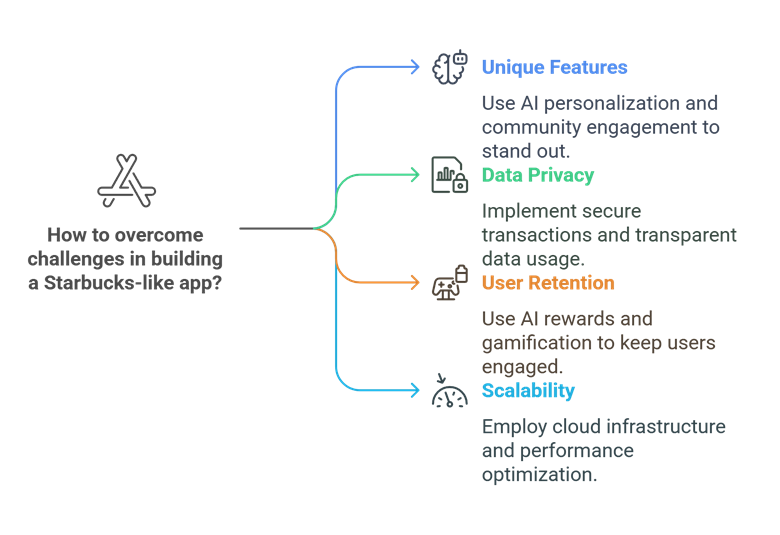
9.1 High Competition
Problem:
The Australian Cafe and beverage industry is a very competitive area of business. There are many well-established businesses, represented by brand names, as well as numerous specialty coffee shops and new businesses competing for customers' time. Many international chains (i.e., Starbucks) have developed sophisticated loyalty apps that will provide consumers with an expectation of how their experiences should be personalized and rewarded.
Impact:
Without establishing some level of differentiation, the likelihood of acquiring users and having those users engage with your application will likely be lower than you would like. Consumers may download an app based on convenience or curiosity at first, but they will ultimately stop using an app that does not establish a unique value proposition relative to Starbucks, local coffee establishments, and/or other loyalty applications. The increased competition within the consumer loyalty space can create higher customer acquisition costs, therefore increasing the cost of each marketing campaign and reducing the overall efficiency of those marketing efforts.
Practical Solution:
• Unique Loyalty Incentives: Offer rewards that go beyond standard points, such as subscription drink plans, eco-friendly perks (like reusable cup rewards), or exclusive beverage collaborations.
• Personalization: Use AI to deliver tailored recommendations, promotions, and upselling opportunities based on user preferences, order history, and behavior patterns.
• Community & Social Features: Gamification, referral programs, and social sharing can create a sense of belonging and make your app feel like more than just a transactional tool.
• Local Branding & Flavors: Incorporate local Australian ingredients, seasonal beverages, and promotions to differentiate from global chains.
By providing a unique and personalized experience, your app can stand out even in a saturated market.
9.2 Data Privacy & Security
Problem:
Beverage loyalty apps collect sensitive data, including payment information, personal details, order history, and location. With strict Australian privacy laws (such as the Privacy Act 1988 and APPs compliance), mishandling data can lead to legal issues, fines, and reputational damage.
Impact:
A data breach or poor privacy handling can erode user trust, resulting in lost customers, negative publicity, and even regulatory penalties. Users are increasingly aware of how their data is used and expect brands to protect it.
Practical Solution:
• Encryption & Secure Authentication: Use end-to-end encryption for payments and sensitive user data. Implement secure login options, such as OAuth, multi-factor authentication, or biometric login.
• Compliance-First Approach: Ensure adherence to Australian privacy regulations, PCI DSS for payment processing, and GDPR if targeting international users.
• Transparent Privacy Policies: Clearly communicate how user data is collected, stored, and used. Include options for users to control their preferences, delete accounts, or opt out of tracking.
• Regular Security Audits: Conduct penetration testing, vulnerability assessments, and continuous monitoring to proactively identify and mitigate risks.
Prioritizing privacy and security ensures long-term trust and customer loyalty, which are critical for retention and brand reputation.
9.3 User Retention
Problem:
Acquiring users is only the first step; retaining them is a far bigger challenge. Many users download loyalty apps but stop engaging due to a lack of incentives, complex navigation, or irrelevant content. Retention is particularly difficult in beverage apps where competitors are just one click away.
Impact:
Low retention directly affects lifetime value (LTV) and ROI on marketing spend. If users abandon the app after a few visits, revenue from loyalty programs, upselling, and subscriptions declines sharply.
Practical Solution:
• Engaging Loyalty Programs: Implement tiered rewards, seasonal challenges, birthday bonuses, and referral incentives to keep users motivated.
• Push Notifications & Smart Reminders: Use AI to send targeted notifications for expiring points, new drinks, or personalized offers. Avoid spamming; instead, focus on contextually relevant nudges.
• Personalized Experience: Leverage AI and analytics to recommend beverages, upsell add-ons, or highlight new menu items based on user preferences and purchase history.
• Gamification: Introduce challenges, streaks, badges, or social leaderboards to make loyalty programs fun and interactive.
By combining rewards, personalization, and gamification, apps can convert casual users into habitual customers, significantly improving retention rates.
9.4 Scalability
Problem:
As user adoption grows, the app must handle increasing orders, rewards calculations, AI recommendations, and real-time updates without performance degradation. Poor scalability can lead to slow load times, system crashes, or inaccurate loyalty points.
Impact:
Technical bottlenecks during peak hours or promotional events damage user experience, reduce trust, and potentially drive customers to competitors. Scalability issues also increase operational costs if the backend infrastructure cannot support growth efficiently.
Practical Solution:
• Cloud-Based Infrastructure: Use scalable cloud platforms like Firebase, Supabase, or AWS to automatically handle spikes in user traffic and data processing.
• Modular Backend Architecture: Separate services for order management, loyalty points, AI personalization, and notifications to ensure high availability and maintainability.
• Load Testing & Optimization: Conduct stress testing and optimize database queries, API calls, and push notification delivery to prevent slowdowns.
• Monitoring & Analytics: Implement real-time monitoring dashboards for performance metrics, errors, and server health to address issues proactively.
Scalable infrastructure ensures that as your beverage loyalty app gains popularity, it remains fast, reliable, and enjoyable for every user, maintaining engagement and retention.
10. Compliance & Regulations for Beverage Rewards & Loyalty Apps in Australia
When developing a Starbucks-style beverage ordering and loyalty app in Australia, compliance is not optional—it is a critical factor that protects your business, builds trust with users, and ensures long-term operational stability. Loyalty apps collect sensitive user data, process payments, and manage reward-related transactions, all of which fall under strict regulatory frameworks. Understanding and adhering to data protection, payment compliance, and taxation rules is essential for any beverage brand aiming to operate legally and efficiently in the Australian market.
10.1 Data Protection
Problem:
Loyalty apps require users to create accounts, store personal information, track orders, and manage payment details. Mismanagement of this data can lead to legal consequences, reputational damage, and loss of customer trust.
Australian Regulations:
• The Privacy Act 1988 governs the collection, storage, and use of personal data.
• Organizations must comply with Australian Privacy Principles (APPs), which include obligations such as limiting data collection to necessary information, securely storing it, and allowing users to access or correct their data.
• Sensitive data such as payment information, location history, and purchase behavior is classified under higher standards of protection.
Practical Measures for Compliance:
• Secure Storage & Encryption: Encrypt sensitive data in transit and at rest using industry-standard protocols like AES-256 or TLS.
• User Consent & Transparency: Clearly explain what data is collected, how it is used, and obtain explicit consent before any tracking or marketing activities.
• Data Access & Deletion: Implement features allowing users to download, correct, or delete their personal data on demand.
• Regular Audits: Conduct privacy audits to identify vulnerabilities and ensure APPs compliance.
Ensuring robust data protection practices not only meets legal obligations but also enhances user confidence, which is critical for engagement and retention in loyalty-driven apps.
10.2 Payment Compliance
Problem:
Beverage loyalty apps handle digital payments, including credit/debit cards, mobile wallets, and buy-now-pay-later (BNPL) services. Non-compliance with payment regulations can result in fines, account suspension, or loss of payment gateway access.
Australian Regulations & Standards:
• PCI DSS Compliance: Apps handling card payments must follow the Payment Card Industry Data Security Standard (PCI DSS) for secure cardholder data storage and processing.
• Payment Gateway Requirements: Gateways like Stripe, Square, or Tyro have their own compliance checks and may require local licensing or verification.
• BNPL & Wallet Regulations: Services such as Afterpay or Zip fall under ASIC (Australian Securities and Investments Commission) oversight. Apps must adhere to disclosure requirements and consumer protection laws.
Practical Measures for Compliance:
• Use Verified Gateways: Integrate trusted, compliant payment providers to handle sensitive transactions. Avoid storing card data directly unless fully PCI-compliant.
• Secure Authentication: Implement multi-factor authentication and tokenization for wallet and card payments.
• Regular Updates & Monitoring: Stay updated with gateway changes, and continuously monitor transactions for anomalies.
Payment compliance ensures that users can confidently transact within the app, reducing friction and increasing repeat purchases.
10.3 GST Implications
Problem:
Australian businesses must account for Goods and Services Tax (GST) on digital products and services, including beverages sold through apps and associated subscription plans or loyalty rewards. Failing to manage GST properly can lead to fines, audits, or back taxes.
GST Requirements for Loyalty Apps:
• Beverage Sales: The sale of physical beverages is subject to standard GST rules (10% GST on retail sales).
• Subscription Plans & Digital Rewards: Subscription-based drink plans or digital reward points may have GST implications depending on whether they are classified as taxable supplies.
• Promotional Offers & Discounts: Redemption of loyalty points or discounts should be properly documented to ensure GST is applied correctly on the net transaction amount.
Practical Measures for Compliance:
• Integrated Accounting Systems: Connect your app with accounting software that automatically calculates GST for all transactions.
• Detailed Reporting: Maintain clear records of purchases, points earned/redeemed, and subscription payments.
• Consult Tax Professionals: Engage Australian tax advisors to clarify GST obligations, particularly for complex loyalty structures or multi-location operations.
By integrating GST considerations into app workflows and reporting, businesses avoid costly audits and maintain financial transparency, which is especially important for chain operators and franchises.
11. KPIs & Success Metrics for a Starbucks-Like Beverage Rewards & Loyalty App
Measuring the success of a Starbucks-style beverage loyalty app goes beyond tracking downloads. The true indicators of success lie in user engagement, repeat purchases, reward redemption, and overall lifetime value. For Australian beverage brands aiming to build a sustainable app, defining the right KPIs (Key Performance Indicators) and success metrics ensures that the app drives both customer loyalty and business revenue.
11.1 Repeat Purchase Rate
What it is:
Repeat purchase rate measures how frequently users return to make orders after their first purchase. It’s one of the most important KPIs for loyalty apps because it reflects habit formation and customer retention.
Why it matters:
A high repeat purchase rate indicates that your app successfully encourages users to engage with your brand regularly, which directly drives revenue. For beverage apps, where daily or weekly consumption is common, this KPI is critical to assessing the effectiveness of rewards programs, personalization, and order convenience.
How to track:
• Monitor the percentage of users making multiple orders within a defined time frame (e.g., 30, 60, or 90 days).
• Segment users by frequency (occasional, regular, loyal) to identify areas for improvement or targeted engagement.
• Use push notifications, promotions, and personalized suggestions to increase repeat orders.
11.2 Reward Redemption Rate
What it is:
Reward redemption rate measures how often users redeem points, perks, or loyalty rewards within the app. This KPI evaluates how valuable and appealing your loyalty program is to users.
Why it matters:
If users earn points but never redeem them, it signals poor engagement or a confusing reward structure. Conversely, a high redemption rate indicates that rewards are motivating user behavior, increasing satisfaction, and reinforcing loyalty.
How to track:
• Calculate the percentage of earned points redeemed over a specific period.
• Track redemption by reward type (free drinks, discounts, subscription perks) to understand what drives engagement.
• A/B test different reward offerings to optimize appeal and ensure maximum program effectiveness.
11.3 Customer Lifetime Value (CLV)
What it is:
Customer Lifetime Value (CLV) estimates the total revenue a user generates throughout their relationship with your app. It’s a critical financial metric for determining marketing ROI and loyalty program effectiveness.
Why it matters:
High CLV indicates that users are not only returning frequently but also spending more per order. For beverage apps, CLV reflects the combined impact of upselling, subscriptions, tiered loyalty rewards, and personalized promotions. CLV helps determine how much to invest in user acquisition, engagement campaigns, or app enhancements.
How to track:
• CLV = Average Order Value × Average Purchase Frequency × Average Customer Lifespan.
• Segment by loyalty tier, subscription plan, or geographic region to identify high-value customer groups.
• Align marketing campaigns and rewards strategies to maximize CLV over time.
11.4 Engagement Metrics
What it is:
Engagement metrics measure how users interact with the app beyond placing orders. They reflect user interest, satisfaction, and app “stickiness.”
Key engagement metrics include:
• Daily/Monthly Active Users (DAU/MAU): Measures how many users engage with the app regularly. A high ratio indicates strong habit formation.
• Session Duration & Frequency: Shows how long and how often users navigate menus, explore promotions, or check loyalty dashboards.
• Push Notification Open Rates: Evaluates the effectiveness of reminders, offers, and loyalty nudges.
• Referral Activity: Tracks how often users invite friends, sharing rewards or promotions.
Why it matters:
Engagement metrics reveal how compelling your app is. Even with a great loyalty program, low engagement indicates friction points—such as confusing navigation, slow loading times, or unappealing rewards—that may deter users.
How to track:
• Use analytics platforms like Firebase, Mixpanel, or Appsflyer to monitor in-app activity.
• Segment users by behavior to target retention campaigns for inactive or low-engagement users.
• Continuously iterate app features based on user interactions and feedback to improve engagement.
Integrating KPIs for a Holistic View
To get a complete picture of your app’s performance:
• Combine quantitative metrics: Repeat purchase rate, reward redemption, CLV, and engagement metrics.
• Analyze correlations: For example, determine if high reward redemption leads to increased CLV or if frequent push notifications drive repeat purchases.
• Set benchmarks and goals: Define target ranges for each KPI to measure progress over time and adjust strategy as needed.
By consistently monitoring these KPIs, beverage brands can fine-tune their loyalty programs, improve user experience, and maximize both customer satisfaction and business growth
12. Common Mistakes to Avoid When Building a Starbucks-Like Beverage Loyalty App
Building a beverage rewards and loyalty app can be a game-changer for customer engagement and revenue growth. However, many businesses make avoidable mistakes that undermine the app’s effectiveness, frustrate users, and reduce adoption. Understanding these pitfalls and proactively addressing them ensures your Starbucks-style loyalty app delivers real value for both your brand and your customers.
12.1 Overcomplex Rewards
Problem:
Many apps try to offer too many reward tiers, points calculations, or conditional perks, making the loyalty program confusing for users. For example, points that expire in unpredictable ways or multiple overlapping reward rules can frustrate customers.
Impact:
Overcomplex rewards reduce user engagement. Customers may stop tracking their points, miss out on redemptions, or abandon the app entirely. A loyalty program that is difficult to understand undermines its main goal: encouraging repeat purchases.
Practical Solution:
• Keep the rewards system simple and transparent. Use a straightforward points system with clear milestones.
• Offer tiered rewards that are easy to visualize in the app, such as “Collect 10 points to get a free coffee.”
• Use push notifications to remind users of points earned, rewards available, or milestones achieved.
• Gradually introduce advanced rewards like subscriptions, limited-time offers, or eco-friendly perks only after users are familiar with the core program.
A clear, simple, and rewarding system helps users quickly understand benefits, motivating them to engage regularly.
12.2 Poor Onboarding Experience
Problem:
The first impression is crucial. Many apps fail to guide new users effectively through account creation, loyalty enrollment, and order placement. Confusing navigation, long forms, or unclear explanations of rewards can lead to immediate churn.
Impact:
A weak onboarding experience directly impacts user retention and activation rates. Even if the app has excellent features, users who don’t understand how to order or earn rewards may abandon it after the first use.
Practical Solution:
• Implement a guided onboarding flow that explains core features: ordering, payment, and loyalty points.
• Use interactive tutorials or tooltips to demonstrate beverage customization, order-ahead options, and reward redemption.
• Offer instant rewards for signing up, such as bonus points or a free drink on the first order, to immediately engage users.
• Minimize the number of steps in account creation and allow social or email logins to reduce friction.
A seamless onboarding experience ensures users understand the app’s value from the first interaction, increasing adoption and long-term retention.
12.3 Ignoring Analytics
Problem:
Many businesses launch loyalty apps but fail to track user behavior, order patterns, and reward engagement. Ignoring analytics leads to missed insights that could improve personalization, retention, and revenue.
Impact:
Without analytics, app owners cannot identify high-value users, monitor reward effectiveness, or optimize features. Marketing campaigns, push notifications, and AI recommendations become less targeted and less effective, reducing the overall ROI of the app.
Practical Solution:
• Integrate analytics tools such as Firebase, Mixpanel, or Amplitude to track key metrics: repeat purchase rate, reward redemption, CLV, session duration, and referral activity.
• Segment users based on behavior, loyalty tier, or location to provide personalized offers and promotions.
• Continuously A/B test different app features, reward structures, and notification strategies to optimize engagement.
• Monitor KPIs and success metrics regularly and use insights to iterate on app design, loyalty rewards, and upselling strategies.
Data-driven decisions allow beverage brands to continuously improve user experience, increase engagement, and maximize revenue from their loyalty programs.
13. Future Tech Trends in Beverage Rewards & Loyalty Apps
The landscape of mobile beverage loyalty apps is evolving rapidly. As we move into 2026 and beyond, technology continues to redefine how users interact with brands, order beverages, and earn rewards. Staying ahead of these trends ensures your Starbucks-style app remains competitive, engaging, and innovative in the Australian market. Below, we outline the key trends shaping the future of beverage rewards and loyalty apps.
13.1 AI-Driven Personalization
Trend:
Artificial Intelligence (AI) is no longer optional—it is becoming a core feature for delivering personalized recommendations, predictive offers, and smart upselling in loyalty apps.
Impact:
AI helps increase repeat purchases, average order value, and reward redemption rates. By analyzing user behavior, order history, and preferences, AI can suggest beverages, upsells, and promotions that are highly relevant to individual users.
Practical Application:
• Implement machine learning algorithms to recommend drinks or seasonal items based on past orders.
• Use AI to optimize push notifications, delivering reminders only when users are likely to engage.
• Leverage predictive analytics to identify high-value customers and offer targeted loyalty perks or subscription plans.
AI personalization increases engagement while making each user feel uniquely valued, enhancing brand loyalty.
13.2 Augmented Reality (AR) Experiences
Trend:
AR is emerging as a powerful tool for interactive brand engagement. Beverage apps can use AR to create fun, immersive experiences around menu items, rewards, or promotions.
Impact:
AR can make loyalty programs more engaging, encouraging users to interact with the app beyond basic ordering. This also increases social sharing and word-of-mouth promotion.
Practical Application:
• AR-based reward games where users scan cups or QR codes to unlock points or badges.
• Visualizing beverage customization in real-time before placing an order.
• Seasonal AR campaigns tied to limited-time promotions or sustainability initiatives.
By integrating AR, beverage brands can differentiate their loyalty apps and create memorable user experiences.
13.3 Voice Ordering & Smart Assistants
Trend:
Voice-enabled ordering through smart assistants like Siri, Google Assistant, or Alexa is becoming more common. Users expect hands-free, seamless ordering experiences, especially during commutes or busy routines.
Impact:
Voice ordering improves convenience and reduces friction, potentially increasing order frequency and loyalty engagement.
Practical Application:
• Integrate voice commands for reordering favorite drinks.
• Enable voice-based reward queries (“How many points do I have?”).
• Use smart assistant integrations to promote limited-time offers or upsells through voice notifications.
Voice ordering strengthens ease of use and positions your app as a modern, tech-forward solution.
13.4 Blockchain & Secure Loyalty Systems
Trend:
Blockchain technology is starting to play a role in secure, transparent reward tracking, especially for points, vouchers, and digital currencies within loyalty apps.
Impact:
Blockchain ensures tamper-proof reward transactions, builds trust, and opens the door to cross-brand loyalty ecosystems where points can be redeemed across multiple partners.
Practical Application:
• Implement blockchain-based rewards tracking to guarantee accuracy and prevent fraud.
• Explore tokenized loyalty programs that allow points to be exchanged for goods or services across partner networks.
• Offer secure, transparent reporting of reward balances and redemptions.
Blockchain increases customer confidence in the loyalty program and adds a layer of technological innovation to your app.
13.5 Sustainability & Eco-Incentives
Trend:
Consumers increasingly value eco-friendly practices, and loyalty apps are integrating sustainability as part of their reward mechanisms.
Impact:
Incorporating green initiatives can increase engagement, differentiate the brand, and appeal to environmentally conscious users—a growing segment in Australia.
Practical Application:
• Reward users for using reusable cups or eco-friendly packaging.
• Offer badges or bonus points for environmentally conscious behavior.
• Promote sustainable sourcing or carbon-neutral beverage options within the app.
Sustainability features build brand affinity while contributing to a positive social impact.
14. Conclusion: Building a Starbucks-Like Beverage Rewards & Loyalty App in 2026
While creating a loyalty and rewards application for beverages is becoming less of a choice and more of a necessity to increase repeat purchasing, improve user interaction with your brand, and encourage long-term loyalty to your brand; there are many ways to leverage this opportunity to convert occasional consumers into loyal advocates using features such as mobile ordering, artificial intelligence (AI) powered personalization, tiered loyalty programs, and engaging features such as chatbots and gamification.
To successfully create an effective application, you will need to focus on several key areas of development, including an understanding of the Australian beverage market, an intuitive and visually appealing user interface, secure payment processing, and compliance with all applicable privacy and Goods & Services Tax (GST) regulations. Additionally, by tracking Key Performance Indicators (KPI's) such as repeat purchase rates, reward redemption rates, Customer Lifetime Value (CLV), and engagement metrics, companies can use data-driven decision-making processes to continually optimize both the user experience and the overall revenue generated from their applications.
In order to avoid costly mistakes when developing a loyalty and rewards application for your beverage company, it is crucial to avoid overcomplicating your reward structure, providing an ineffective onboarding experience, and failing to analyze your users' behavior through analytics. By avoiding these mistakes, companies can prevent wasted time and resources, reduce churn, and ultimately provide a valuable experience for their end-users.
Looking forward, incorporating emerging technologies such as AI-powered personalization, augmented reality (AR) experiences, voice ordering, blockchain-based loyalty programs, and sustainability-related incentives can help differentiate your loyalty and rewards application from competitors in the marketplace.
Ultimately, by utilizing a combination of thoughtful and strategic planning, selecting the most appropriate technologies for your needs, and focusing on delivering a user-centric experience, companies can develop an ecosystem similar to Starbucks' loyalty program that will generate excitement among users and measurable business growth. Companies looking to expedite this process can partner with experienced development teams such as FlutterflowDevs, who utilize FlutterFlow's visual development platform, AI-based integrations, and cloud-based back-end solutions to rapidly deploy scalable, high-feature, beverage industry applications.
Take the First Step Today
Creating a loyalty app for your beverages does not have to be confusing or complex. To begin, identify your key features and develop an MVP that focuses on mobile ordering and a loyalty program. From there, you will add advanced personalization and engagement capabilities as needed. Using FlutterflowDevs' No-Code/Low-Code Development Services, AI Integration; Cross Platform Deployment, and other services can significantly lower costs, shorten development time, and provide long-term protection of your app's performance.
Each step you take towards developing a well-designed, data-driven loyalty app will help increase customer Lifetime Value (LTV), encourage repeat purchases, and create a lasting impression of your brand. By using a smart, customer-first method of app development combined with the right development partner in 2026 and beyond, industry leaders will differentiate themselves from the followers. Ensure that your beverage company is one of the leaders with a flawless Starbucks-like loyalty app developed with FlutterflowDevs.


View more blogs
.png)
.png)
.png)

.png)

.png)


Ready to develop your own product? Get in touch today!
Get in Touch
