


.png)


1. Introduction
The ride-hailing and on-demand mobility sector in Australia has experienced remarkable growth over the past decade, creating significant opportunities for taxi booking app development. What began as a convenient solution for urban commuters has evolved into an essential transportation service across major cities such as Sydney, Melbourne, Brisbane, and Perth.
Today, app-based taxi services support a wide range of use cases—including airport transfers, corporate travel, tourism, late-night commutes, and everyday intra-city transportation. As customer expectations continue to rise, users now demand instant bookings, real-time vehicle tracking, transparent pricing, and seamless digital payments—all delivered through intuitive and reliable mobile applications.
This shift has opened the door for startups and local taxi operators to modernize their services and compete more effectively in the digital economy. Rather than relying on traditional dispatch systems, many businesses are adopting digital-first platforms that improve customer experiences, streamline fleet operations, and enable scalable growth.
Australia's high smartphone penetration, widespread internet connectivity, and increasing adoption of cashless payments create an ideal environment for mobility innovation. As a result, businesses investing in taxi booking applications are well-positioned to meet evolving consumer demands while unlocking new revenue opportunities.
Modern development platforms like FlutterFlow further accelerate this transformation by enabling companies to build scalable, feature-rich ride-hailing applications faster and more cost-effectively than traditional development methods. With capabilities such as real-time tracking, payment integrations, notifications, and multi-role dashboards, businesses can launch and scale mobility platforms with greater speed and flexibility.
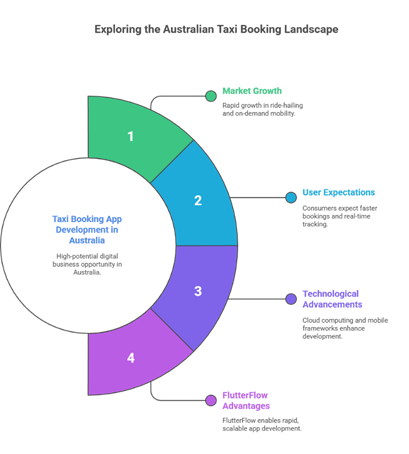
Several factors will combine to create an extremely attractive environment for taxi and ride-hailing apps in Australia by 2026. International tourist numbers are expected to increase due to increased international travel, large-scale events, and growing domestic tourism. At the same time, urbanization is expected to generate increasing demand for flexible transportation options, particularly in larger metropolitan and suburban regions. Users are also becoming increasingly comfortable with utilizing mobile app services and are expecting rapid availability, safety features, and tailored experiences from them, which further supports the decision to build a taxi booking app with FlutterFlow.
From a technological perspective, 2026 will be a fully formed phase for cloud computing, mobile framework support, and payment systems. Organizations will no longer require multi-year development times and/or millions of dollars to develop and deploy a competitive product. The move to a Minimum Viable Product (MVP)-first strategy provides entrepreneurs and founders with the opportunity to rapidly validate their ideas, adapt to user feedback, and scale their products when they prove the existence of market demand using a scalable taxi booking app architecture. This transition creates an opportunity for smaller startups and mid-size organizations to effectively compete against larger platforms by focusing on specific niches, geographic locations, and specialized mobility solutions.
FlutterFlow has developed itself into a popular, no-code and low-code development platform for creating production-ready mobile applications. In the context of taxi booking applications, FlutterFlow presents significant advantages in terms of the speed at which developers can build, test, and iterate while maintaining the ability to scale the applications to meet end-user demands, making it ideal to build a taxi booking app with FlutterFlow. Through its visual development process, developers are able to create complex user flows, integrate real-time location-based services, and integrate robust back-end systems much more rapidly than traditional coding processes.
In addition, FlutterFlow provides developers the capability to integrate scalable back-end systems such as Firebase, BuildShip, Supabase, REST APIs, and third-party services. These back-end integration capabilities enable developers to manage real-time ride tracking, driver matching, payments, and notifications more efficiently within FlutterFlow taxi app development workflows. As a result, for entrepreneurs planning to target the Australian market in 2026, FlutterFlow will provide a means to get their products to market more quickly, at a lower cost, and on a flexible platform that will allow them to expand to multiple cities and user bases while supporting long-term taxi booking app development in Australia.
2. Why Invest in a Taxi Booking Business in Australia by 2026
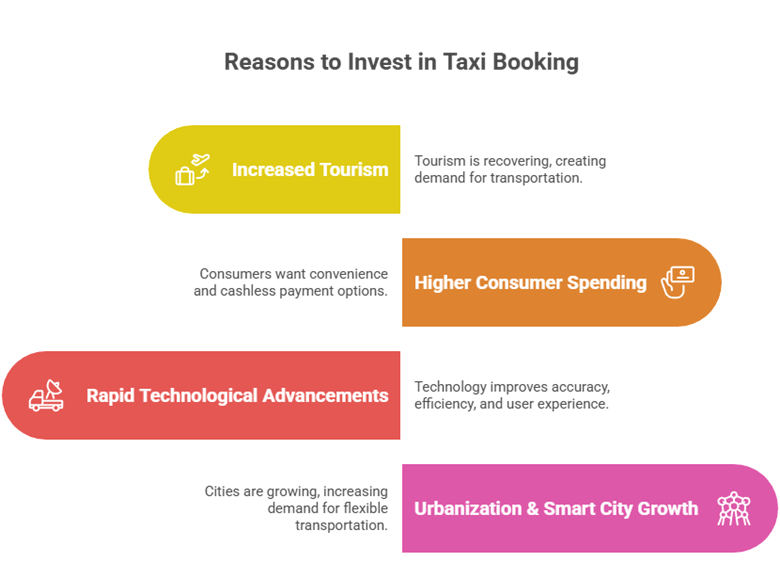
The conditions in Australia are positive for establishing and expanding a taxi-booking company, making taxi booking app development in Australia a strong long-term investment. A large number of people will be using app-based services for their mobility needs as they recover from the economic downturn, begin to change how they spend money, continue to develop technology, and expand into cities by 2026. This provides an ideal time for startup companies and other transportation-related businesses to establish themselves in the market with a new, scalable taxi-booking application built on a scalable taxi booking app architecture.
2.1 Increased Tourism & International Travel
Tourism in Australia is slowly rising back from the pandemic as international traveler numbers, domestic visitor numbers, and business tourism continue to grow. Cities throughout Australia will be hosting major international events (conferences, concerts, etc.) and sporting events and tournaments that will create an additional need for reliable and safe transportation options, accelerating taxi booking app development in Australia. Airports are still by far the largest source of demand for taxi service. Travelers are increasingly choosing to book their taxis through App’s because they provide transparency, a safer way to pay, and predictability of cost.
Travel between cities/urban centers is also growing, particularly for both business and leisure. Users of taxi Apps can now pre-book, track where their driver is at any time, and receive digital receipts. By 2026, it is estimated that demand from tourism will significantly contribute to the growth of On Demand Taxi Service in Australia, encouraging more businesses to build a taxi booking app with FlutterFlow.
2.2 Higher Consumer Spending on Mobility
The demand for convenience is rising amongst Australian consumers. Convenience is at its highest point with respect to transportation as mobile-first app-based taxi services provide instant availability, fare estimates, ease of use, and reduce the inconvenience of traditional booking systems supported by FlutterFlow taxi app development. As such, app-based taxi booking services have evolved from an occasional experience to an everyday utility and are now considered a necessary part of the consumers' routine.
Additionally, cashless payment options have increased consumer adoption and usage. With an increase in digital wallet usage, card usage, and online payment gateway usage across Australia, the expectation from users is for fast and secure transactional processes that do not require the use of physical currency. Therefore, as taxi apps enable consumers to select their preferred method of payment, view their receipts, and receive refunds, these taxi apps built using a scalable taxi booking app architecture will be very appealing to Australian consumers.
2.3 Rapid Technological Advancements
Technology is changing the way taxicab services are delivered. The improvement in GPS for more accurate pickups, route delivery, and more accurate time of arrival estimates has been made possible. With artificial intelligence-based matching systems, users can be connected to available drivers near them more efficiently, therefore decreasing wait times and increasing efficiency in the taxi industry as a whole, especially for platforms planning to build a taxi booking app with FlutterFlow.
Tracking in real time has moved from being a "nice" feature to an expected feature by users of taxi apps. Users expect to see where they are at all times, from when they book the cab to when it drops them off. And taxi app users also use this same technology to navigate from one location to another. In 2026, the taxi apps that do not provide the ability to track the user's experience smoothly through to drop off will be behind those that provide this level of technology and, therefore, will need to consider investing in FlutterFlow taxi app development or similar technology-driven platforms.
2.4 Urbanization & Smart City Growth
The four largest metropolitan cities of Australia — Sydney, Melbourne, Brisbane, and Perth — continue to grow at a rapid pace as they develop into megacities, strengthening the case for taxi booking app development in Australia. Smart city developments have increased demand for flexible and on-demand transportation as the population grows, and cities experience greater urban sprawl. Public transportation is a great way to travel within cities, but it does not provide for individual mobility demands at peak hours, late-night travel, or in new suburban areas that do not yet have an established public transportation system.
On-demand taxi booking apps fill this gap as they offer residents of each of these cities convenient and reliable access to transportation options when they are needed. These apps will fit well into the urban transportation systems of the future of each city due to their ability to be integrated into the broader smart city ecosystem and digital infrastructure investments made by each city using a scalable taxi booking app architecture.
3. Core Features of a Scalable Taxi Booking App
An affordable and expandable booking application for taxis isn’t merely about ordering an automobile – it's about creating a simple-to-use customer experience (for riders), empowering the drivers using your application, and providing the Administrator with complete authority of the business functions as part of taxi booking app development in Australia. In order for you to be successful in the competitive Australian Mobility Market, your application must be created around three important areas: the "Rider Application", "Driver Application", and "Admin Panel". The success of each component is paramount to building on reliability, scalability, and ultimately sustainability using a scalable taxi booking app architecture.
3.1 Rider App Features
1. User Registration & Authentication
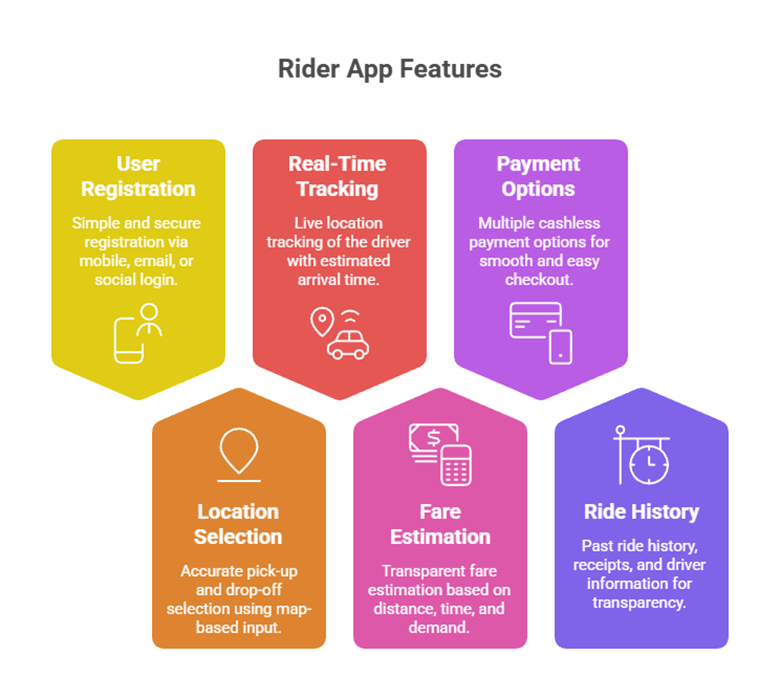
Registration of a user is the initial interface point for an Australian rider to engage with your company’s taxi service application as part of the taxi booking app development in Australia. Your application should therefore be able to provide a simple and efficient process for riders to register securely via mobile number verification, email login, or social login to authenticate their identity to ride when you build a taxi booking app with FlutterFlow. It is therefore critical that you minimize the friction in the onboarding process in order to make the process simple and secure for all Australian riders. A well-designed and implemented authentication flow will ensure that user data is protected while providing riders with a seamless experience when booking again in the future. The successful implementation of this component can also enable riders to receive personalized information from your company through the development of loyalty programs and targeted offers using FlutterFlow taxi app development.
2. Pickup & Drop-off Location Selection
The accurate and correct choice of pick-up and drop-off in a taxi booking application is the key to all taxi applications developed as part of taxi booking app development in Australia. The use of map-based location input makes it easy for users to choose a specific address or landmark, or their current location. The ability to do an auto-complete search on locations previously used by the user also adds to the ease of selecting a location when you build a taxi booking app with FlutterFlow. When designing an application that will be scalable, one must account for both dense urban areas and airport terminals, as well as airport terminals and suburban areas alike, when allowing users to select a location within a scalable taxi booking app architecture. Accurately selecting a user's location will decrease the amount of confusion a driver has with the selected location; thereby increasing the time a user takes to arrive at a destination, and ultimately affecting the level of satisfaction a customer feels about using the application.
3. Real-Time Ride Tracking (Google Maps)
The integration of Google Maps into the platform provides an accurate expectation for users to be able to track the current live location of their driver, along with the estimated arrival time and route of the driver in real-time when you build a taxi booking app with FlutterFlow. Real-time tracking is expected by users and enhances the level of transparency, and builds confidence that will help establish a good relationship between the rider and the driver (especially when it comes to a new rider or a late-night trip). In addition, from a scalable perspective, the application must maintain stability while handling high-volume peaks and enable automatic notifications to the rider (i.e., driver's arrival and trip completion) to enhance the overall user experience within a scalable taxi booking app architecture.
4. Fare Estimation & Surge Pricing
A transparent fare is a key factor in building confidence among consumers. Therefore, a scalable taxi app will have to estimate fares with regard to distance, time, and demand before starting the trip as part of taxi booking app development in Australia. The surge price calculation mechanism will allow operators to optimize peak hour demand while ensuring service remains available. Clearly explaining fare changes to consumers (especially in Australia) is important for building consumer confidence and for providing transparency regarding the cost of their fare; Dynamic pricing strategies are also made possible through this type of functionality to enable a business to increase its revenue without negatively impacting the level of satisfaction from customers.
5. Multiple Payment Options
Modern customers expect to have flexible ways of paying for their products or services. Ensuring that your application supports multiple ways of making a cashless payment (i.e., Apple Pay, Google Pay, Card Payments, PayPal, Stripe) is a core requirement in taxi booking app development in Australia and will ensure that the user can check out as smoothly as possible. This type of payment method reduces the operational complexity of managing and processing payments and ultimately speeds up the completion of a trip. On an operational level, this allows you to automatically process invoicing and refunds on behalf of the customer and automatically calculate the amount of commission owed to you from each transaction. The payment platform needs to scale and be both secure and reliable so that it meets the financial regulatory requirements of Australia.
6. Ride History, Ratings & Reviews
Past ride histories enable users to see their previous trips as well as their receipts for each trip and information about the drivers that provided those rides, which will help create a more honest and professional experience on the app built using FlutterFlow taxi app development. The ratings and reviews from users will also help promote quality services and provide an incentive for good service and accountability. In addition, when analyzing the historical ride data of all users over a long period of time, it is possible to identify trends in how drivers are performing, solve problems with regard to the dispute resolution process, and build confidence among the riders utilizing the app. When expanding the operation of the app, past ride history can become an excellent source of data to better understand user behaviors and assess the overall quality of service.
3.2 Driver App Features
1. Driver Onboarding & Verification
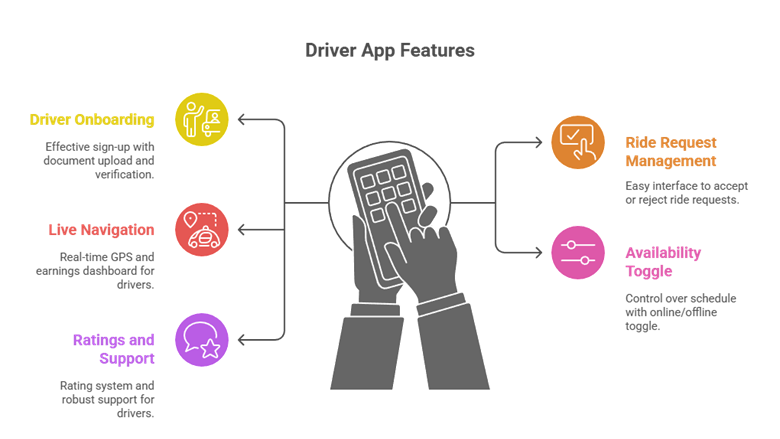
An effective driver sign-up process is key to expanding the size of your platform as part of taxi booking app development in Australia. The process should include uploading documents, verifying the individual's identity, providing information about the vehicle, and completing a background check. Since Australia has strict regulations regarding compliance and safety, these processes must be clearly defined and well-organized to ensure the successful implementation of the verification workflows. Additionally, having a scalable system that enables administrators to approve, reject, or suspend drivers as needed, while maintaining high-quality processes across all cities using a scalable taxi booking app architecture, will be important for expansion.
2. Ride Request Management (Accept/Reject)
The most efficient way for a driver to manage ride requests will be through an easy-to-use and fast interface when you build a taxi booking app with FlutterFlow. Drivers should receive notifications when there is a ride available near them, and they should have an option to either "accept" or "reject" the ride. There also needs to be logic built into the system to automatically cancel the ride after a certain amount of time if the driver does not respond. This will provide fairness in terms of how rides are distributed and minimize downtime for drivers. As your platform expands, you'll want to utilize smart match logic to optimize the allocation of rides to each driver, based on the driver's availability and the demand from riders.
3. Live Navigation & Earnings Dashboard
Real-time GPS navigation is helpful to ensure the driver reaches the rider's pickup and drop-off location as efficiently as possible in taxi booking app development in Australia. The earning tracker dashboard will provide drivers with real-time information regarding completed trips, total daily income, and any applicable incentives. By providing transparency into the earning potential of driving on your platform, you will build credibility and loyalty among your drivers. This feature will also enable you to track performance and incentivize your drivers to remain active on your platform as your platform expands through FlutterFlow taxi app development.
4. Availability Toggle & Shift Management
You want to provide your drivers with complete control over their schedule. Your platform should include a simple toggle that allows the driver to turn themselves "online" or "offline," as well as a mechanism to create and manage shifts to help drivers plan their work schedule. This will be particularly valuable in cities where demand fluctuates throughout the day. As your platform grows, using a scalable taxi booking app architecture, having this type of functionality will ensure that you always have enough drivers available to meet the increased demand during peak periods.
5. Ratings, Reviews & Support
Your rating system will measure the quality of service provided by your drivers, which will ultimately help maintain the standard of service expected by your riders. Having a robust support system for your drivers will provide them with a means to quickly report issues, ask for assistance, or dispute issues that arise. Implementing this type of support system will create a positive environment and reduce the likelihood of driver churn as your platform expands within taxi booking app development in Australia.
3.3 Admin Panel Features (Enhanced for Scalability)
While riders and drivers can engage with their respective mobile applications, an admin panel is the operational backbone for a scalable taxi-booking business as part of taxi booking app development in Australia that will allow it to be managed by Administrators who use the Admin Dashboard to oversee its operation, resource management, regulatory compliance, and business performance. The design of the admin panel is critical to enable a scalable taxi-booking business to expand from one city to many cities throughout Australia with consistent service delivery, efficient operations, and profitable business outcomes supported by a scalable taxi booking app architecture.
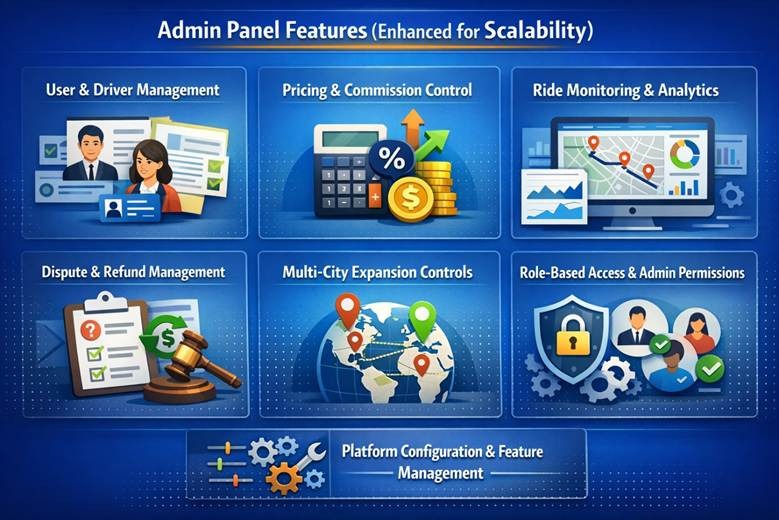
1. User & Driver Management
Admin Panel user and driver management capabilities are some of the most important features for admins to utilize when you build a taxi booking app with FlutterFlow. The primary function of the admin panel is to provide admins with the ability to see all riders/drivers, to verify, approve, suspend, deactivate, etc., both rider and driver account(s) from a single dashboard. For drivers, this would include: documentation verification (i.e., IDs, driver's license, vehicle registration, and insurance documents); and it will be particularly relevant for Australian-based drivers due to the high level of regulations and restrictions that need to be met in terms of compliance and safety standards.
For scalability purposes, it is necessary to have advanced searching/filtering options to deal with large numbers of users based in different regions, for example, tracking a driver's performance history, onboarding status, and other activity in real-time. This feature is designed to ensure that your services are consistent at all times, issues can be resolved quickly, and the onboarding process is streamlined as you expand into additional cities using FlutterFlow taxi app development.
2. Pricing & Commission Control
Pricing and Commission Management are critical to revenue and business flexibility in taxi booking app development in Australia. Admin users should be able to manage Base Fare, Per Km Rate, Time Pricing, and Surge Multiplier by City/City Zone for each region. In Australia, this is particularly relevant as the pattern of demand varies significantly from Metro to Suburbs.
Customizing pricing strategies on an individual basis allows businesses to remain competitive and protect profit margins as the business grows. Consistent pricing controls with transparent options help to minimize disputes and maintain consistency throughout the entire ecosystem.
3. Ride Monitoring & Analytics
Real-time tracking enables platform managers to see how everything is functioning within a scalable taxi booking app architecture. From the administrative side, managers are expected to have access to all rides currently running, completed rides, cancelled rides, and available drivers at all times using a live dashboard. Managers can also quickly respond to any emergencies, rider complaints, or service interruptions that occur in real time.
Historical analytics are used in addition to real-time data. Analytical tools provide historical data such as total number of rides completed per week/month/quarter; peak hours of operation; average fare per ride by location; and city-by-city performance metrics. The data will allow managers to make informed decisions regarding where to focus their marketing efforts, manage the supply of drivers to meet demand, and plan for future geographic expansions throughout Australia's largest cities.
4. Dispute & Refund Management
Any ride-hailing platform will inevitably have disputes at some level with a large number of users. As a result, an effective dispute resolution process would provide a method for administrators to evaluate complaints from users regarding a wide range of subjects, such as fare pricing, driver behavior, cancellations, and service quality within taxi booking app development in Australia. In evaluating complaints, administrators will be able to view ride information, chat history, and payment records to support their decision-making processes.
Refunds must also be handled appropriately by providing administrators with the capability to issue refunds on either a partial or total basis through an integrated payment processing system. The administration of disputes in a professional manner enhances customer confidence, protects the brand image, and minimizes the loss of customers (churn)—all essential elements for sustainable business growth and survival in a highly competitive market environment such as Australia.
5. Multi-City Expansion Controls
The ability to scale is based on the ability of a platform to expand past its original area using a scalable taxi booking app architecture. The multi-city control allows admins to bring on board additional cities without disturbing the current operation. This also includes city-specific pricing, management of local drivers, and measuring of regional performance metrics.
In Australia, as each city has a different demand for services and regulatory requirements, companies must have a system that provides flexibility but also centralization in order to ensure that growth from city to city can be achieved with consistent operation, compliance, and high-quality service throughout the platform.
6. Role-Based Access & Admin Permissions
The more a company expands its operations, the higher the likelihood is that an increasing number of teams will have to use the Admin Panel in order to perform their daily duties while scaling taxi booking app development in Australia. Therefore, role-based access control enables companies to establish permissions that fit the roles within their organization, such as support staff, finance teams, etc., as well as operations managers; in doing so, companies can protect the integrity of their data and prevent unauthorized changes to critical settings in the Admin Panel.
In the long term, this functionality improves productivity by enabling teams to complete tasks independently while still providing the necessary oversight at the company level. Also, this function provides a means for creating audit trails and therefore enhances accountability — two very important features for organizations with enterprise-level capabilities.
7. Platform Configuration & Feature Management
The configuration of Admin settings (e.g., Ride Types, Promotions, Payment Methods, Notifications) can allow for enabling or disabling these admin functions without having to push an app update when you build a taxi booking app with FlutterFlow. This will provide the ability for rapid prototyping, seasonally based marketing, and feature rollouts.
In terms of scalability, using configuration-based administrative controls means that the platform can rapidly adjust to market fluctuations, customer feedback, and/or changing business objectives without incurring redevelopment costs, reinforcing long-term success through FlutterFlow taxi app development.
4. Step-by-Step Process to build a taxi booking app with FlutterFlow
To develop a scalable taxi-booking application, it is necessary to follow an organized process, especially when focusing on taxi booking app development in Australia. FlutterFlow helps to simplify the process by combining the development of the user interface (UI) / user experience (UX) with back-end development, making it easier to build a taxi booking app with FlutterFlow. Below is a detailed explanation of how to develop a taxi-booking application using FlutterFlow, from the initial configuration of the application to the deployment of the final application ready for use in production.
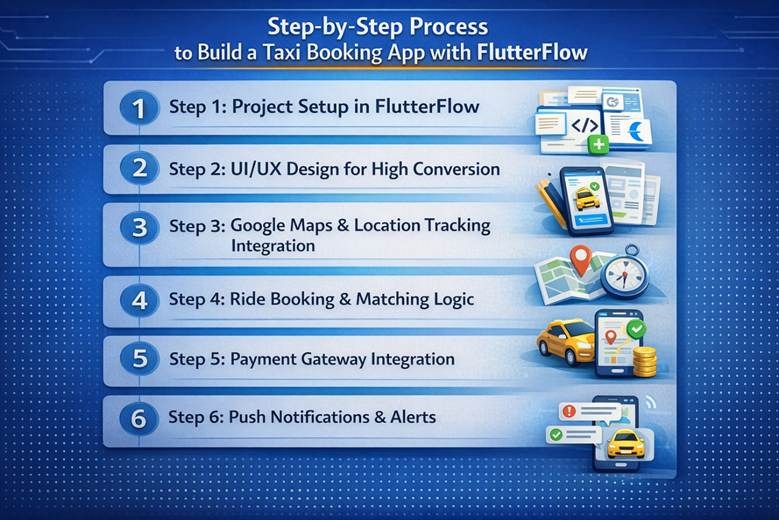
Step 1: Project Setup in FlutterFlow
Initial configuration of the application architecture in FlutterFlow refers to configuring the general structure of the application, the navigation paths between the various pages or components, and the data models for the application's riders, drivers, and administrators. This stage is fundamental in FlutterFlow taxi app development, as the most important aspect of developing an architecture that is scalable is to ensure that it is possible to add additional features, cities, and roles without having to modify the base code of the application.
One of the primary aspects of establishing the architecture of an application is role-based access. The application must provide distinctly separate user experiences for the riders, drivers, and administrators of the application, each providing the specific permissions and workflows required by the respective user types. FlutterFlow provides a method to develop conditional logic, as well as screens that are dynamic based on the user type, which are used to establish the role-based access.
Establishing a strong foundation for the architecture of an application is a critical component for ensuring that the application operates securely, efficiently, and transparently as it grows across multiple geographic regions within Australia, supporting a scalable taxi booking app architecture.
Step 2: UI/UX Design for High Conversion
The user experience is one of the most significant contributors to the success of any taxi-booking application, particularly in competitive markets involved in taxi booking app development in Australia. Through the use of FlutterFlow, designers can develop clean, simple interfaces that facilitate the process of guiding users from the initial onboarding process through to the completion of the booking process. Separate flows for riders and drivers must be developed to focus on the ease of use, speed, and clarity of the process for each user type when you build a taxi booking app with FlutterFlow.
Development of a mobile-first application ensures that the application performs properly regardless of the size of the device's display or the type of device that is used to view the application. Elements of design that contribute to accessibility include easily readable fonts, buttons that are easy to understand, and navigation that is logical and intuitive. A well-developed user experience not only contributes to increasing conversion rates but also contributes to reducing the need for support and improving the retention of users — both of these factors are significant contributors to scalability in highly competitive markets within Australia and align closely with FlutterFlow taxi app development best practices.
Step 3: Google Maps & Location Tracking Integration
Real-time tracking of a user's location is at the heart of a taxi-booking application and is a core requirement when designing a scalable taxi booking app architecture. Integration of Google Maps provides real-time location updates of the user, route visualization, and the ability to calculate distances. FlutterFlow provides map widgets and APIs that enable developers to seamlessly integrate real-time tracking into the application while continuing to build a taxi booking app with FlutterFlow.
In addition to capturing the user's pickup and drop-off locations, real-time tracking of the driver, and estimating the time of arrival for the driver, the integration of Google Maps provides the ability to track the user's location accurately in real-time. Providing users with accurate and reliable information regarding their location contributes to building trust among users, reducing cancellations, and creating a positive experience for users — all of which are essential outcomes of successful taxi booking app development in Australia.
As the platform continues to grow, ensuring that the application operates efficiently in terms of handling large amounts of real-time location data is crucial for maintaining performance during periods of high usage, particularly in large-scale FlutterFlow taxi app development projects.
Step 4: Ride Booking & Matching Logic
Logic for booking rides and matching rides defines the methods by which users book rides and how drivers are assigned to the booked rides, which is a core component of taxi booking app development in Australia. The logic for booking rides must determine which available drivers are closest to the pick-up location of the user, send a request to the selected drivers to accept the ride, and manage the responses from the drivers in real-time. FlutterFlow provides the tools to develop the logic for booking rides visually and integrate the logic with backend workflows that support real-time updates, making it easier to build a taxi booking app with FlutterFlow.
The lifecycle of the status of the ride — requested, accepted, arriving, in progress, and completed — must be established and coordinated among all users of the application (riders and drivers). Establishing a scalable method for matching rides minimizes delays between users requesting rides and users accepting the rides, manages the balance of demand and supply of rides, and creates a seamless experience for users regardless of the volume of users, which is essential for a scalable taxi booking app architecture and effective FlutterFlow taxi app development.
Step 5: Payment Gateway Integration
Secure and flexible payment processing is essential for modern taxi applications, especially when focusing on taxi booking app development in Australia. Integration of payment gateways such as Stripe and PayPal allows users to make payments electronically using credit cards and digital wallets. FlutterFlow provides secure payment workflows that process transactions, refund transactions, and confirm payment, supporting businesses that want to build a taxi booking app with FlutterFlow.
In addition to processing payments, wallet functions may be integrated to support promotional offers, credits, and partial refunds to users. In the context of the Australian market, the application must account for taxes, including Goods and Services Tax (GST), and invoicing requirements. A well-integrated payment system provides financial transparency to users, reduces the number of disputes, and facilitates long-term scalability as part of a robust scalable taxi booking app architecture.
Step 6: Push Notifications & Alerts
Push notifications inform and engage users throughout the lifecycle of the ride and are a critical engagement layer in FlutterFlow taxi app development. Notifications for confirmation of the ride, arrival of the driver, completion of the ride, and payment status enhance communication and minimize uncertainty for users.
FlutterFlow provides tools to integrate with push notification services, enabling developers to send notifications to both riders and drivers in real-time while they build a taxi booking app with FlutterFlow. As the platform expands, automated notifications are essential to maintaining smooth operation and maximizing the quality of the user experience. The proper implementation of notification logic ensures that users receive timely and relevant notifications without receiving excessive notifications, contributing to increased satisfaction and retention in large-scale taxi booking app development in Australia.
5. Backend & Database Architecture for Scalability
The success of a taxi booking app is highly dependent upon how effectively the backend has been developed, especially for taxi booking app development in Australia. The Backend manages all the critical components of a taxi booking app, including real-time communication between the rider and driver, Ride coordination, payment processing, Notifications, and data security. As the number of users increases in major cities such as Sydney, Melbourne, Brisbane, and Perth, the backend will need to continue to be dependable, responsive, and secure within a scalable taxi booking app architecture. This scalability of the backend is possible through the use of FlutterFlow, which allows teams to build a taxi booking app with FlutterFlow by supporting modern backend technologies that can grow with the business and not limit it, making it ideal for FlutterFlow taxi app development.
5.1 Using BuildShip as Backend
Event-Driven Workflows
Event-based workflow processes help with applications related to booking taxis in real-time and are a core requirement for taxi booking app development in Australia. User behavior is used to have instant action taken based on an application’s design. Workflows using BuildShip are triggered directly through events like a ride being requested, a driver accepting the ride, the ride being completed, or payment confirmation. The need to continuously poll the application is removed with BuildShip. The example of a rider requesting a trip with BuildShip can immediately create a workflow for driver matching, notification delivery, and fare calculation. Event-based workflow processing helps to keep an application operating efficiently when it is at its most demanded (ie, at peak hours), therefore making it suitable for the Australian market and aligning with a scalable taxi booking app architecture.
Real-Time Updates
To be competitive in today's on-demand ride-hailing market, each stakeholder (riders, drivers, admin) must have real-time access to all of their respective data related to the ride, especially when you build a taxi booking app with FlutterFlow. The buildship platform provides a real-time update capability for driver and rider actions, including status changes, driver location updates, cancellation of rides, and confirmation of payments. To ensure consistency with scalable ride-hailing platforms, buildship’s architecture is designed to provide real-time updates while allowing for thousands of rides to occur concurrently. By doing so, buildship's architecture allows for low-latency and reliable data exchange with the end-user during peak usage times (such as events, airport surge pricing, etc.), thus contributing to increased levels of user trust and satisfaction in FlutterFlow taxi app development.
Secure API Management
As BuildShip grows in use, so does the need for increased protection. To ensure the safety of all stakeholders, BuildShip offers a robust and scalable way to manage the security of APIs. Through mandatory authentication and authorization, along with role-based access control, the rider, driver and admin roles will be able to view and manipulate only the data and perform the actions relevant to each of these roles. Also, sensitive information including user data, payments and ride history will be stored securely on secure endpoints. Strong API Security is key to maintaining the compliance standards and preventing data breaches and loss of user trust, when operating large-scale taxi platforms across Australia's major cities as part of taxi booking app development in Australia.
5.2 Firebase – Real-Time & Rapid MVPs
A major use of Firebase is to build very fast and responsive MVPs (minimum viable products), especially in taxi booking app development in Australia. The ability of the real-time database to synchronize data instantly makes it perfect for things like "live" ride tracking, updating the drivers' status, and confirming bookings. Firebase authentication also makes it easy to onboard users, and Cloud Functions provide the necessary back-end logic to develop an MVP quickly when you build a taxi booking app with FlutterFlow.
When a startup wants to launch a taxi application in Australia and needs a way to be able to test their application and get it out to the public quickly, and with little need to worry about managing the underlying infrastructure, they may want to consider Firebase as part of FlutterFlow taxi app development. When the number of users increases, Firebase can increase its horizontal capabilities, which gives it a good head start for early-stage platforms while still supporting a scalable taxi booking app architecture.
5.3 Supabase – SQL-Based Scalability
The primary difference between Supabase and other alternatives is its structured, SQL-based backend, which gives developers much better control over the relationships of the data and complex queries. For example, a taxi application requires reporting, analytics, and transactional consistency, especially for taxi booking app development in Australia.
Supabase is designed to allow developers to create rides, users, payments, and commissions through relational data; this makes long-term scalability much easier within a scalable taxi booking app architecture. For Australian platforms wanting to expand into multiple cities, Supabase supports more advanced queries, performance optimizations, and data integrity, making it a strong option when you build a taxi booking app with FlutterFlow, in addition to being a good choice for mature and data-driven taxi businesses.
5.4 REST APIs – Third-Party Integrations
REST APIs are ideal for FlutterFlow apps to easily connect to third-party services (payment gateway, maps, CRM systems, etc.) in addition to using the built-in capabilities of FlutterFlow. This method is best suited for use when integrating your app with an existing system or platform that has been created for a specific purpose. The REST API model provides both consistency and adaptability; therefore, if your taxi application grows and changes, you can continue to modify it without having to rely on a single backend service provider. Additionally, REST APIs help enable scalability within taxi apps and support FlutterFlow taxi app development by providing ease of integration with additional services, partners, and features as the business requirements change.
5.5 GraphQL – Optimized Data Fetching
GraphQL helps improve performance by enabling clients to fetch only the necessary data from the server instead of fetching all data. As a result, this eliminates network traffic and minimizes response time, which can be very beneficial to taxi apps that have high data usage. For highly scalable platforms that are capable of supporting thousands of concurrent users at one time, GraphQL enables data to be delivered efficiently while also providing flexibility within a scalable taxi booking app architecture. Therefore, as taxi apps grow in size and expand across Australia, GraphQL will continue to support fast and reliable performance as data complexities increase.
5.6 SMS, Email & AI APIs
Automation and communication are key components of an efficient and scalable taxi system. SMS API’s (application programming interface) allow users to receive one time passwords (OTP), alert riders of their rides, notify drivers of upcoming trips, etc., which is essential for taxi booking app development in Australia. Email API’s allow taxi apps to send receipts to users as well as support requests and updates on user accounts. AI API’s will help improve the operational experience through smart driver matching, predictive demand and automated customer service. The integration of all of these technologies will allow taxi apps built through FlutterFlow taxi app development to provide a better, more personal experience to users while reducing the manual work required. These types of integrations will be crucial to the operational success of a growing taxi app and its ability to satisfy its user base.
6. Testing & Deployment Strategy
Deploying and testing are the last two stages of developing a scalable taxi booking app architecture as part of taxi booking app development in Australia. The app's design may be the best possible design; however, it is likely to fail if the app cannot function consistently in the real-world environment. Testing an Australian taxi platform will need to confirm that the app functions as intended (functionality), performs well (performance), is secure (security), and complies with regulatory requirements (compliance) prior to releasing to customers when you build a taxi booking app with FlutterFlow. A defined deployment approach enables easier app store approvals and enhances overall application longevity, especially for teams focused on FlutterFlow taxi app development.
6.1 Functional Testing
1. Booking Flow Testing
Booking flow testing is used to test whether the full ride process has worked from start to finish in taxi booking app development in Australia. This includes checking whether you can select your pickup and drop-off points, confirming the ride, assigning a driver, checking on the status of your ride, and completing the ride when you build a taxi booking app with FlutterFlow. Each component of the booking process must work correctly across multiple devices and varying internet conditions as part of FlutterFlow taxi app development. Booking flow testing must also include edge cases (i.e., when the user's location changes, cancels the ride, or experiences a timeout) to ensure that they function as expected. The booking flow process directly impacts the overall experience of a customer and will significantly reduce friction for customers who book rides through the app, provide clarity and certainty to avoid confusion for customers, and result in an increased confidence level by the customers in using the App, especially in relation to the scalable taxi booking app architecture required for busy metropolitan cities in Australia.
2. Payment Testing
Payment testing verifies that all payment processing occurs properly and securely within a scalable taxi booking app architecture. It covers all possible payment types, including successful payment, unsuccessful payment, partial charge, refund, and wallet deduction. Testing must also verify all forms of payment, including credit/debit cards, digital wallets, and third-party payment gateway providers such as Stripe and PayPal, which are commonly integrated during FlutterFlow taxi app development. Payment testing is crucial for Australian customers due to the strict guidelines regarding accurate fare calculation and taxation in taxi booking app development in Australia. Accurate payment processing will increase the user's confidence in the use of the application, build their trust, ensure compliance with relevant laws and regulations, and ultimately prevent revenue loss when you build a taxi booking app with FlutterFlow.
3. Driver Matching Testing
The driver matching logic of the application must be tested under many different circumstances to determine if it operates efficiently and fairly within a scalable taxi booking app architecture. Testing may involve verifying the ability of the application to detect nearby drivers, testing the flow of accepting/declining a ride offer, and testing fallback mechanisms when there are no drivers available, especially when you build a taxi booking app with FlutterFlow. Simulating peak hour usage of the application is useful to test how well the system performs during periods of high usage, a critical requirement for taxi booking app development in Australia. Reliability in the performance of the application will result in lower wait times for riders, improved service levels, and a fairer workload distribution for the drivers across large-scale FlutterFlow taxi app development deployments.
6.2 Performance & Load Testing
1. Concurrent Rides Testing
This type of testing checks the capacity of a System to handle several active rides at the same time as part of a scalable taxi booking app architecture. It also assesses whether a System can process some bookings at the same time, whether it can handle updates from drivers, and whether it can process payments for the rides while all these events are happening when you build a taxi booking app with FlutterFlow. Load testing software will simulate a variety of high-traffic scenarios to determine where performance problems occur with a System during FlutterFlow taxi app development. With an increasing amount of taxi app users in metropolitan Australian cities, Systems that operate them must be able to efficiently manage concurrent rides when there is high demand in taxi booking app development in Australia.
2. Real-Time Tracking Stability Testing
Testing the stability of the real time location updates of a system involves checking to see if the location updates on a real-time basis stay up to date and are delivered in a timely manner within a scalable taxi booking app architecture. The testing of real-time tracking includes testing the GPS accuracy, the rendering of maps, and the delivery of updates as they are generated by a user's device or other sources of data, especially when you build a taxi booking app with FlutterFlow. If a System has stable real-time tracking, users will be confident in the information they receive about their rides, and the Drivers will be efficient in their operation. As the number of users increases, so does the number of locations being tracked. Testing for real-time tracking stability will help prevent delays to the ETA (Estimated Time of Arrival), synchronization problems, and incorrect delivery of information across large-scale FlutterFlow taxi app development deployments in taxi booking app development in Australia.
6.3 Security & Compliance Testing
1. User Data Protection Testing
Testing for the protection of users' private data (such as their address, phone number, location history, etc.) ensures that this type of sensitive information is properly secured when it is being stored or transmitted by a platform built using a scalable taxi booking app architecture. Access control and the encryption of communication should also be tested on an ongoing basis to ensure compliance in Australia, especially when you build a taxi booking app with FlutterFlow. Testing for security on an ongoing basis will lower the potential for a breach and increase consumer trust in large-scale FlutterFlow taxi app development projects focused on taxi booking app development in Australia.
2. Payment Security Testing
Security testing for payments verifies that payment processing meets the appropriate security standards of its industry within a scalable taxi booking app architecture. The testing includes the verification of encryption used during transmission, that API calls are made securely, and that there are adequate fraud prevention measures in place to protect consumers and the company from potential financial losses or legal repercussions when you build a taxi booking app with FlutterFlow. Strong payment security is especially critical for taxi booking app development in Australia, where compliance, consumer protection, and financial regulations are strictly enforced across FlutterFlow taxi app development platforms.
7. App Deployment
7.1 Google Play Store (Android)
Deploying a taxi booking app built with FlutterFlow on the Google Play Store requires thorough testing across multiple Android devices and OS versions. Ensuring stable performance, proper permissions, and accurate app metadata improves approval chances and user confidence. Post-launch monitoring and updates are critical to maintaining app quality, security, and compliance, especially for taxi booking app development in Australia targeting large metropolitan cities.
7.2 Apple App Store (iOS)
Apple’s App Store enforces strict review guidelines focusing on performance, privacy, and design quality. When you build a taxi booking app with FlutterFlow, preparing complete documentation, testing thoroughly, and adhering to Apple's best practices reduces rejection risks. Ensuring Apple compliance is essential for long-term success and builds trust with users in FlutterFlow taxi app development projects.
7.3 Store Guidelines & Approval Tips
Understanding both Google Play and Apple App Store guidelines helps avoid delays or rejections during deployment. Clear privacy policies, accurate app descriptions, and fully compliant features streamline approvals. A well-planned deployment strategy ensures faster app launches, smoother updates, and scalability as the taxi booking app expands across multiple Australian cities.
8. What You Can Learn from Successful Taxi Apps
Global ride-hailing platforms like Uber and Lyft have reshaped how people move around cities. While they operate at a massive scale, the principles behind their success are highly relevant for startups and regional taxi businesses in Australia. By understanding what makes these platforms work, founders can design scalable, reliable, and user-centric taxi booking apps—without needing the same level of resources.
8.1 Uber: Global Scalability & Real-Time Reliability

Dynamic Pricing
One of Uber’s most powerful features is its dynamic pricing model, often referred to as surge pricing. This system adjusts fares based on demand, availability of drivers, location, and time of day. During peak hours, events, or bad weather, dynamic pricing helps balance demand and supply while ensuring drivers are incentivized to stay active. For taxi booking app development in Australia, implementing transparent and well-communicated surge pricing can significantly improve service availability without frustrating users. The key lesson is not just increasing prices, but using data intelligently to maintain reliability and operational efficiency as the platform scales. Building these features is seamless when you build a taxi booking app with FlutterFlow, leveraging tools to manage fare calculations, surge multipliers, and real-time pricing updates as part of a scalable taxi booking app architecture.
City-Level Rollout Strategy
Uber did not scale globally overnight. Instead, it followed a city-by-city expansion strategy, adapting pricing, driver onboarding, and operations to local market conditions. Each city was treated as an independent ecosystem with its own demand patterns, regulations, and user behavior. For Australian founders, this approach is highly relevant. Launching in one city, validating the model, and then expanding to others like Melbourne, Brisbane, or Perth allows controlled growth. Using FlutterFlow taxi app development, founders can implement city-specific features, pricing, and driver workflows efficiently, ensuring that a scalable taxi booking app architecture supports expansion without disrupting existing operations. This strategy reduces risk, ensures better quality control, and makes scalability manageable rather than overwhelming.
8.2 Lyft: User Experience & Community Trust
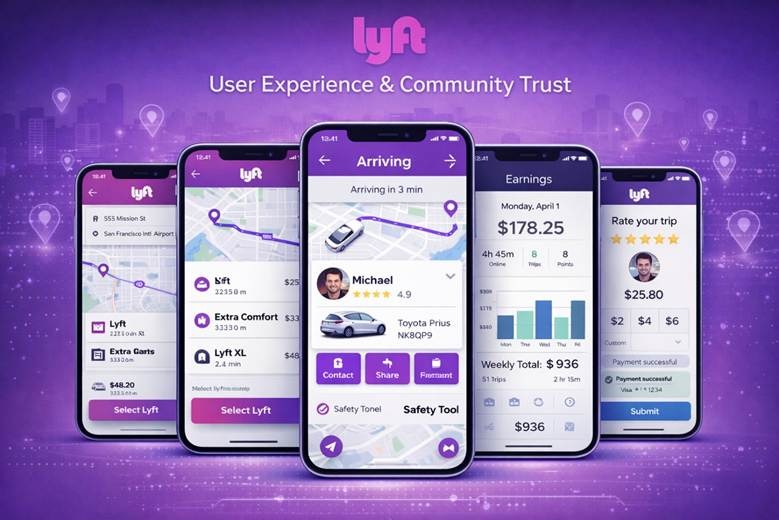
Simpler UX
Lyft’s success is largely driven by its focus on simplicity and ease of use. The app minimizes unnecessary steps, making booking a ride fast and intuitive. Clear navigation, straightforward pricing, and friendly visual design contribute to a stress-free user experience. For taxi booking app development in Australia, simplicity in UX can be a key differentiator in a competitive market. A cleaner UX reduces onboarding friction, improves retention, and lowers support costs. When you build a taxi booking app with FlutterFlow, you can design a streamlined interface that enhances usability while maintaining a scalable taxi booking app architecture, ensuring the app grows without complicating the user experience.
Driver-Focused Features
Lyft places strong emphasis on driver satisfaction, offering transparent earnings, incentives, and support tools. Driver-friendly features help maintain a reliable supply of drivers, which directly impacts rider experience. For FlutterFlow taxi app development, investing in driver-centric design leads to better service quality and lower churn. Features such as clear earnings dashboards, flexible schedules, and responsive support systems create a healthier platform ecosystem. Balancing rider and driver needs within a scalable taxi booking app architecture is critical for sustainable growth and long-term success in the Australian market.
9. How FlutterFlow Enables Apps Like Uber & Lyft
9.1 Faster Development Cycles
FlutterFlow taxi app development dramatically reduces development time by allowing teams to visually build complex mobile apps. This enables faster MVP launches, quicker iterations, and shorter feedback loops. For startups looking to enter the market, speed is a critical advantage in taxi booking app development in Australia, allowing founders to validate their ideas and scale quickly.
9.2 Visual Logic + Custom Code
Building a taxi booking app with FlutterFlow combines visual workflows with the ability to add custom code when needed. This hybrid approach allows developers to implement complex logic, such as ride matching, dynamic pricing rules, and notifications, without sacrificing flexibility. It ensures a scalable taxi booking app architecture while maintaining efficiency in development and deployment.
9.3 Scalable Backend Integrations
FlutterFlow supports seamless backend integrations with platforms like BuildShip, Firebase, Supabase, REST APIs, and GraphQL. This makes it possible to develop real-time, high-performance taxi apps that scale effortlessly as the number of riders and drivers grows. Leveraging these integrations is essential for FlutterFlow taxi app development aimed at the Australian market.
9.4 Lower Cost Than Traditional Development
Compared to conventional app development, FlutterFlow taxi app development reduces both development and maintenance costs significantly. This allows startups and regional businesses to compete effectively in taxi booking app development in Australia, even without large budgets, while ensuring a scalable taxi booking app architecture that supports long-term growth.
10. Estimated Cost & Timeline for a Taxi Booking App in Australia (2026)
The estimated time and budget to create a taxi booking app in Australia will vary depending on the scope, regulatory compliance requirements, and growth ambitions. Below is a realistic estimate of the time and budget required to develop an MVP and then expand it into a fully scalable platform.
10.1 MVP Development (6–8 Weeks)
An MVP allows you to quickly validate your business model in a specific city as cost-effectively as possible. While limited in features, it is functional and enables early feedback on pricing, user experience, and demand. With FlutterFlow taxi app development, creating the UI is fast, and integrating tools like BuildShip or Firebase enables real-time backend functionality efficiently. The MVP will include basic rider and driver apps, essential booking flows, and limited admin controls, helping startups launch quickly in taxi booking app development in Australia.
10.2 Scalable Version 1 (V1) – 3 to 4 Months
After validating your MVP, Version 1 (V1) focuses on reliability and scalability. Key improvements include multi-city support, dynamic pricing, advanced driver onboarding, wallet systems, refund handling, analytics dashboards, and enhanced security. For taxi booking app development in Australia, V1 must comply with payment standards, privacy laws, and app store requirements. Building a taxi booking app with FlutterFlow allows the backend and front-end architecture to scale efficiently, handling multiple riders and drivers concurrently, with minimal delays during peak hours. FlutterFlow’s modular architecture ensures that new features can be added without rewriting the app, making the platform ready for public release and commercial expansion.
10.3 Feature Expansion Roadmap (Post-Launch Growth
Post-launch growth requires a clear roadmap to stay competitive and retain users. Potential features include AI-powered driver matching, predictive demand analysis, loyalty programs, corporate bookings, subscription pricing, and smart city integrations. For example, Australian expansions may involve airport partnerships, EV support, carbon tracking, and accessibility features. Using FlutterFlow taxi app development, these features can be added incrementally and cost-effectively, avoiding large-scale redevelopment cycles. This ensures that the app maintains a scalable taxi booking app architecture while adapting to market changes in real-time.
10.4 Why This Approach Works in 2026
Dividing the development into MVP, V1, and expansion phases reduces financial risk while maximizing flexibility. build a taxi booking app with FlutterFlow to benefit from rapid delivery, lower costs, and effortless scalability. This approach makes FlutterFlow the ideal platform for startups aiming to compete in taxi booking app development in Australia, ensuring that the application is reliable, adaptable, and growth-ready.
11. Common Mistakes to Avoid When Building a Taxi Booking App
Even with the best tools and a great idea for your taxi booking app development in Australia, several preventable strategic and technical mistakes can derail your project. Awareness of these pitfalls can save months of redesign, reduce unnecessary spending, and prevent user disengagement. Below are the top three mistakes founders make and how to avoid them.
11.1 Ignoring Backend Scalability
A critical error in FlutterFlow taxi app development is failing to prioritize backend scalability. Taxi-hailing applications depend heavily on real-time data, including driver availability and location tracking, which require a robust backend capable of handling thousands of concurrent requests. In busy Australian cities like Sydney, Melbourne, or Brisbane, peak demand at airports, events, and rush hours can quickly overwhelm poorly designed backends, resulting in failed ride matches, lost connections, and inaccurate ETAs. To avoid these pitfalls, it’s advisable to choose scalable backend solutions such as BuildShip, Firebase, or Supabase, and implement event-driven workflows from the start. Building for scale from the beginning ensures your scalable taxi booking app architecture can grow with demand without overcomplicating the initial design.
11.2 Overbuilding Before MVP Validation
Another common mistake is overbuilding the app before validating the core business model. Startups often invest heavily in advanced features like AI-powered driver recommendations, loyalty programs, or complex admin dashboards before testing whether users actually need them. Creating a minimum viable product (MVP) allows founders to validate pricing, rider behavior, and driver supply while keeping costs low. Using FlutterFlow taxi app development, founders can rapidly iterate, toggle features, and validate their ideas quickly. The key takeaway: build only what is necessary to demonstrate demand, and expand features based on real user feedback rather than assumptions.
11.3 Poor Driver Onboarding Flow
Drivers are the backbone of any taxi booking app development in Australia, and poor onboarding flows often lead to high churn. Lengthy registration, unclear verification processes, and lack of transparency regarding potential earnings discourage drivers from completing the sign-up process. In competitive markets like Sydney and Melbourne, drivers compare multiple platforms before committing. A seamless onboarding experience—featuring clear instructions, document uploads, verification timelines, and immediate access to earning dashboards—enhances retention and platform reliability. build a taxi booking app with FlutterFlow to provide guided forms, automated status updates, and transparent communication, ensuring a smooth onboarding experience and improving long-term driver engagement.
12. Conclusion
In terms of developing a taxi booking app development in Australia — and preparing for the new taxi and mobility laws coming into effect in 2026 — the Australian market is rapidly evolving. It has become increasingly competitive, technological, and experience-driven. Developing a taxi booking app today is not simply about launching first — it is about going to market smartly, validating quickly, and scaling with confidence. Here is why building a taxi booking app with FlutterFlow is the smartest solution for mobile mobility start-ups today:
FlutterFlow offers a low-code, highly extensible approach. This enables businesses to go-to-market quickly without sacrificing performance, security, or scalability. The FlutterFlow toolset allows founders to create fully functional, production-ready apps capable of tracking riders in real-time, managing complex booking rules, and expanding into multiple cities — all while controlling development timelines and costs.
An MVP-First Approach is Essential for Start-Ups. Rather than spending months or years building an overly large product, FlutterFlow taxi app development allows start-ups to launch a fully functional, market-ready MVP in just weeks. This approach enables founders to validate demand, test pricing models, understand rider behavior, and optimize driver onboarding using real-world data. After validation, the same scalable taxi booking app architecture can be extended into a robust Version 1 and beyond — without needing to rebuild the entire application. This incremental growth model reduces risk, preserves capital, and allows start-ups to adapt to evolving market conditions, regulatory changes, and customer expectations within Australia’s dynamic urban mobility ecosystem.
Scalability from Day One. With FlutterFlow, concerns about scaling are eliminated. Its ability to connect seamlessly to scalable backends such as BuildShip, Firebase, Supabase, REST APIs, and GraphQL ensures your platform can handle increasing ride volumes, peak-hour demand, and real-time updates as your business grows. Combined with modern payment integration tools, analytics, and notifications, FlutterFlow provides everything needed to develop a taxi booking app that is both stable and future-ready — all at a fraction of the cost of traditional development. This makes quality software development accessible to start-ups and growing mobility businesses alike.
If you’re planning to launch or upgrade a taxi booking platform in Australia, now is the ideal time to act. With the right technology, a clear MVP strategy, and a scalable taxi booking app architecture, you can compete effectively in the Australian taxi and mobility markets in 2026 and beyond. At FlutterflowDevs, we specialize in building taxi booking apps with FlutterFlow, real-world mobility solutions, and scalable backend architecture. We can help you develop your FlutterFlow taxi app faster, smarter, and with confidence. Contact FlutterflowDevs today to transform your taxi booking app idea into a fully scalable, production-ready solution for the Australian market.



.png)
.png)

%20(1).png)
_a_change__2025__to__20.png)
.png)
.png)

.jpg)
Ready to develop your own product? Get in touch today!
Get in Touch
