


.png)


1. Introduction: The Rise of Digital Banking Apps Like Revolut
The past decade has transformed the banking industry, with digital-first financial platforms reshaping how consumers manage their money. Traditional banks, often constrained by physical branches and legacy systems, are increasingly being challenged by a new generation of digital banks built around speed, transparency, and user experience.
Leading fintech companies such as Revolut, Monzo, and N26 have redefined customer expectations by offering seamless onboarding, instant account creation, and intuitive mobile experiences. Today's users expect to open accounts in minutes, track spending in real time, manage budgets, and access financial services directly from their smartphones.
Modern digital banks are far more than payment tools. They provide comprehensive financial ecosystems that include international money transfers, expense tracking, subscription management, savings goals, budgeting tools, and personalized financial insights—all within a single application. This shift has set a new benchmark for digital banking app development and transformed how consumers interact with financial services.
As demand for innovative financial experiences continues to grow, businesses are increasingly exploring no-code and low-code approaches to fintech development. Platforms like FlutterFlow enable startups and enterprises to build scalable, secure, and feature-rich banking applications faster and more cost-effectively than traditional development methods.
By combining intuitive user experiences with advanced financial capabilities, the next generation of digital banking apps is redefining what modern banking looks like—making financial services more accessible, transparent, and customer-centric than ever before.

In Australia, the shift toward digital banking is accelerating rapidly. With over 80% of Australians owning smartphones and increasingly embracing mobile-first experiences, digital banking has become an integral part of everyday life. Government initiatives such as the Consumer Data Right (CDR) and Open Banking framework have further encouraged innovation, enabling fintech companies to build more connected, customer-centric financial products.
Today's consumers expect seamless account creation, instant transaction notifications, real-time spending insights, and personalized financial tools as standard features rather than premium offerings. This shift presents significant opportunities for startups and fintech innovators seeking to redefine banking experiences in Australia.
However, building a modern banking application similar to Revolut requires far more than an attractive user interface. Successful fintech products must be secure, scalable, and compliant with financial regulations from day one. Traditional development approaches can be expensive and time-consuming, often delaying time-to-market and increasing operational costs.
As a result, many startups and enterprises are turning to no-code and low-code platforms such as FlutterFlow to accelerate fintech innovation. FlutterFlow enables teams to design, build, and iterate on banking applications rapidly while maintaining high standards of performance, security, and scalability.
In today's competitive fintech landscape, the ability to innovate quickly while preserving user trust and regulatory compliance has become the defining factor between successful digital banking platforms and those that struggle to gain adoption. By leveraging modern development tools and agile methodologies, businesses can bring next-generation banking experiences to market faster than ever before.
2. Understanding Revolut: Features That Define Modern Banking Apps
Building an effective application that is comparable to Revolut in terms of banking — and aligned with Revolut-style banking app development — will require you to identify what fundamentally separates these types of banking applications from older generations of digital banking and other traditional banking options. It was not the fact that Revolut took banking online that made it a global sensation within digital banking app development in Australia and globally. What made Revolut a global sensation was its re-imagining of how customers interact with their money. The ultimate goal of Revolut is to establish experience-based, real-time, and universally accessible banking and to abstract complex banking functions into simple and intuitive user experiences — a guiding principle for no-code fintech app development. The modern banking application is no longer measured by whether or not it "works", but rather by how effortless, intelligent, and secure it feels — expectations that are shaping FlutterFlow fintech app development in Australia. The characteristics listed below describe this new standard.
2.1 Core Revolut Banking Features
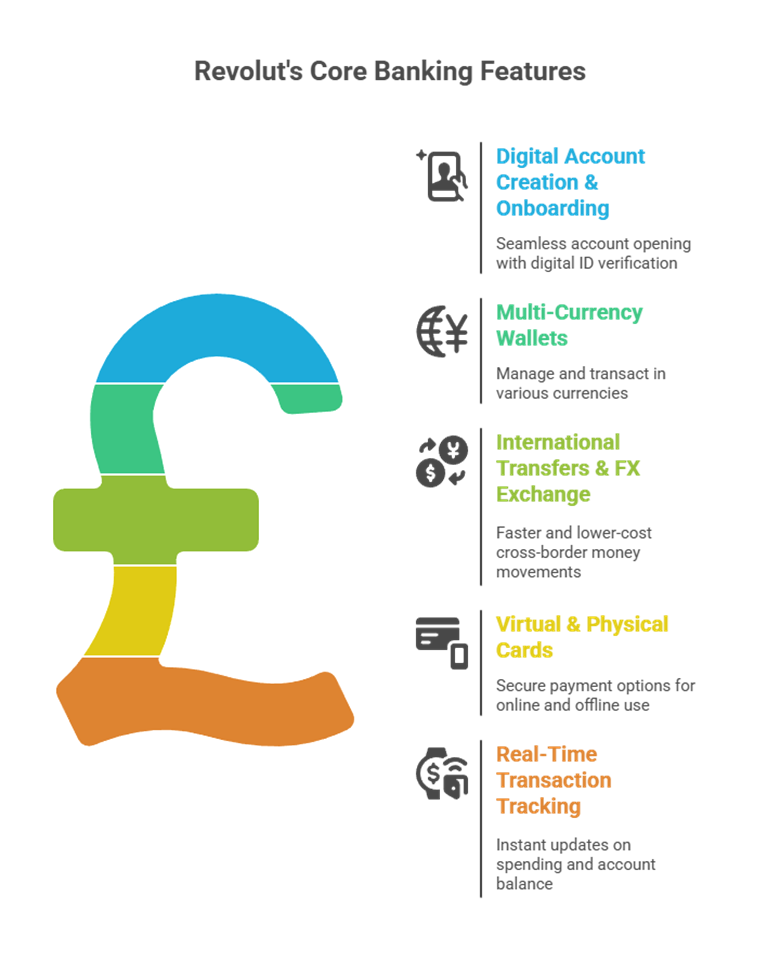
Digital Account Creation & Onboarding
Revolut has removed barriers that have historically existed when opening a new bank account — setting a benchmark for Revolut-style banking app development. The user signs up from his/her smartphone, completes digital ID verification; and receives full use of all core banking functions in minutes, an expectation increasingly common in digital banking app development in Australia. The seamless user experience for opening a new Revolut bank account is made possible through Revolut's automated KYC (Know Your Customer) workflow as well as through the uploading of documents and an identity verification API (Application Programming Interface), approaches often replicated using no-code fintech app development platforms. These tools eliminate paper-based requirements while ensuring Revolut remains compliant with regulatory requirements.
Multi-Currency Wallets
Another unique feature of Revolut is the ability to hold and manage multiple currencies within a single account, a core capability in Revolut-style banking app development. The user may store, convert, and transact in various currencies without having to open separate bank accounts. This tool is very beneficial for international travelers, remote workers, and companies doing business globally, as it allows them to manage foreign currency exchanges in an efficient and transparent manner — a growing requirement within FlutterFlow fintech app development in Australia.
International Transfers & FX Exchange
Revolut also offers another unique service in regards to making international money movements easier than before, by providing faster and lower-cost cross-border wire transfers with real-time exchange rates, a standard now influencing digital banking app development in Australia. Users are able to utilize these services instead of using the traditional banking methods, which were slower and much more expensive than Revolut's method of exchanging currencies and sending money across borders, a pattern often implemented through no-code fintech app development.
Virtual & Physical Cards
In addition to accounts, modern banking applications include flexible payment instruments as part of Revolut-style banking app development. Revolut provides both virtual and physical cards to allow users to make secure payments both online and offline. Virtual cards provide additional security to the user in terms of providing a one-time or disposable card number for the user to make online purchases, thereby significantly reducing the risk of fraudulent activities, a feature commonly delivered through FlutterFlow fintech app development in Australia.
Real-Time Transaction Tracking
All transactions are reported to the user in real time — a defining expectation of digital banking app development in Australia. The user will be able to receive real-time reports of all transactions, view their spending categorized, and view their current account balance in real time. As such, the user will have full visibility and control of their financial affairs in a timely manner, something that many legacy banking systems fail to achieve and a key differentiator in Revolut-style banking app development.
2.2 Progressive FinTech App Features
The Core Banking Features of a FinTech App represent its functional capabilities; however, it is the Progressive Fintech Capabilities of a FinTech App that represent the true potential to enhance User Engagement and Retention, especially within Revolut-style banking app development.
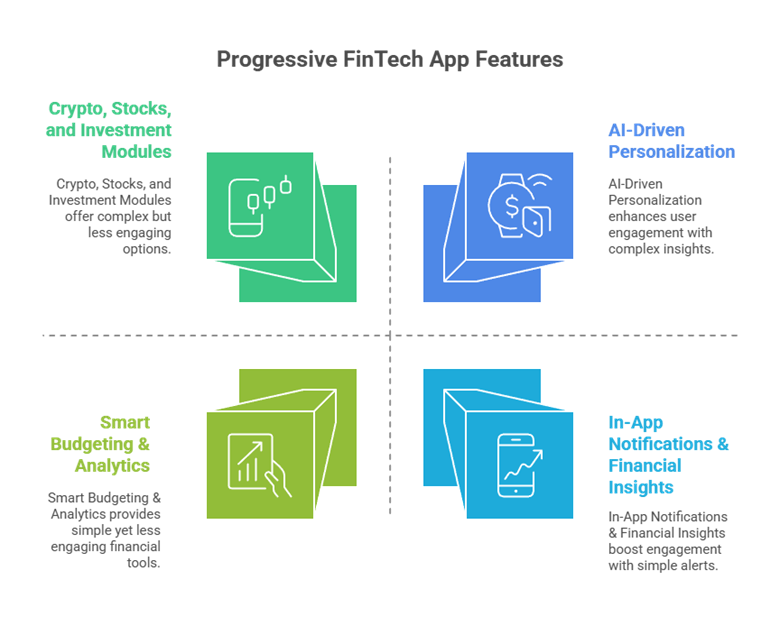
Smart Budgeting & Analytics
Revolut offers its users automatic categorization of their spending and gives them graphical insights into their financial behaviors — a foundational expectation in digital banking app development in Australia. In addition, Revolut's monthly financial summaries, spending trend data, and budget alerts allow users to be proactive in managing their finances rather than reactive, a capability often delivered through no-code fintech app development.
In-App Notifications & Financial Insights
Push Notifications in a FinTech App offer much more than just alerting you to a Transaction, particularly in Revolut-style banking app development. The push notifications provide context such as irregular spending patterns, upcoming subscription renewals, or when your account balance has reached a threshold. As a result, a FinTech App is transformed from a passive tool to an active financial assistant — a growing differentiator in FlutterFlow fintech app development in Australia.
Subscription & Expense Management
Users today have numerous subscriptions across entertainment, productivity, and lifestyle services — a challenge increasingly addressed in digital banking app development in Australia. Revolut allows users to manage all of their recurring payments, identify unused subscriptions, and manage their expenses through one easy to use interface, a pattern commonly implemented using no-code fintech app development. This represents a very practical solution to a common problem users face every day.
Crypto, Stocks, and Investment Modules
Additionally, many Revolut-style FinTech Apps — as part of advanced Revolut-style banking app development — provide additional Wealth Management capabilities, including direct access to various types of investments, including Cryptocurrencies, Stocks, ETF's and Commodities. These modules are typically optional and may also be regulated more strictly than other aspects of a FinTech App. However, they do represent a way for a FinTech App to become a complete financial platform and not simply a traditional Bank Account, particularly within FlutterFlow fintech app development in Australia.
AI-Driven Personalization
FinTech Apps will increasingly utilize Artificial Intelligence to create a personalized user experience — a key evolution in digital banking app development in Australia. Examples include providing customized financial insights, predictive spending analysis, and recommendations based on user behavior. Ultimately, this represents a more intelligent and contextual way for a user to interact with a FinTech App, and a natural extension of no-code fintech app development capabilities.
2.3 Security and Compliance in Banking Apps
For a banking application to achieve success—no matter its function or features—it needs to have effective security and regulatory compliance in place, particularly within Revolut-style banking app development. A banking application cannot exist without the trust that customers give it, which is based on financial products and the standards expected in digital banking app development in Australia.
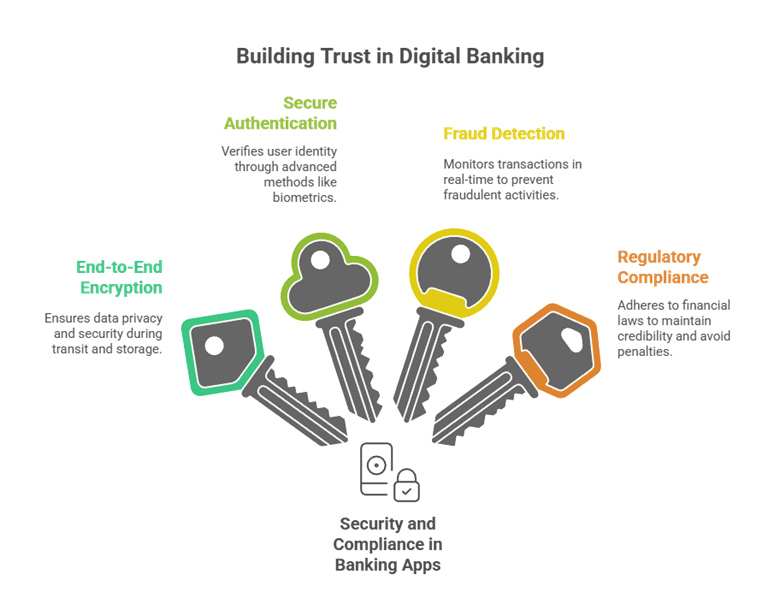
End-to-End Encryption
The encryption of all data, especially personal identifiable information and transactional data, is required to protect user privacy and to provide an additional layer of security in the event of a breach of user data; this includes protecting user data in transit and at rest — a foundational requirement for FlutterFlow fintech app development in Australia.
Secure Authentication & Authorization
Revolutionary banking applications built using modern Revolut-style banking app development approaches — use multi-factor authentication, biometric authentication, and role-based access control to provide assurance that users who attempt to access sensitive financial data have been authenticated correctly, often implemented through no-code fintech app development platforms.
Fraud Detection & Transaction Monitoring
Transaction monitoring systems monitor and analyze the transaction patterns of users in real time to identify potentially suspicious activity and alert the appropriate personnel to review the transactions and block potential fraudulent transactions, a critical expectation in digital banking app development in Australia.
Regulatory Compliance as a Trust Enabler
Compliance with financial regulations, data protection regulations and banking laws are not only necessary to avoid regulatory actions but also provides credibility to your users and partners — a key differentiator in FlutterFlow fintech app development in Australia. As a result, banks and other financial institutions need to include compliance in their technical architecture and operational workflow as part of Revolut-style banking app development.
3. Why FlutterFlow Is Ideal for Fintech App Development in Australia
The type of development process needed for an Australian Banking App (such as Revolut) — aligned with Revolut-style banking app development — is one which balances development speed, flexibility and security; and scales well enough to meet regulatory requirements within digital banking app development in Australia. This is exactly what FlutterFlow offers, making it a strong choice for FlutterFlow fintech app development in Australia. While conventional methods require large engineering teams, and take long timeframes to deliver apps; FlutterFlow allows fintech teams to produce production ready applications at a much faster pace than traditional development processes through no-code fintech app development; and still allows for full control and technical depth. As such, the combination is very powerful for Australian start-ups and enterprises that need to operate within a regulated environment.
3.1 FlutterFlow Features That Power Banking Apps
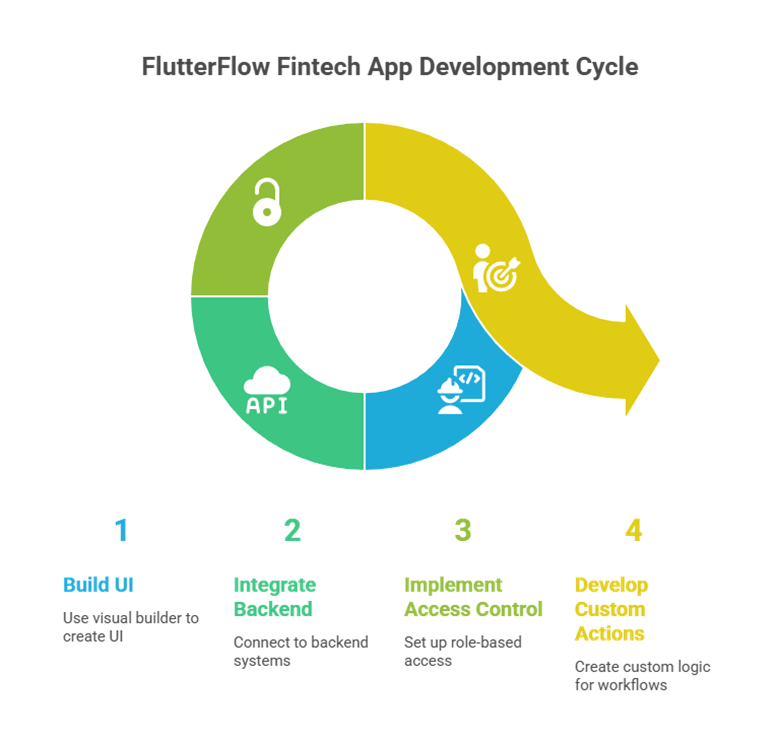
Visual UI Builder with Clean Flutter Code Output
As a team uses the visual builder provided by FlutterFlow to build the UI for their fintech app — a common approach in FlutterFlow fintech app development in Australia — the resulting Flutter code will be clean and maintainable. The developer retains ownership of their code base. This is important for long term scalability, auditability, and enterprise level deployments of an app within Revolut-style banking app development.
Backend Flexibility: Firebase, Supabase, Xano & Custom APIs
Modern fintech apps require back-end systems to be complex, particularly in digital banking app development in Australia. FlutterFlow has integrated with all the major back-end options. Teams can choose from Firebase for real time data, Supabase for SQL based systems, Xano for scalable APIs, and even custom REST end points — enabling no-code fintech app development without limiting architectural choices.
Role-Based Access and Advanced Logic Flows
Most fintech platforms have users who fall into different categories (customer, admin, compliance, etc), especially in Revolut-style banking app development. FlutterFlow enables role based access control and conditional logic flows. This gives developers the ability to restrict access to certain areas of the app and data to specific types of users — a critical requirement in FlutterFlow fintech app development in Australia. This is critical for developing compliant banking workflows and internal management tools.
Custom Actions for Fintech-Grade Workflows
For advanced use cases (such as payment processing, identity verification, transaction validation, encryption logic) FlutterFlow provides developers with the capability to develop custom actions using Dart — a powerful extension of no-code fintech app development. This enables teams to add custom logic to their no-code environment where needed, allowing them to bridge the gap between rapid development and enterprise-grade function required for digital banking app development in Australia.
3.2 Advantages FlutterFlow Offers for Financial Applications
Faster Time-to-Market
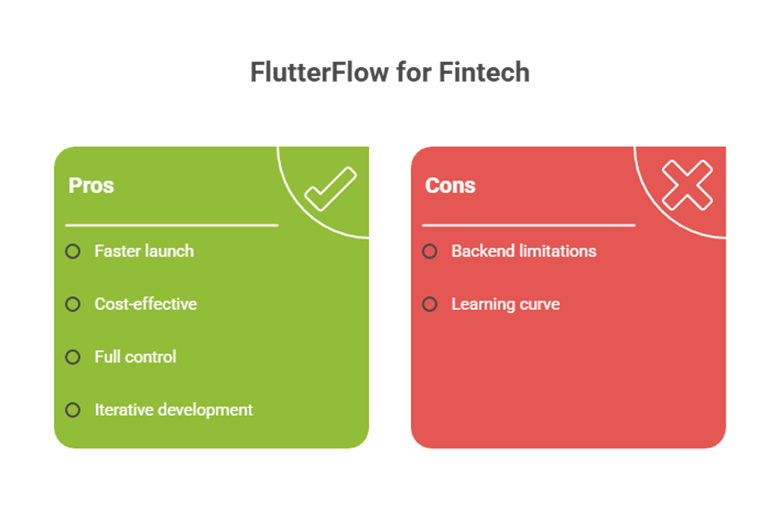
A fast time-to-market is a major advantage of fintech, particularly in Revolut-style banking app development; FlutterFlow provides speed through the elimination of repeated UI coding and streamlining of workflow integration. As a result, founders can build MVPs (minimum viable product) faster and test whether there is a market need and get valid user feedback sooner than would be possible if they had to wait months before their app was released, an expectation increasingly seen in digital banking app development in Australia.
Reduced Development and Maintenance Costs
FlutterFlow reduces the amount of manual work required for building an app and therefore reduces the total cost of both the initial build of the app and the ongoing maintenance of the app, a key benefit of FlutterFlow fintech app development in Australia. Users can easily make updates, UI changes and add new features so that users can quickly respond to changing regulation, or user needs — a major advantage of no-code fintech app development.
Full Control Over Frontend Logic and User Experience
Although FlutterFlow uses a visual method to design the app, it does not reduce the level of control over the frontend logic of the app or the user experience of the app, which is vital for Revolut-style banking app development. Therefore, teams have full control over defining complex frontend logic, managing state appropriately and creating a very customized user experience which is critical for fintech applications where the clarity, trust and usability of the application have direct relevance to the level of adoption.
Easy Iteration for MVPs and Regulated Rollouts
Regulatory approvals in Australia's fintech sector typically happen in stages. FlutterFlow enables teams to build apps iteratively allowing them to start with a compliant MVP and progressively add more regulated features as approvals are received and market traction grows, making it ideal for digital banking app development in Australia and FlutterFlow fintech app development in Australia.
3.3 Scalability and Performance for Banking Solutions
Scalable Architecture with Cloud Backends
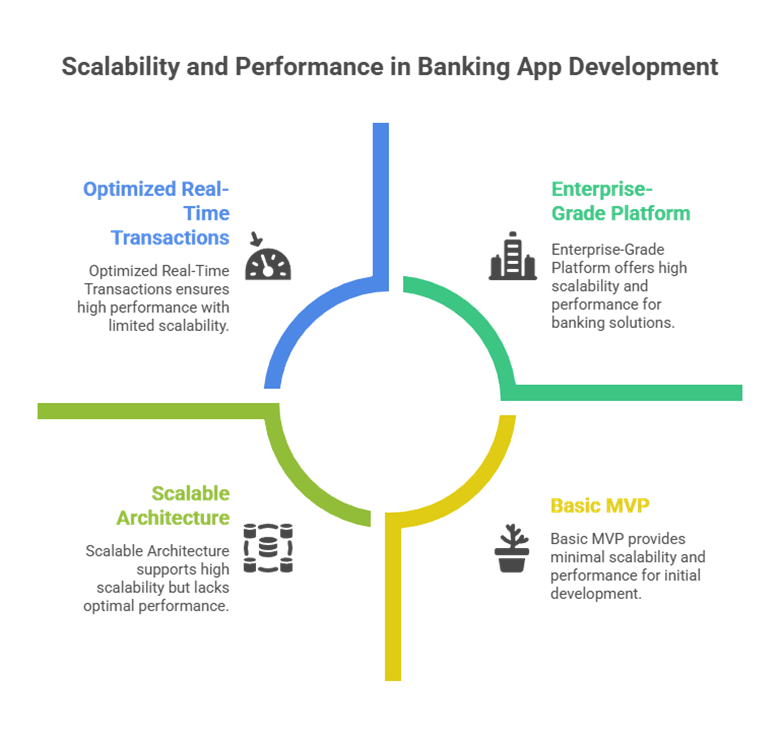
The scalability of FlutterFlow Apps — a key feature in FlutterFlow fintech app development in Australia — will follow that of their backend clouds. The architecture of a FlutterFlow App will develop and increase in its capacity to handle the increased volume of transactions, the number of users and the complexities of data associated with each type of use case whether it is 100's or 1,000,000's of users, an important consideration in digital banking app development in Australia and Revolut-style banking app development.
Optimized Performance for Real-Time Transactions
For Banking Apps, real-time response time is critical — balances, transactions, and notifications have to update instantaneously. The combination of FlutterFlow, along with real-time databases and optimized API call methods, enables the same level of performance demanded by modern banking app applications, a standard in FlutterFlow fintech app development in Australia.
From MVP to Enterprise-Grade Platform
Perhaps one of the best advantages of using FlutterFlow — central to Revolut-style banking app development — is that it can grow with your application. What begins as an MVP (Minimum Viable Product) can be transformed into an enterprise grade banking application over time with additional integrations, added layers of security and customized infrastructure without having to build everything again, a benefit that is driving no-code fintech app development adoption in Australia.
4. Key Features of a Revolut-Style Banking App (Australia-Ready)
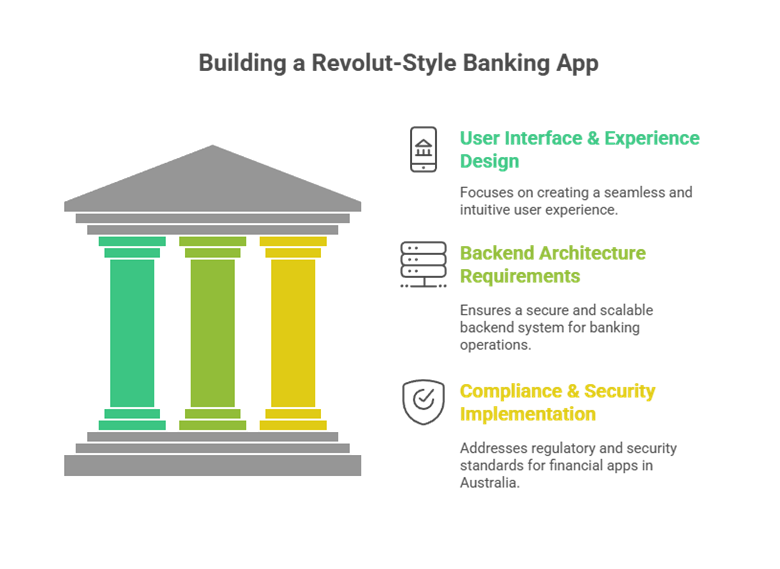
Creating an Australian banking application, similar to Revolut — a prime example of Revolut-style banking app development — is much more than simply creating a banking application with a number of the common fintech applications that have become so well known today. A good example of a successful banking application will need to create the perfect blend of user experience, strong technical design of the backend, and legal regulatory requirements, which are increasingly emphasized in digital banking app development in Australia. Users of banking applications in Australia are among the most technologically savvy users in the world; they are very concerned about the safety of their personal information, and increasingly understand how their financial data is being used, a consideration at the core of FlutterFlow fintech app development in Australia. Therefore, to successfully launch an Australian banking application, it must look like it was created without effort on the surface level (easy and seamless), but must also be capable of meeting both the technical and regulatory requirements of a banking application — a requirement that can be effectively addressed through no-code fintech app development.
4.1 User Interface & Experience Design
Simple Onboarding and KYC-Friendly Flows
In fintech, first impressions are everything. Users expect to open an account in a few minutes, not hours or days. The same app style as Revolut — a key example of Revolut-style banking app development — should have a seamless onboarding workflow that guides users through opening an account and completing KYC verification with little friction. In this process, document upload, identity verification, and consent screens need to be clear, easy to follow, and optimized for mobile use, allowing for compliant processes without overwhelming the user, a best practice in digital banking app development in Australia.
Intuitive Dashboards and Financial Summaries
The home screen of a banking app is its control center. Users should immediately know where they stand financially (Current Balance, Recent Transactions, Spending Patterns and Upcoming Obligations). Easy-to-understand data visualizations, smart categorization, and contextually relevant information allows users to understand their financial situation without needing to be a financial expert — a functionality often delivered through FlutterFlow fintech app development in Australia. This level of transparency and ease of understanding is one of the key factors to define a successful Neobank, reflecting the principles of no-code fintech app development.
Accessibility and Mobile-First UX Principles
Australia's diverse user base has people who require varying levels of accessibility. Any modern banking application will adhere to mobile-first design principles and will meet accessibility guidelines for readability (typography), sufficient color contrast, user-friendly navigation, and accessibility to assistive technology. Meeting these standards will increase usability, build credibility, and promote inclusion — expectations that are essential in digital banking app development in Australia and Revolut-style banking app development.
4.2 Backend Architecture Requirements
Secure and Flexible Backend Infrastructure
The back end of a banking application (Revolut style) — a prime example of Revolut-style banking app development — must be supported by a secure and adaptable back-end system. Most banking applications utilize one of the several platforms available in order to implement authentication and authorization; store data; and implement the business logic of an application. The most appropriate back-end will depend upon the performance requirements, compliance requirements, and scalability requirements of the banking application, a critical consideration in digital banking app development in Australia and FlutterFlow fintech app development in Australia.
Transaction Processing and Ledger Management
All banking applications rely on an accurate and dependable transaction engine — a requirement in no-code fintech app development. All financial activities must be recorded, traced, and reversible when necessary. Systems utilized to manage ledgers must accurately record and track transaction histories; account balances; and reconcile account balances in order to provide a high level of financial integrity at all times.
User Data Segregation and Audit Trails
Users' financial data must be segregated from other users' financial data in order to meet security and compliance requirements — a core principle in Revolut-style banking app development. Proper data segmentation provides a means to segregate users' financial information and protect it from unauthorized access. It is also essential to have complete logs of all activity in order to monitor users' activity; resolve any disputes; and provide evidence to auditors during a regulatory audit, practices increasingly implemented through FlutterFlow fintech app development in Australia.
Webhooks and Real-Time Updates
In today's banking industry, banks must respond in real-time. Therefore, back-end systems must support instant webhooks and instantaneous events to immediately update an application reflecting transactions, payment confirmations, and status changes in real-time. This instant response is a critical expectation of modern banking customers, especially in digital banking app development in Australia.
4.3 Compliance & Security Implementation (Australia Focus)
Australian Securities and Investment Commission (ASIC) Regulatory Considerations
ASIC regulates financial service provision and consumer protection in Australia. In order for Fintech Apps to operate within Australia — particularly those involved in Revolut-style banking app development — they will need to meet ASIC's transparency, user disclosure, and financial conduct requirements, a crucial aspect of digital banking app development in Australia.
Regulatory Compliance for APRA Regulated Financial Institutions
Apps that either function as a financial institution or provide services in conjunction with one will be subject to the regulations of the Australian Prudential Regulation Authority (APRA). These regulations include risk management, data protection, and operational resilience, which are essential for FlutterFlow fintech app development in Australia.
Compliance with AUSTRAC Anti-Money Laundering (AML)/Know-Your-Customer (KYC)
Fintech apps that are banking apps will also be subject to anti-money laundering (AML) and know-your-customer (KYC) regulations provided by AUSTRAC. They will need to develop identity verification systems, transaction monitoring systems, and reporting mechanisms to assist in preventing money laundering in Australia — a standard often implemented via no-code fintech app development.
PCI DSS Compliance for Secure Payment Data Processing
In addition to developing systems to collect, store, and use credit/debit card payments and other forms of electronic payments, all apps that handle card payments must meet the Payment Card Industry Data Security Standard (PCI-DSS) requirements in relation to protecting sensitive customer payment data. These include secure tokenization, encryption, and access control, which are critical in Revolut-style banking app development.
Consumer Data Right (CDR)/Open Banking Readiness
As part of the Australian government's open banking initiative, consumers can share their financial data with third-party providers via a secure platform. Fintech apps that are ready for CDR — a key feature for digital banking app development in Australia — will be able to provide more innovative and integrated services to their customers while continuing to respect their customers' rights over their financial data, a capability supported by FlutterFlow fintech app development in Australia.
5. Payment & Banking Integrations with FlutterFlow
The power of a banking application such as Revolut — a leading example of Revolut-style banking app development — will be limited to the quality and reliability of the financial infrastructure supporting the application; secure, reliable, and real-time payments and card transactions, secure and fast data sharing, and currency exchange are all necessary components of a successful banking application. In terms of this functionality, FlutterFlow is excellent at serving as a flexible front-end layer and supports seamless integration with current payment gateways, Open Banking frameworks, and third-party financial APIs, making it an ideal choice for either a banking application that is focused on Australia — a key consideration in digital banking app development in Australia — or a global fintech product. This capability highlights the strengths of FlutterFlow fintech app development in Australia and the efficiency of no-code fintech app development for modern banking solutions.
5.1 Stripe Integration for Australia & Global Banking
Payments, Subscriptions, and Card Issuing
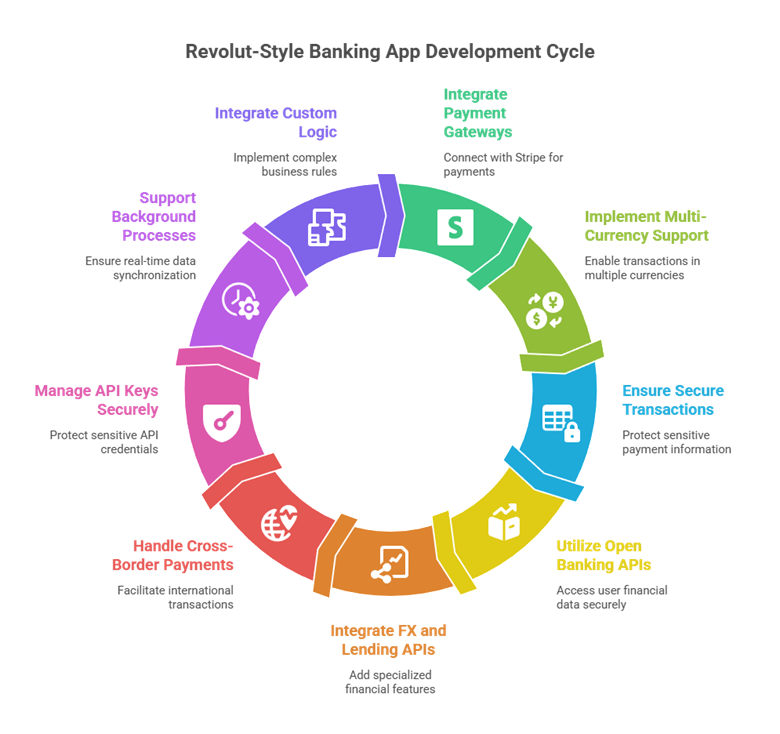
Stripe has become a leading payment platform across Australia and the world — so much so that it would be an obvious choice for any financial app using a "Revolut" style banking model, a common implementation in Revolut-style banking app development. The ability to accept card payments and bank transfers via Stripe is just two examples of the services available to apps utilizing Stripe. In addition to this, apps have access to subscription services via Stripe and also to issue credit/debit cards directly via Stripe Issuing. As a result, fintech platforms can now offer their customers a combination of virtual and/or physical cards, as well as set spending limits — features increasingly expected in digital banking app development in Australia. Fintech platforms can also service consumers or businesses depending upon the user's needs, a scenario supported by FlutterFlow fintech app development in Australia.
Multi-Currency Support
With global banking being the new normal, the need to be able to handle currency quickly and easily is becoming more prevalent by the day. One area that Stripe excels at is its ability to offer multi-currency transactions. Through the use of Stripe's multi-currency options, users can process transactions in multiple currencies with full transparency regarding exchange rates and fees. As a result, the multi-currency wallet experience users expect from a neobank application — a critical aspect of Revolut-style banking app development — is now possible through Stripe and no-code fintech app development.
Secure Transaction Handling
Another area where Stripe has excelled is providing a secure payment processing environment. For example, Stripe provides features such as tokenization, strong customer authentication (SCA), and compliance with all PCI DSS standards to protect sensitive payment information. When used with FlutterFlow — a key platform for FlutterFlow fintech app development in Australia — these capabilities provide a fully functional and compliant payment experience, while still protecting sensitive data from exposure to the client, a major consideration in digital banking app development in Australia.
5.2 Open Banking & Third-Party Financial APIs
Open Banking APIs (Consumer Data Right – CDR)
The open banking system in Australia, based on the Consumer Data Right (CDR), allows consumers to safely share their personal financial information with accredited third-party service providers. Using Open Banking APIs, Fintech applications — especially those involved in Revolut-style banking app development — can obtain the user's transaction history, account balance, and other financial information, which can be used to develop new application use cases including financial aggregation, customized finance insight, and intelligent credit assessment. This capability is a critical part of digital banking app development in Australia and FlutterFlow fintech app development in Australia.
FX, Lending, and Card-Issuing APIs
In addition to payment processing, many of the same types of applications that offer features similar to those of Revolut also utilize specialized APIs for foreign exchange, lending, and card issuing. Utilizing these types of APIs allows the developer to add additional features to an application without having to build out all of the underlying financial systems themselves — a benefit of no-code fintech app development. The foreign exchange API provides the current FX rate for various currency combinations, while the lending API is utilized to determine whether or not to provide funding to the applicant, and the card issuing API is utilized to manage cards that have been issued to customers, enhancing the functionality expected in Revolut-style banking app development.
Cross-Border Payment Providers
When transferring funds internationally and when dealing with a global user base, Revolut-style applications may need to integrate with one or more of the cross-border payment service providers (Wise, PayPal) that enable fast, affordable cross-border payments. These types of services can complement Stripe by providing support for P2P transfers, international remittance, and global merchant payment use cases, all of which are increasingly relevant in digital banking app development in Australia and FlutterFlow fintech app development in Australia.
5.3 How FlutterFlow Handles Financial Integrations
Integration of REST & GraphQL APIs
FlutterFlow has the ability to integrate with both REST & GraphQL APIs, which gives developers access to almost all financial services — a critical capability for Revolut-style banking app development. API calls can be set up visually; however, developers have complete control of the request headers, payload, and how they handle responses — all important features for fintech workflows and FlutterFlow fintech app development in Australia.
Secure Handling of API Keys
In order to follow security best practices when integrating with a financial API, it is very important to securely manage your API keys and tokens. FlutterFlow enables developers to securely manage their API keys and tokens because FlutterFlow will pass the sensitive operations to its back-end services, so that credentials are never exposed on the client-side — a practice increasingly adopted in digital banking app development in Australia and no-code fintech app development.
Background Process and Webhook Support
Most financial events (i.e., payment confirmation, refund, transaction update) are asynchronous events. FlutterFlow allows for seamless integration with webhooks and background processes, therefore enabling your application to always stay in sync with your back-end systems in real-time — a standard expectation in Revolut-style banking app development.
BuildShip Custom Logic or Cloud Function Integration
When building complex workflows, FlutterFlow has the ability to integrate with platforms such as BuildShip or cloud functions to allow for custom business logic to be executed. This is especially useful for implementing payment validation, compliance checks, and event-driven automation, bringing enterprise-level flexibility to no-code fintech app development and FlutterFlow fintech app development in Australia.
6. Step-by-Step Process to Build Your Banking App
The creation of an app similar to Revolut — a prime example of Revolut-style banking app development — is a long-term project; it has several parts (strategy, design, engineering, regulatory compliance). The strategic and methodical way to accomplish this project will help in reducing the risks involved with the project, help you save money on the project, and make sure your application is ready for users as well as ready for regulators. Below is the step-by-step plan to create a new financial application using FlutterFlow — a proven approach in FlutterFlow fintech app development in Australia and no-code fintech app development — that many fintech companies have successfully used in digital banking app development in Australia.
6.1 Planning & Requirements Analysis
Defining the Business Model and Regulatory Scope
The first step for developing a successful banking app — especially for Revolut-style banking app development — is clarity. What type of users will your banking app target: consumers, businesses, or both? How will your app function: will it act as a neobank, a financial management layer, an embedded finance solution, etc.? The answers to these questions will have a direct impact on the regulatory scope of your app — whether you are required to comply with ASIC regulations, APRA oversight, AUSTRAC reporting, or if your app requires accreditation with Open Banking. Avoiding costly architectural changes down the line by defining this from the start will allow you to better define what features will be included in your MVP (minimum viable product) and which will be added as additional features to your app over time — a strategy widely used in digital banking app development in Australia.
Feature Prioritization: MVP vs Full Product
Trying to develop every feature that your banking app could have at the same time is one of the most common pitfalls in building a successful fintech application. Instead, it would be beneficial to identify the core features that your app must have in order to provide value to its users (i.e., onboarding, payments, account views, and transaction tracking) and prioritize those in the MVP. All other features (i.e., investing, AI-driven insights, lending, etc.) can then be developed and rolled out to users as additional features over time. FlutterFlow's ability to quickly iterate through multiple versions of your app makes this "staged" roll-out process particularly effective, a benefit of FlutterFlow fintech app development in Australia and no-code fintech app development.
Compliance Planning from Day One
Developers of fintech applications often do not think about compliance until they have already built their application. However, compliance issues cannot be fixed retroactively. Therefore, developers need to consider all aspects of compliance when developing their application from the very beginning (e.g., KYC flows, AML monitoring, data storage policies, and audit requirements). Proactive compliance planning will help ensure smoother approval processes, facilitate quicker partnerships with banks and financial institutions, and build greater user confidence in the bank's ability to protect users' information upon release — a necessity in digital banking app development in Australia and Revolut-style banking app development.
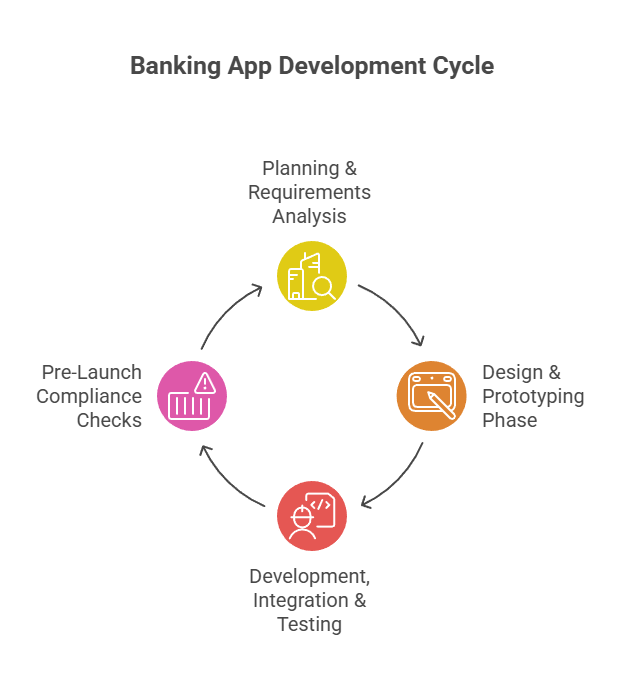
6.2 Design & Prototyping Phase
UX Wireframes and User Journeys
After the application of the requirements, the next area of focus is the user experience, a critical factor in Revolut-style banking app development. The user journey maps the flow of a user using the application from initial registration and identification to daily usage of the application and the management of their accounts. The use of these user journeys will allow us to find areas of friction early and create an application that is intuitive and easy to navigate, as opposed to a complicated application, a practice essential in digital banking app development in Australia.
High-Fidelity UI Design in FlutterFlow
Using FlutterFlow, design and development occur together. Users can create high-fidelity designs for their application using FlutterFlow, which closely mirror the final version of their application. Since this eliminates potential gaps in the handoff of design to developers, teams will be able to see the actual application experience sooner in the process, a major advantage of FlutterFlow fintech app development in Australia.
Early Usability Validation
Prior to writing all backend code, we can test the prototype with end-users or stakeholders. We receive early feedback on navigation and clarity of financial terms and test our assumptions. The early testing saves time and money when compared to the cost of developing the application after the prototype has been created, demonstrating the effectiveness of no-code fintech app development for fintech MVPs.
6.3 Development, Integration & Testing
Frontend Development in FlutterFlow
The front end was developed by combining the visual builder of FlutterFlow with customized code where necessary, a core practice in FlutterFlow fintech app development in Australia. Complex workflows (conditional onboarding, role-based dashboard, transaction workflow) can be easily developed while providing full control over all UI behaviors, a key feature for Revolut-style banking app development and digital banking app development in Australia.
Backend, Payment, and API Integration
In this phase, we connect our app to back-end services, payment systems such as Stripe, Open Banking APIs, and other third-party financial services. We implement secure authentication, data management, and event-driven processes to support real-world banking activities — a standard expectation in no-code fintech app development and FlutterFlow fintech app development in Australia.
Security Testing and Performance Optimization
We perform extensive testing prior to launch. Security testing validates encryption, access controls, and fraud detection mechanisms; performance testing verifies real-time response under load to both provide users with trust and regulatory bodies with confidence in the application, a necessity for Revolut-style banking app development.
Pre-Launch Compliance Checks
Prior to launching, we perform an in-depth review to ensure that we meet compliance requirements. These include validation of Know Your Customer (KYC) flow, Anti-Money Laundering (AML), data retention policy, and payment security standards. Completing these reviews prior to launch will minimize risk and allow us to expedite approvals from partners and regulatory bodies — a critical consideration in digital banking app development in Australia.
7. Why Partner with FlutterFlowDevs for Your Banking App?
Establishing a banking app similar to Revolut — a high-risk endeavor in Revolut-style banking app development — will require much more than just designing and developing an application. It will need an in-depth understanding of fintech, familiarity with the relevant regulations, and a clear and long-term technical vision for the application. Therefore, finding a suitable development company can make or break a product’s ability to grow and gain users’ trust from day one. This is where FlutterFlowDevs provides a competitive edge in FlutterFlow fintech app development in Australia, digital banking app development in Australia, and no-code fintech app development.
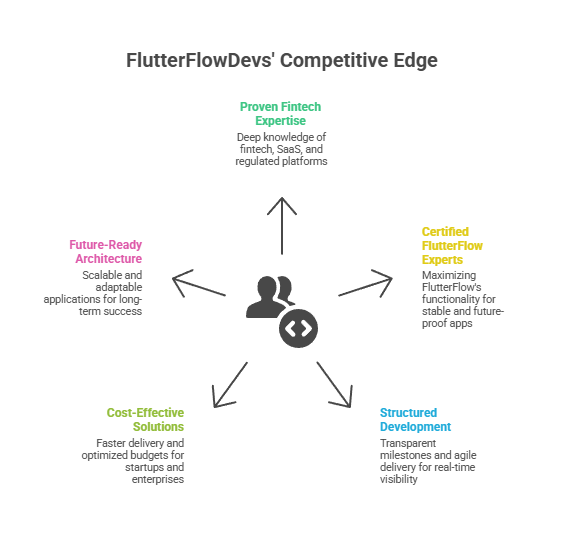
7.1 Proven Fintech & FlutterFlow Expertise
Deep Experience in Fintech, SaaS, and Regulated Platforms
At FlutterFlowDevs, we have direct knowledge of developing fintech/SaaS products within a regulated environment — a critical factor in Revolut-style banking app development. We have an understanding of financial workflows, architectural requirements based on regulatory compliance, and the high-performance requirements for real-time banking systems. These factors enable us to identify and solve issues that will arise during the development process. In addition to this, we can provide innovative, yet compliant, solutions for your banking application — a key advantage in digital banking app development in Australia.
Certified FlutterFlow Experts
We are certified FlutterFlow developers and therefore do not simply utilize the FlutterFlow platform; we maximize its functionality. Our experience includes the ability to create complex conditional logic, customized actions, and scalable User Interface (UI) architectures. Therefore, you can be assured that your banking application is developed on a stable, future-proof base with clean and easily maintained code, a hallmark of FlutterFlow fintech app development in Australia and no-code fintech app development.
Experience with Stripe, Open Banking, and Secure Backends
We also have practical experience integrating Stripe for payment processing and card-based workflows, Open Banking APIs for accessing users’ financial data under the Consumer Data Right (CDR), and secure backend platforms including Firebase, Supabase, Xano, and other custom API infrastructures. The level of technical knowledge we possess enables seamless, secure, and scalable integration into the financial system — an essential requirement for digital banking app development in Australia and Revolut-style banking app development.
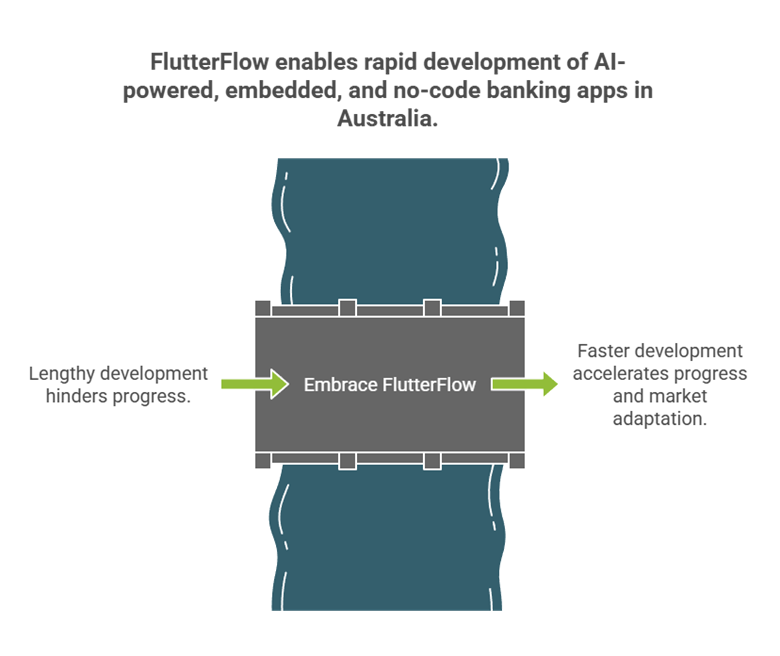
7.2 Structured Development & Ongoing Support
Transparent Development Milestones
Fintech requires both transparency and accountability; this is why we use milestones to measure our development of each fintech project. Our milestone-driven development process will provide you with real-time visibility of all phases of the project, including timelines and deliverables, which is especially important in Revolut-style banking app development and digital banking app development in Australia.
Agile Delivery and Regular Demos
We utilize an iterative, agile methodology to ensure that we can quickly iterate through new developments and receive continuous feedback from you. We also offer regular demos and reviews so that the final product meets all of your needs and expectations, including business objectives, regulatory requirements, and user expectations — a key advantage in FlutterFlow fintech app development in Australia and no-code fintech app development.
Post-Launch Maintenance and Scaling Support
The launch of the app represents the end of one phase of our work together. We are committed to providing post-launch maintenance and scaling support, including but not limited to maintaining the app, enhancing the app's security, optimizing the app's performance, and expanding on the app's features. This ensures your users can grow with confidence, a necessity in digital banking app development in Australia and Revolut-style banking app development.
7.3 Cost-Effective & Scalable Solutions
Faster Delivery Without Compromising Security
Our application delivers faster development times through a combination of FlutterFlow’s development speed with the best practices used in large enterprise environments, delivering faster time-to-market with the same level of security and reliability expected in Revolut-style banking app development and digital banking app development in Australia.
Optimized Budgets for Startups and Enterprises
At TechSolve, we have a good understanding of the financial budgets that are available to small start-ups and larger enterprises. As such, our development process is structured to provide maximum value to our customers — allowing them to develop high-impact functionality at a cost that can be predicted and controlled, a benefit of FlutterFlow fintech app development in Australia and no-code fintech app development.
Future-Ready Architecture
Each of our solutions is built with long-term success in mind. Therefore, whether you plan to add features to your existing product or expand into other markets, we build each application so that it can grow and adapt as needed to support the needs of your business, without incurring the expense of rebuilding the entire application — a core advantage in digital banking app development in Australia.
8. The Future of Digital Banking Apps & FlutterFlow in 2026
The fintech landscape is transforming at an accelerated rate; by 2026, banking applications will be much different than those we have today. The technological advancements, the regulations, and the changing expectations of users all contribute to the development of the next generation of banking applications that will be more sophisticated, more interconnected, and able to develop more quickly than ever before. The three major trends influencing the development of the next generation of banking applications and how FlutterFlow fintech app development in Australia can assist in this evolution are below.
Rise of AI-Powered Banking Experiences
Artificial Intelligence (AI) will no longer be an option in banking applications by 2026; AI will be an integral component of banking applications. AI will provide personalized financial insight, predictable cash flow analysis, identify potential fraud, and automatically address user concerns. Banking applications will be transformed into a proactive personal financial assistant, anticipating the user's needs, recognizing risk before the user does, and making relevant recommendations in real time. For example, AI-based systems may generate optimal budgets for users, warn them of possible overdrafts in advance, or recommend financial products based on their behaviors. AI will also assist in the operational aspects of banking applications such as reducing compliance burdens, automating transaction monitoring, anomaly identification, and report workflows. When used in conjunction with AI-based APIs and backend automation tools, platforms like FlutterFlow will enable fintech teams to include intelligent functionality in Revolut-style banking app development while not significantly increasing the complexity of the application development process.
Embedded Finance and API-First Platforms
Embedded finance will change how users interact with financial services. Rather than using standalone banking applications, users will increasingly use financial capabilities within non-financial platforms (i.e., marketplaces, software-as-a-service (SaaS) products, and other types of consumer applications). Financial capabilities such as payments, loans, insurance, and banking functions will be accessible as modules through APIs. By 2026, API-based design will be the standard method of developing fintech applications, allowing fintech developers to quickly incorporate functionality from external partners, third-party services, and ecosystem members. Embedded finance will enable organizations to develop financial functionality in their products and services without having to establish themselves as banks. Due to its extensive support for REST and GraphQL APIs, FlutterFlow fintech app development in Australia is uniquely suited to the API-based design trend and will enable fintech teams to develop user interfaces that seamlessly communicate with embedded finance providers and other backend services.
No-Code + Low-Code Becoming Mainstream in Fintech
The perception of no-code and low-code platforms is shifting. No-code and low-code platforms will no longer be viewed as "workarounds" or "MVPs"-only solutions by 2026. They will be widely accepted as primary development tools for fintech products due to growing regulatory pressures, a lack of qualified talent, and a desire for rapid innovation. No-code and low-code platforms, such as FlutterFlow, provide the benefits of both worlds: the rapid development capabilities of visual development and the flexibility of custom coding for complex logic. This hybrid approach enables fintech organizations to innovate more quickly, adapt to regulatory changes rapidly, and decrease technical debt. As governance and security capabilities continue to improve, no-code fintech app development will become standard in serious fintech development pipelines.
FlutterFlow’s Role in Next-Generation Banking Apps
FlutterFlow will play a significant part in the next generation of digital banking app development in Australia. Its ability to produce production-quality Flutter code, interface securely with backend systems, and support complex workflows positions FlutterFlow as a strategic choice for fintech teams seeking to innovate rapidly without sacrificing control. By 2026, FlutterFlow is anticipated to be fully integrated into the enterprise stacks of fintech organizations — powering customer-facing banking applications, internal dashboards, and partner portals. When combined with cloud infrastructure, AI-based services, and compliant backend systems, FlutterFlow provides fintech teams with a scalable, secure, and future-proof platform for building banking applications. As a result, founders and product managers will benefit from quicker experimentation, smoother growth, and greater clarity in transitioning ideas into viable financial products — a critical advantage in Revolut-style banking app development.
9. Conclusion: Launch Your Revolut-Style Banking App with Confidence
Digital-first banking is reshaping the financial services industry, with platforms like Revolut setting new standards for speed, transparency, and user experience. Today's consumers expect instant account creation, real-time financial insights, seamless payments, and global accessibility—all from a single mobile application. As a result, fintech innovation is accelerating rapidly across Australia.
Building a successful banking app, however, requires much more than replicating features. It demands a careful balance of intuitive user experiences, scalable architecture, enterprise-grade security, and regulatory compliance. From payment integrations and identity verification to fraud prevention and data privacy, every component must be designed with trust and reliability at its core.
Throughout this guide, we've explored the essential building blocks of a modern banking application—from core financial services and fintech features to compliance requirements and payment infrastructure. We've also highlighted the importance of speed and adaptability in today's competitive fintech landscape.
This is where FlutterFlow stands out as a powerful platform for fintech development. By combining visual development with flexible integrations and full code extensibility, FlutterFlow enables startups and enterprises to build secure, scalable, and high-performance banking applications faster than traditional development methods. It empowers teams to validate ideas quickly, launch MVPs efficiently, and evolve their products as customer needs change.
Equally important is choosing the right development partner. Financial applications operate in a high-trust environment where security, compliance, and performance are critical. Working with experienced fintech specialists can help reduce risk, accelerate development, and ensure long-term scalability.
At FlutterFlowDevs, we specialize in building secure and scalable fintech applications using FlutterFlow. From product strategy and compliance planning to backend architecture and deployment, our team helps founders and enterprises bring innovative financial products to market with confidence.
The future of banking is digital, intelligent, and customer-centric. With the right strategy, technology, and execution, you can create a next-generation banking experience that earns trust, drives growth, and stands out in an increasingly competitive market.
Now is the time to build the future of fintech. Start your digital banking journey today.


View more blogs


.png)

.png)
.png)


Ready to develop your own product? Get in touch today!
Get in Touch
