

.png)

.png)


1. Introduction — Why Every Startup Wants a Social Platform Today
Social media platforms are no longer built only by giant tech companies. Startups, creators, niche communities, coaches, and even local brands are now launching their own platforms to build direct audiences and stronger engagement.
But building a modern Facebook clone app is much harder than most founders expect.
Users no longer want a basic posting app. They expect reels, stories, messaging, notifications, personalized feeds, profile systems, group chats, and smooth mobile performance from the start. Building all of that from scratch usually takes months of development, backend setup, testing, and constant iteration.
That is exactly why ready-made solutions are becoming popular.
Instead of rebuilding common social features repeatedly, many teams now start with a production-ready Facebook app template and customize it around their own brand and audience. Scrollo, created by Arixlabs (previously FlutterFlowDevs), is designed specifically for that purpose.
Scrollo is a modern Facebook like app built using Flutter and Supabase, helping startups launch a scalable flutter social media app faster with core social features already connected and structured properly.
In this blog, we will explore what users expect from a modern Facebook clone app, the real challenges of social media app development, how scrollo works, and why using a customizable social media app template can significantly reduce launch time and development effort.
2. What Users Actually Expect From a Modern Facebook Like App
The biggest mistake founders make while planning a social platform is assuming users only care about posting content.
They do not.
A modern Facebook clone app survives on engagement. People open social apps because something is always happening — new posts, new messages, new reels, new notifications, new conversations. If the platform feels inactive or limited, retention drops very quickly.
That is why building a successful Facebook like app now requires much more than a timeline feed.
Modern users expect a complete social experience where content discovery, communication, and interaction all work together naturally. And honestly, this is where development complexity starts increasing fast.
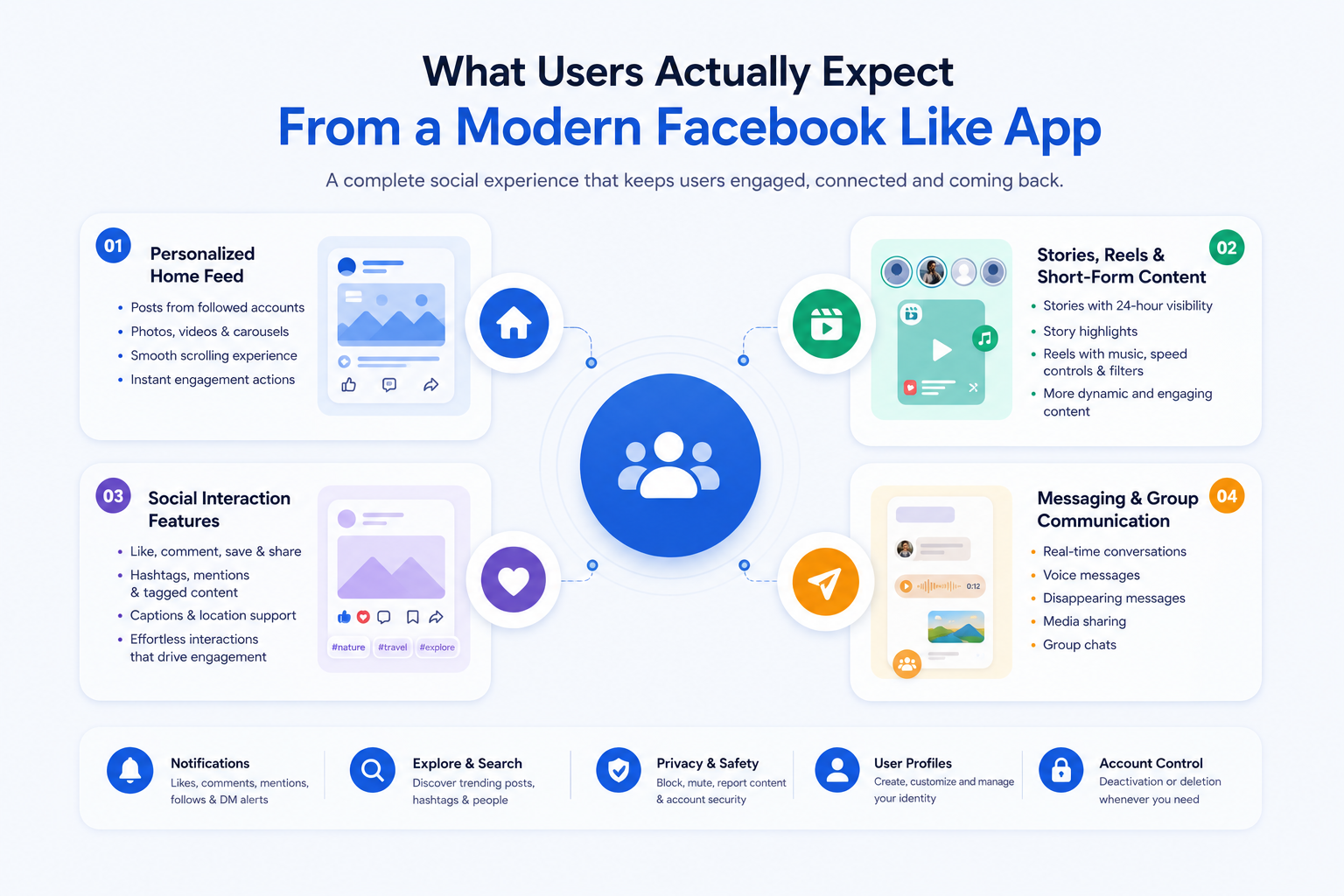
2.1 Personalized Home Feed
The home feed is the center of every successful Facebook clone app. It controls how users consume content and how long they stay inside the platform.
Users expect:
- posts from followed accounts
- photos and videos
- carousel posts
- smooth scrolling
- instant engagement actions
A weak feed makes the app feel empty. A good feed keeps users continuously interacting.
Scrollo already includes a personalized home feed system inside the Facebook app template, allowing users to follow accounts and view content from their network in a structured way.
This becomes especially important for startups trying to launch quickly because feed systems are usually one of the most time-consuming parts of social media app development.
2.2 Stories, Reels, and Short-Form Content
Short-form content changed user behavior completely.
People now expect stories for casual updates and reels for fast entertainment. Without them, a social app instantly feels outdated.
That is why a modern flutter social media app needs multiple content formats instead of relying only on standard posts.
Scrollo includes:
- stories with 24-hour visibility
- story highlights
- reels support
- music integration
- speed controls
- trimming tools
- filters
These features help the Facebook like app feel more dynamic and interactive instead of static.
Stories also increase repeat usage naturally because users return frequently before content disappears. Reels work differently — they improve content discovery and increase session time through short-form engagement loops.
Together, they create the kind of activity users already expect from modern social platforms.
2.3 Social Interaction Features
Social apps grow when interactions feel effortless.
A user should be able to like a post, leave a comment, save content, share media, mention others, or tag locations without friction. These small interaction systems are what make a platform feel active.
Inside scrollo, the social media app template already supports:
- likes
- comments
- saves
- shares
- hashtags
- tagged content
- captions
- location support
For startups building a Facebook clone app, recreating all these systems individually can easily stretch development timelines for months. That is one reason many teams now prefer using a customizable Facebook clone script instead of starting every feature from zero.
And there is another practical advantage here.
When interaction systems are already connected properly, teams can spend more time improving branding, user acquisition, and growth strategy instead of rebuilding standard infrastructure repeatedly.
2.4 Messaging and Group Communication
Messaging is no longer optional inside a social platform.
Users expect direct communication without leaving the app. That includes:
- realtime conversations
- voice messages
- disappearing messages
- media sharing
- group chats
Without messaging, users often move their conversations somewhere else, which weakens platform engagement.
Scrollo includes direct messaging and group communication features directly inside the Facebook app template, helping founders launch a more complete social ecosystem from the beginning.
For a flutter social media app, realtime messaging also creates technical challenges because conversations, notifications, and user activity need to update smoothly across devices. Combining those systems correctly takes significant backend planning during custom development.
That is why production-ready social infrastructure saves so much time for startups and agencies.
The reality is simple: users compare every new social platform with apps they already use daily. Expectations are already set. A basic MVP with limited interaction systems rarely holds attention anymore.
Modern users expect feeds, stories, reels, chats, notifications, discovery tools, and profile systems to work together naturally inside a polished Facebook clone app.
And that is exactly why platforms like scrollo are becoming increasingly valuable for founders trying to launch faster without rebuilding the same social systems repeatedly.
3. Why Startups Are Choosing a Facebook App Template Instead of Building From Scratch
Most founders underestimate how difficult it is to build a modern Facebook clone app until development actually begins.
At first, the idea sounds manageable:
users create profiles, upload content, follow accounts, send messages, and interact with posts.
But once teams start building, the complexity grows very quickly.
A modern Facebook like app is not a single feature product anymore. It is a connected ecosystem where feeds, reels, stories, messaging, notifications, profile systems, search functionality, and engagement tools all need to work together smoothly inside one platform.
That is why more startups are now launching with a ready-made Facebook app template instead of developing every feature manually from zero.
3.1 The Real Problem With Building a Facebook Clone App From Scratch
Building a scalable Facebook clone app requires much more than frontend screens.
The moment users start interacting inside the app, the backend workload increases heavily. Feeds need to update correctly. Notifications need to trigger instantly. Messages need realtime delivery. User activity needs proper synchronization across devices.
Even a small Facebook like app quickly becomes a large infrastructure project.
Most teams building a custom flutter social media app usually spend months working on:
- feed systems
- media uploads
- story viewers
- reels interfaces
- realtime chat
- notification handling
- user authentication
- profile management
- search systems
- content reporting
And the difficult part is that none of these systems work independently.
Inside a modern Facebook clone app, every action connects to another system:
- likes trigger notifications
- follows affect feeds
- stories impact engagement
- messaging affects activity status
- reports connect to moderation systems
That interconnected structure is exactly why social media app development becomes expensive so quickly.
Many startups initially think they are building a simple Facebook like app, but eventually realize they are building an entire social ecosystem.
That is one of the biggest reasons demand for a customizable Facebook app template continues growing.
3.2 Faster Launches With a Production-Ready Facebook App Template
Speed matters heavily in social products.
If startups spend too much time building infrastructure, they often lose momentum before launch even happens. Trends change quickly. Communities move quickly. User attention shifts constantly.
That is why many founders now prefer launching with a production-ready Facebook clone script instead of building every component manually.
Scrollo helps solve that problem by providing a connected Facebook clone app where major social systems are already structured together.
Instead of spending months assembling separate modules, teams already get:
- personalized home feeds
- stories and highlights
- reels support
- profile systems
- post uploads
- messaging
- group chats
- notifications
- explore functionality
- reporting systems
- account controls
inside a scalable flutter social media app built with Flutter and Supabase.
This dramatically reduces development time for startups trying to launch a modern Facebook like app quickly.
And honestly, this changes how founders approach product launches.
Instead of allocating most of the timeline to infrastructure, teams can focus more on:
- branding
- community building
- creator onboarding
- audience growth
- engagement strategy
- platform positioning
That shift is one of the biggest advantages of using a reusable social media app template.
A connected Facebook app template allows startups to validate ideas earlier instead of spending months rebuilding standard social systems repeatedly.
3.3 Why Facebook App Templates Reduce Startup Risk
One of the biggest startup mistakes is overbuilding too early.
Many founders invest heavily into custom development before understanding how users will actually behave inside the platform. If engagement fails later, large amounts of budget and development time disappear with it.
Using a customizable Facebook app template reduces that risk significantly.
Instead of delaying launch for months, startups can release a working Facebook clone app earlier, gather user feedback faster, and improve the platform gradually based on real engagement patterns.
That matters even more for niche communities, creator-focused products, and private social networks where audience behavior shapes the product direction after launch.
A scalable flutter social media app also helps teams simplify mobile deployment across Android and iOS while keeping the experience consistent for users.
Another important factor is team size.
Not every startup has:
- backend specialists
- realtime infrastructure engineers
- dedicated mobile teams
- social platform architects
But users still expect a polished Facebook like app experience from day one.
That expectation gap is exactly why ready-made solutions like scrollo are becoming more valuable.
Instead of spending months developing a custom Facebook clone app, startups can begin with a production-ready Facebook clone script, customize the platform, and focus more on user growth.
And realistically, most users never ask whether a social app was built fully from scratch.
They only care about experience.
If the platform feels smooth, interactive, responsive, and engaging, users stay. If the experience feels incomplete, users leave quickly — regardless of how much time was spent building the backend manually.
That is why modern founders increasingly prioritize speed, engagement, and iteration over rebuilding standard infrastructure repeatedly.
Especially in social media app development, momentum matters.
And a scalable Facebook app template like scrollo helps startups reach that momentum much faster.
4. How Scrollo Uses Flutter and Supabase for Modern Social Media App Development
Technology decisions can completely shape the success of a social platform.
A modern Facebook clone app is expected to handle continuous user activity — feeds refreshing, messages updating, notifications arriving instantly, reels loading smoothly, and profiles syncing properly across devices. If the architecture feels slow or unstable, users notice immediately.
That is why choosing the right stack matters so much in social media app development.
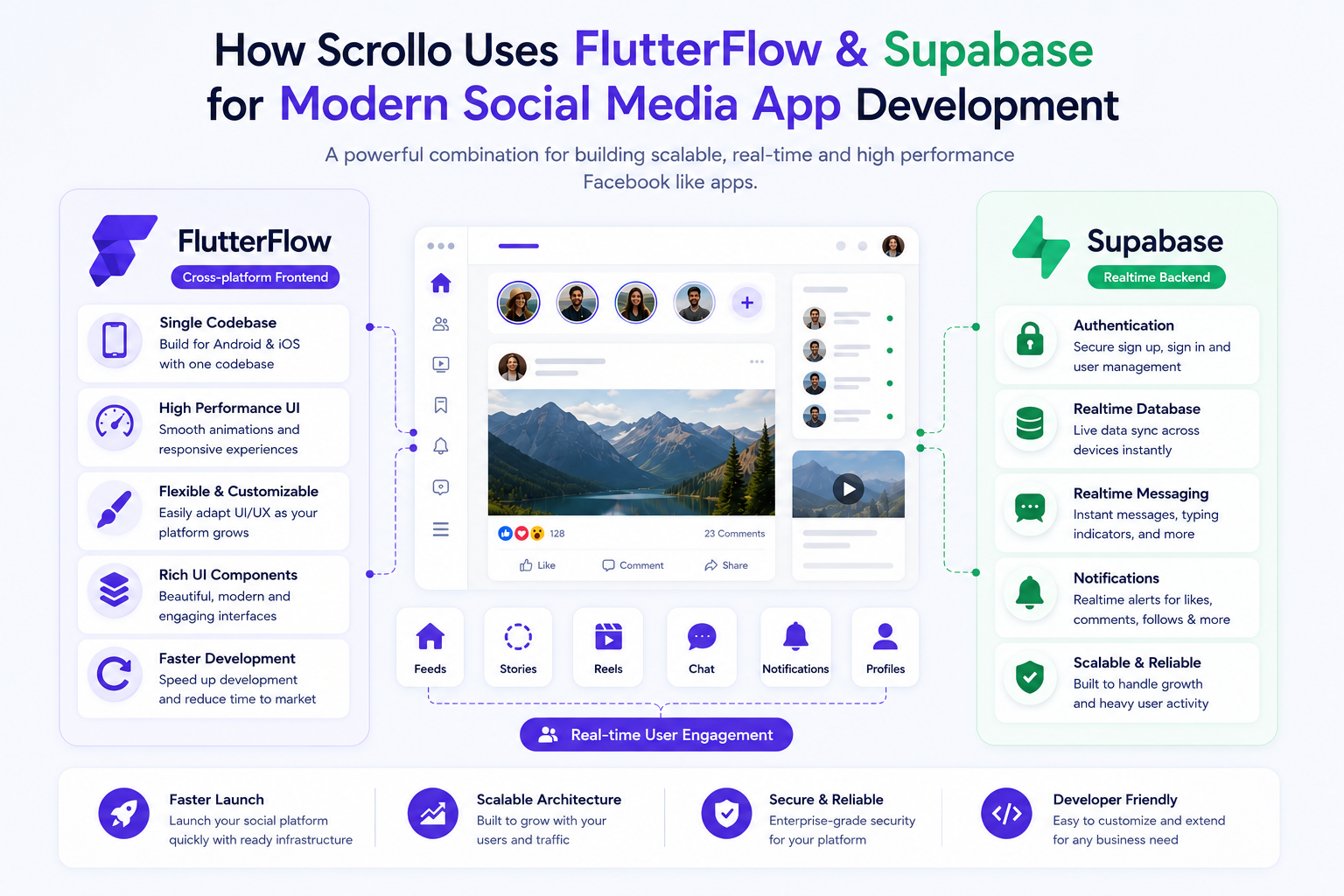
Scrollo is built as a scalable flutter social media app using flutter for the frontend and Supabase for the backend. This combination helps startups launch a high-performance Facebook like app without maintaining overly complicated infrastructure during the early stages.
Instead of stitching together disconnected systems manually, the Facebook app template already combines the frontend experience and backend functionality into one connected social platform structure.
4.1 Why Flutter Works Well for a Facebook Clone App
Flutter has become one of the most practical choices for building a modern Facebook clone app because it allows teams to maintain a single frontend codebase across Android and iOS.
For startups, this changes development speed significantly.
Instead of managing separate mobile applications, teams can launch one connected flutter social media app with a more consistent user experience across devices.
That becomes extremely important in social products because users constantly move between:
- feeds
- reels
- stories
- chats
- notifications
- profile screens
- explore pages
Every interaction needs to feel smooth and responsive.
Inside scrollo, flutter helps structure:
- realtime feed rendering
- media-heavy interfaces
- story viewers
- reels layouts
- profile systems
- messaging screens
- content uploads
in a way that feels modern and mobile-first.
Another advantage of flutter for a Facebook like app is UI flexibility.
Social platforms evolve constantly. Startups often redesign feeds, profile layouts, or engagement flows based on user behavior after launch. A scalable flutter social media app makes those frontend iterations easier without rebuilding the entire platform structure repeatedly.
This flexibility is one reason many startups now prefer a reusable social media app template instead of starting social media app development completely from scratch.
4.2 Supabase Backend for Realtime Social Features
The backend is where most of the hidden complexity exists inside a Facebook clone app.
Users may only see feeds and profiles on the frontend, but behind the scenes the platform is constantly managing:
- authentication
- user relationships
- post storage
- realtime messaging
- notifications
- engagement tracking
- content updates
- reporting systems
All of these systems need reliable backend communication.
Scrollo uses Supabase to structure the backend architecture of the Facebook app template, helping startups manage realtime interactions more efficiently.
For example, Supabase helps power:
- account authentication
- database management
- realtime updates
- social interactions
- message synchronization
- user activity handling
inside the Facebook clone app.
This becomes especially important for messaging and engagement systems.
When users send messages, upload stories, like posts, or interact with reels, the app needs to update information quickly across multiple devices. Delays make the platform feel inactive.
A realtime-ready backend is one of the most important parts of a successful Facebook like app because social engagement depends heavily on responsiveness.
That is also why many startups now avoid manually assembling backend infrastructure during early-stage social media app development. A connected Facebook clone script reduces a huge amount of setup work before launch.
4.3 Managing Feeds, Notifications, and User Activity
Feeds and notifications are what keep users returning to a social platform repeatedly.
Without continuous engagement loops, even a well-designed Facebook clone app struggles with retention.
Inside scrollo, the Facebook app template already includes connected systems for:
- personalized home feeds
- notifications
- follows
- likes
- comments
- messaging activity
- content discovery
This allows startups to launch a more complete flutter social media app experience from the beginning.
Notifications are particularly important because they create user return cycles naturally. When someone receives a message, comment, mention, or interaction alert, they reopen the platform and continue engaging.
The same applies to reels and stories.
Short-form content works because users constantly refresh feeds looking for new interactions. That behavior increases session time and overall platform activity inside a Facebook like app.
Managing all these systems manually inside custom social media app development usually requires significant backend planning and ongoing maintenance. That is why many startups now prefer a reusable social media app template that already connects these engagement systems together properly.
Another major advantage of using a production-ready Facebook clone script is scalability during early growth.
When new users join the platform, upload content, and begin interacting rapidly, the app infrastructure already has a structured foundation instead of relying on temporary MVP systems that need constant rebuilding later.
And honestly, that transition period is where many early-stage social platforms struggle the most.
The frontend grows quickly. User activity increases quickly. But backend systems often fail to scale smoothly because they were rushed during development.
Using a connected Facebook app template helps reduce those early architecture problems significantly.
Instead of spending months solving infrastructure bottlenecks, startups can focus more on improving user engagement, refining the experience, and growing their audience inside a scalable Facebook clone app.
5. Core User Features Included Inside the Scrollo Facebook Clone App
People don’t stay on social apps because the UI looks nice. They stay because there’s always something happening.
A friend uploads a reel. Someone replies to a comment. A new message appears. A story disappears in a few hours. That constant activity is what makes a modern Facebook clone app feel alive.
And honestly, this is where many early-stage platforms struggle. They launch with posting features but miss the interaction systems users already expect from a serious Facebook like app.
Scrollo is built to solve that problem with a connected set of social features already structured inside the platform.
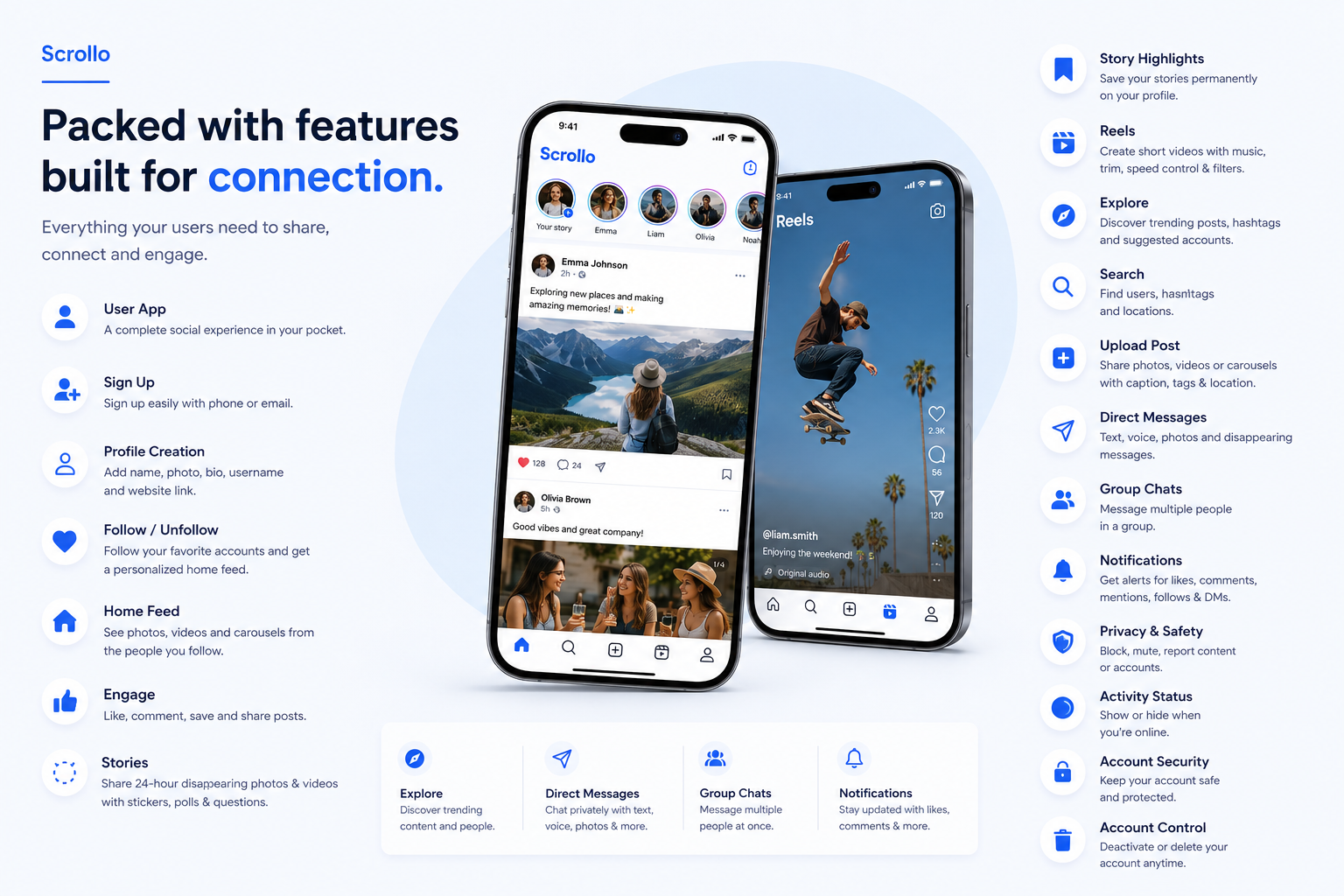
5.1 Profiles, Following, and Social Identity
Every social platform starts with user identity.
Inside scrollo, users can create profiles using phone or email signup, upload profile photos, add bios, usernames, and even attach website links. The Facebook app template also includes follow and unfollow functionality so users can build their own network naturally.
That following system matters more than people think.
It shapes the home feed, affects content discovery, and drives long-term community engagement inside the flutter social media app. Without strong profile systems, even a polished Facebook clone app starts feeling disconnected very quickly.
Users can also manage activity visibility, account settings, and profile controls directly inside the app.
5.2 Posts, Discovery, and Explore Features
Content is the engine behind every Facebook like app.
Scrollo allows users to upload:
- photos
- videos
- carousel posts
with captions, hashtags, tags, and location support already included inside the social media app template.
The platform also includes explore and search systems so users can discover trending content, hashtags, creators, and accounts without depending only on their home feed.
This sounds simple on paper. It really isn’t.
Discovery systems inside a Facebook clone app require feeds, hashtags, user relationships, and search behavior to work together properly. That is one reason startups often choose a ready-made Facebook clone script instead of trying to rebuild discovery infrastructure from scratch.
5.3 Stories and Reels
Short-form content changed social media completely.
Users now expect stories and reels inside almost every modern Facebook clone app. Without them, the platform immediately feels behind.
Scrollo includes:
- stories
- story highlights
- reels
- music support
- trimming tools
- filters
- speed controls
inside the flutter social media app structure.
Stories help increase repeat visits because users reopen the app before content disappears. Reels improve content consumption and keep engagement moving continuously.
For startups building a Facebook like app, these features are no longer “extra features.” They are part of the standard user expectation now.
5.4 Messaging and Notifications
A social app without communication features usually loses engagement fast.
People want conversations to happen inside the platform itself. That is why scrollo includes:
- direct messaging
- voice messages
- disappearing messages
- group chats
- realtime notifications
inside the Facebook app template.
Notifications are especially important because they bring users back into the platform naturally. Likes, comments, mentions, follows, and messages create continuous activity loops inside the Facebook clone app.
And building those systems manually during social media app development takes serious backend coordination, especially for realtime interactions.
That is where using a reusable social media app template saves a huge amount of development effort.
5.5 Privacy and Moderation Controls
Moderation becomes important very quickly once users start generating content.
Scrollo includes:
- block controls
- mute functionality
- reporting systems
- activity visibility settings
- account security options
inside the Facebook clone script structure.
These features help startups create safer communities while improving user trust across the platform.
Because realistically, users already expect moderation and privacy controls inside every serious Facebook like app today. Launching without them usually creates problems later.
And that’s exactly why connected infrastructure matters so much in a scalable Facebook clone app.
6. The Real Cost of Building a Facebook Clone App
Most founders think building a Facebook clone app is mainly about creating screens and uploading content features.
It is not.
The real complexity appears when all systems need to work together in realtime. Feeds, messaging, notifications, reels, stories, search, and user activity all depend on connected backend infrastructure inside a modern Facebook like app.
That is why social media app development usually takes much longer than expected.
A scalable flutter social media app requires:
- frontend development
- backend setup
- realtime communication
- media handling
- feed management
- user authentication
- moderation systems
And building all of this manually can easily stretch development timelines for months.
This is one reason many startups now launch using a customizable Facebook app template instead of rebuilding common infrastructure repeatedly.
Scrollo already includes:
- feeds
- profiles
- reels
- stories
- messaging
- notifications
- explore systems
- moderation features
inside a connected social media app template built with Flutter and Supabase.
That allows startups to focus more on branding, growth, and launch strategy instead of spending most of the timeline building infrastructure.
Many founders also prefer using a production-ready Facebook clone script because it reduces early-stage risk. Instead of waiting months to validate the product, teams can launch faster, gather feedback earlier, and improve the platform gradually.
And honestly, that speed matters a lot in social products.
Because users care far more about experience than whether the platform was built entirely from scratch.
7. Launching Your Own Social Platform With Scrollo
Launching a social platform used to require large teams, long development cycles, and heavy backend planning before users could even test the product properly.
That is changing quickly.
Many startups now begin with a ready-made Facebook app template so they can focus more on community growth instead of spending months rebuilding standard social infrastructure.
Scrollo is designed exactly for that type of launch process.
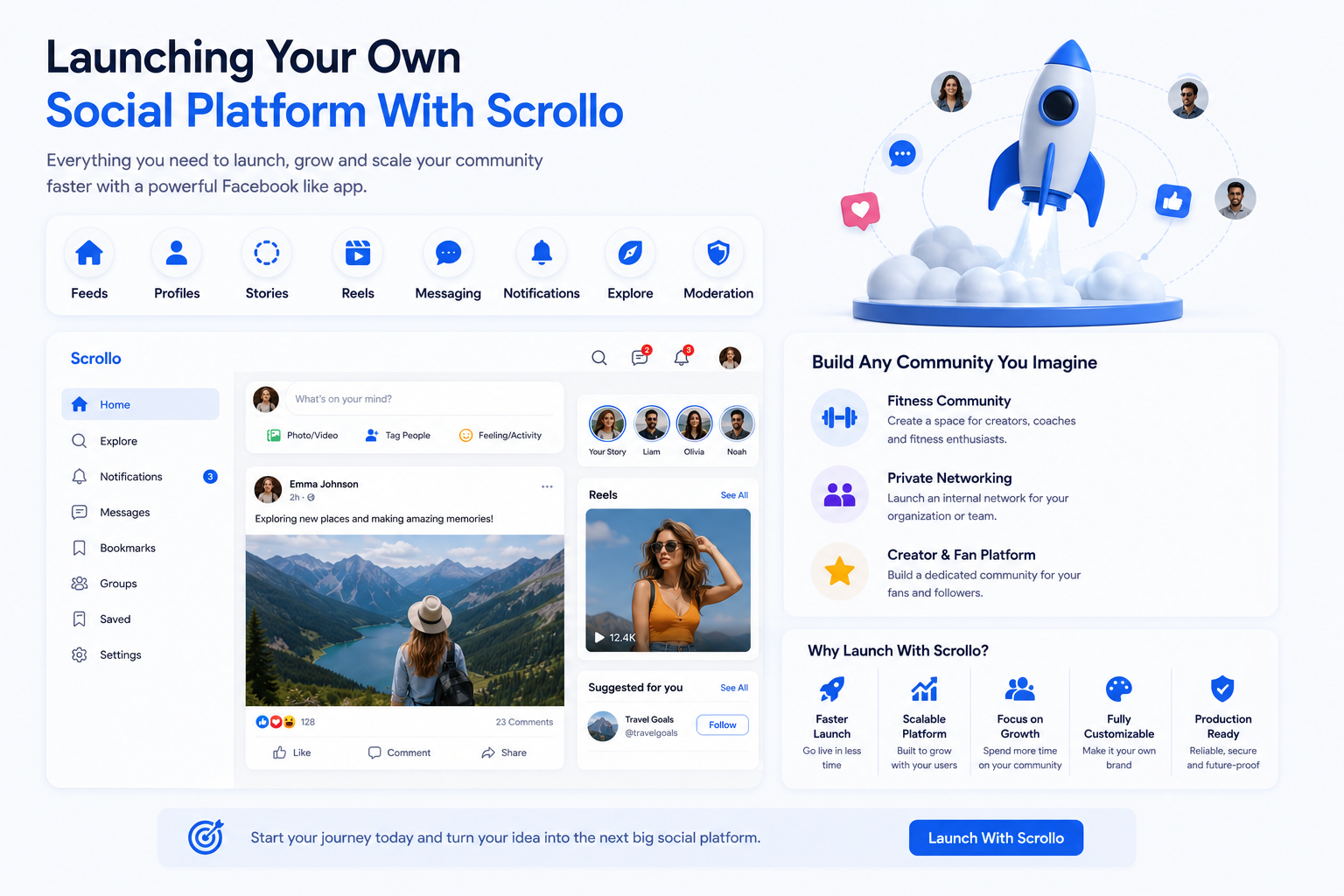
The platform gives startups a connected Facebook clone app with:
- feeds
- profiles
- stories
- reels
- messaging
- notifications
- explore functionality
- moderation systems
already structured inside a scalable flutter social media app.
This allows teams to move faster during early-stage social media app development while still customizing the product around their own audience or niche community.
A fitness startup could turn the platform into a creator community.
A private organization could launch its own internal networking system.
A creator brand could build a dedicated fan platform using the same social media app template foundation.
That flexibility is one reason reusable Facebook clone script solutions continue growing in demand.
Another major advantage is launch speed.
Instead of spending months building feed systems, realtime chat, user profiles, notifications, and engagement flows separately, startups can begin with a production-ready Facebook like app and focus more on:
- onboarding users
- growing communities
- improving engagement
- refining branding
- testing content strategies
And honestly, that early momentum matters a lot.
Most successful social platforms evolve after launch based on real user behavior. Starting with a scalable Facebook clone app helps founders validate ideas faster without delaying growth behind long development timelines.
That is exactly where scrollo becomes valuable as a customizable Facebook app template for modern social media app development.
8. Conclusion
Building a modern Facebook clone app is no longer just about creating profiles and posting content.
Users now expect realtime interaction, short-form content, messaging systems, discovery tools, notifications, and smooth engagement flows inside every serious Facebook like app. Building all of that from scratch can quickly become a large and expensive project.
That is why many startups now prefer launching with a scalable Facebook app template instead of rebuilding common infrastructure repeatedly.
Scrollo combines the core systems users already expect inside a production-ready flutter social media app built with flutter and Supabase. From feeds and reels to messaging, stories, moderation, and discovery systems, the platform helps startups move faster during social media app development while still allowing full customization.
For founders, creators, and agencies trying to launch a modern social platform, using a connected social media app template can significantly reduce development effort, launch delays, and early-stage complexity.
Launch Your Social Platform Faster With Scrollo
Skip months of rebuilding standard social features manually. Scrollo gives you a customizable Facebook clone script with modern social infrastructure already connected using Flutter and Supabase.
Check out the scrollo Facebook app template on the Arixlabs Marketplace → https://www.arixlabs.com/marketplace/scrollo---social-media-app
9. FAQ
1. Can I customize the Scrollo Facebook app template?
Yes. Scrollo is a fully customizable Facebook app template, allowing startups and agencies to modify branding, UI, features, and platform structure based on their own audience and business goals.
2. Does Scrollo support Android and iOS deployment?
Yes. Since Scrollo is built as a flutter social media app, the platform supports deployment across both Android and iOS from a single frontend codebase.
3. Is Scrollo suitable for startups, creators, and agencies?
Absolutely. The platform is designed for startups, creators, niche communities, agencies, and businesses looking to launch a scalable Facebook clone app faster without rebuilding common social infrastructure.
4. Does the Scrollo Facebook clone app include reels, stories, and messaging?
Yes. The Facebook clone script includes reels, stories, story highlights, direct messaging, group chats, notifications, feeds, profiles, and multiple engagement systems inside the connected social media app template.


View more blogs


.png)


%20%5Bweb-search%5D_a_change__2025__to__20.jpg)
.png)

.png)

Ready to develop your own product? Get in touch today!
Get in Touch
